.webp)



.webp)
.svg)


TL;DR
- The problem with traditional methods: Legacy systems struggle with modern data volume, rely on manual analysis, and surface lagging dashboards, leading to delayed responses and missed root causes.
- Core of an AI-powered strategy: AI processes unstructured feedback at scale, detects subtle cross-channel patterns humans miss, and isolates precise root causes.
- Driving actionable outcomes: AI-native VoC platforms like SentiSum prioritize issues by business impact, generate evidence-backed narratives for stakeholder trust, and format insights for direct use in tools like Jira or Slack.
- Implementing the right system: Choose feedback management platforms that enable real-time analysis, align insights to operational decisions, and measure success by actions taken and resolution speed, not dashboard metrics alone.
Your customer insights strategy is probably making churn worse.
The more feedback you collect, the longer it takes to act. The more dashboards you build, the less clarity you have. The more data you gather, the more decisions rely on intuition and lagging metrics.
You basically end up confirming losses after they've already happened.
This is the cost of traditional VoC approaches for subscription businesses. Teams at companies with thousands of monthly support conversations find insights break down at the moment they matter most.
For CX leaders, Product managers, and Support directors, it unfolds into a persistent trap: you're drowning in feedback but starving for actionable intelligence.
This guide will give you a fundamentally different approach. You will learn to reframe customer insights strategy from an analytics function that reports on what happened into a real-time operating system that prevents churn before it costs you revenue.
Why Traditional Customer Insights Strategies Break At Scale?
Traditional customer insights frameworks fracture under the weight of customer data because critical signals arrive in fragments and in real time. Not to mention, manual processes and disconnected tools create a massive delay between customer pain and business response.
The failure of traditional systems manifests in four critical ways:
1. Dangerous lag between signal and action
A frustrated comment in a support ticket on Monday, a subtly negative phone call tone on Wednesday, and a missed feature request in a survey on Friday are all isolated data points.
By the time these signals are manually compiled, tagged, and reported in a weekly or monthly meeting, the customer may have already churned. This latency made insights fundamentally reactive.
2. Siloed ownership
Customer feedback is not a unified asset; it is a series of departmental liabilities. Support owns the tickets, Marketing owns the surveys, Product owns the forum ideas, and Social Media owns the comments. Each team uses a different tool, measures by a different metric, and champions a different priority. Without a single source of truth, businesses lacked a coherent narrative of the customer experience.
3. Reliance on manual tagging and analysis
Human-led analysis of unstructured text (reading tickets, coding surveys, sampling calls) is slow, inconsistent, and largely unscalable. Analysts burn cycles on basic categorization (‘tag as ‘billing issue’) instead of deeper investigation (‘why is billing suddenly a problem?’). This process could not keep pace with the influx of data, resulting in a backlog of unprocessed insights.
4. Dependence on descriptive dashboards
Dashboards are excellent for reporting outcomes. They show you that your NPS dropped by 5 points or that ticket volume for ‘login issues’ spiked. But what they utterly fail to provide is causation. Why did NPS drop? What specific change triggered the login crisis? Dashboards could highlight the symptom, but did not lead to the root cause.
Together, all these traditional strategies created churn blind spots and delayed responses, which ultimately dented priorities.
Businesses and CX leaders that still rely on a traditional customer insights strategy are basically making billion-dollar decisions with million-dollar data ( a total lose-lose).
So, what is the alternative? Or, how to leverage AI for customer insights? Below, we explain how AI is transforming customer insights with scale, power and a complete approach shift.
Reframing Customer Insights as a Real-Time Operating System
The solution is a fundamental mental shift: stop thinking of customer insights strategy as an analytics function that produces reports, and start building it as a decision infrastructure.
A real-time insights operating system should have four defining characteristics:
- Insights must surface continuously, not just quarterly. The system monitors the live pulse of customer conversation, alerting you to shifts as they happen, not in a summary three months later.
- Signals need context, explanation, and confidence. It’s not enough to know a topic is trending; you need to know why, supported by verbatim evidence and statistical significance.
- Outputs must fit into daily workflows, not separate reporting tools. Intelligence should be injected directly into the platforms where teams already work, like Slack for alerts, Jira for bug creation, and Zendesk for ticket triage.
- Leading indicators should appear before scores like CSAT, NPS, and more drops or revenue churns. The system must detect the early dissatisfaction, a change in sentiment on support calls, a new phrase appearing in reviews: basically anything that predicts future failures or churn.
This is where the concept of an AI agent comes into discussion. In 2026, support leaders and product and analytics teams need not struggle with disjoint customer insights frameworks when an AI agent can operate as a persistent, intelligent layer across all feedback channels.
These AI agents act as the interface for customer understanding, translating millions of data points into clear directives for human teams.
Let’s explore in detail below.
How AI Changes the Mechanics of a Customer Insights Strategy?
AI, specifically advancements in Natural Language Processing (NLP), can analyze large volumes of customer interactions, detect patterns, and identify the root cause of churn.
Let’s see how this shift to an AI-native approach fundamentally changes how customer insight strategy works.
1. Interpreting Unstructured Feedback At Volume
AI processes the entirety of your customer conversations: every ticket, call transcript, survey response, and review in real time. It doesn’t just scan for keywords; it comprehends context, nuance, and sentiment at scale.
This eliminates the need for manual reading and inconsistent tagging, applying a consistent, granular taxonomy to 100% of your data.
Where a human team might sample 2% of calls, AI analyzes them all, uncovering issues hidden in the 98% previously ignored, providing a complete data foundation.
However, the true strategic advantage emerges in the next phase.
2. Detecting Patterns Humans Miss
Building on that complete data foundation, AI’s capability expands. The human brain is exceptional at spotting obvious spikes. AI excels at identifying subtle, complex patterns across disparate data sets.
It can detect that a 3% increase in complaints about ‘slow performance’ in tickets, combined with a new phrase (‘X feature unresponsive') appearing in app store reviews, and a dip in sentiment on calls handled by a specific agent group, all point to a single, recent app update.
These multidimensional correlations are often invisible to analysts working in siloed data sets.
3. Moving from Correlation to Root Cause
The pattern process (explained above) enables the pivotal leap. Traditional analytics might tell you, ‘Customer satisfaction is correlated with call wait time.’
But AI-driven analysis can explain, ‘A 20-second increase in average wait time last Tuesday, caused by a routing error in your AWS Connect integration, and is the root cause for a 15-point sentiment drop primarily impacting customers on the ‘Pro’ plan.’
AI-driven customer insight strategy connects the feedback theme directly to the ‘root’ of an operational problem, a product change, or a policy shift.
It’s clear: AI is completely shifting how customer insights are viewed, collected, and studied. But what is AI bringing to your business revenue in real terms? Let’s find out.
From ‘What Happened’ To ‘What To Do Next’
Data alone doesn’t change anything. The real challenge is moving from information to action.
Arguably, the greatest point of failure in any customer insights strategy is decision paralysis. A strong AI-powered system can bridge the gap by building actionability into its core. Below’s how:
1. Automate Decision-Making
Teams often stall when presented with too many problems. AI removes this delay.
AI can weigh factors like volume, sentiment acuity, customer lifetime value impact, and trend velocity to auto-prioritize a backlog. It further analyzes every issue based on real impact: how many customers are affected, how severe their frustration is, and how quickly the problem is growing.
The system then delivers a ranked list. You start with the item at the top, knowing it is the most urgent.
2. Create Evidence for Leadership
AI-generated explanations can help build trust with leadership.
When you present a recommended action, you can back it with a clear, evidence-based narrative: 'We need to fix the checkout error because it has caused a 300% spike in negative tweets and is mentioned in 22% of support tickets with ‘churn risk’ sentiment over the past 48 hours.'
3. Deliver Answers in the Right Format
An insight is only useful if it fits the team that needs it. AI adapts the same finding into different tools.
The product team receives a formatted ticket with customer quotes. The support team gets a draft response for the help desk. Marketing sees an alert with relevant chat excerpts. Each department receives the information ready to use.
4. Act Before Problems Grow
Monthly reports show you what has already gone wrong. AI works in the present. It monitors customer signals continuously and sends an immediate alert when a new issue emerges. This allows for a response within hours, not weeks.
So, instead of learning in a monthly meeting that a pricing page confusion caused lost deals, an AI agent can alert the right teams the day the first confused queries appear. This allows for immediate clarification before significant revenue is lost and ensures customer data leads directly to change.
Below, we explore in detail why the right customer insight is crucial for businesses, yet is often overlooked.
Customer Insights as a Leading Indicator for Churn and Revenue Risk
For CX leaders and teams, it is important to understand that their businesses do not need 10-100 data centers to reduce churn. What they truly need is predictive intelligence.
Here are some reasons we say this with confidence:
- Reason 1: Early dissatisfaction signals appear weeks before a customer formally churns. They manifest in subtle ways: a change in the tone of support interactions (increased frustration, specific phrases like 'looking for alternatives'), a negative review posted after a previously resolved ticket, or a decline in proactive communications. Advanced AI native VoC platforms like SentiSum monitor these signals and can flag at-risk accounts before the cancellation request hits.
- Reason 2: Support conversations are often the first and most honest indicator of revenue risk. An enterprise client’s IT manager expressing repeated, unresolved integration difficulties during support calls is a direct precursor to non-renewal. AI can detect this pattern across multiple conversations and elevate it to the right team.
- Reason 3: Real-time customer insights enable predictive resource allocation. If the system detects a growing cluster of complaints about a specific feature used by your highest-value customer segment, leadership can proactively allocate engineering resources to fix it, prioritizing based on revenue impact rather than just ticket volume.
These signals, however, remain silent unless interpreted. SentiSum bridges that gap, helping businesses shift from reactive support to a real, proactive AI-driven customer insight strategy. Read on to find out how.
How SentiSum Enables an AI-Driven Customer Insights Strategy
Stop guessing what’s broken in your customer experience. SentiSum immediately identifies critical failures, pinpoints the cause, and directs the fix to the correct team, all within their existing tools.
This is powered by Kyo, SentiSum's intelligent AI agent. Read how:
Kyo As The Primary Interface For Real-Time Customer Insight
Kyo, SentiSum's AI Engine, interprets every customer conversation as it happens. It identifies the exact causes of churn and directs teams to act immediately.
- Flags risks early by detecting subtle changes in feedback across all your support and survey channels
- Explains the root cause of customer frustration, not just the topic, using your unique business data
- Surfaces the next step, turning insight into a clear action for support, product, or leadership teams
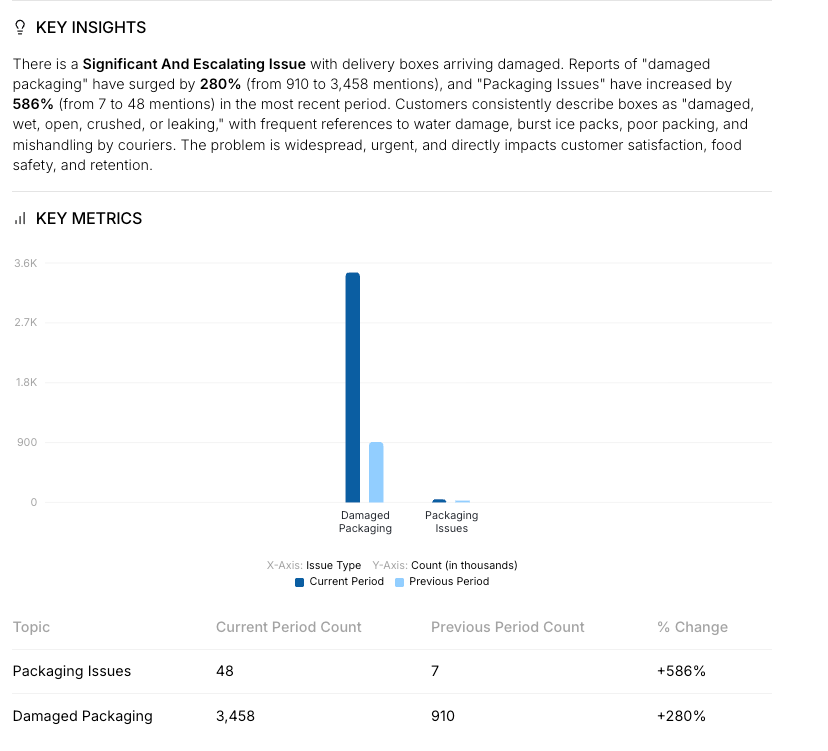
For example, Kyo might alert: 'Sentiment on ‘delivery delay’ tickets has dropped 40% in the UK region. This is linked to a new logistics partner launched last week; customers are citing ‘no tracking updates’ as the key frustration.'
Result? It frees teams from manual analysis and provides a consistent, evidence-based narrative.
Unified Signals Across the Customer Journey
SentiSum breaks down data silos by harmonizing data from tickets (Zendesk, Intercom), CRM notes (Salesforce), surveys (Typeform, SurveyMonkey), calls (via speech-to-text), and reviews (Trustpilot, G2). This creates a single, queryable stream of customer truth.
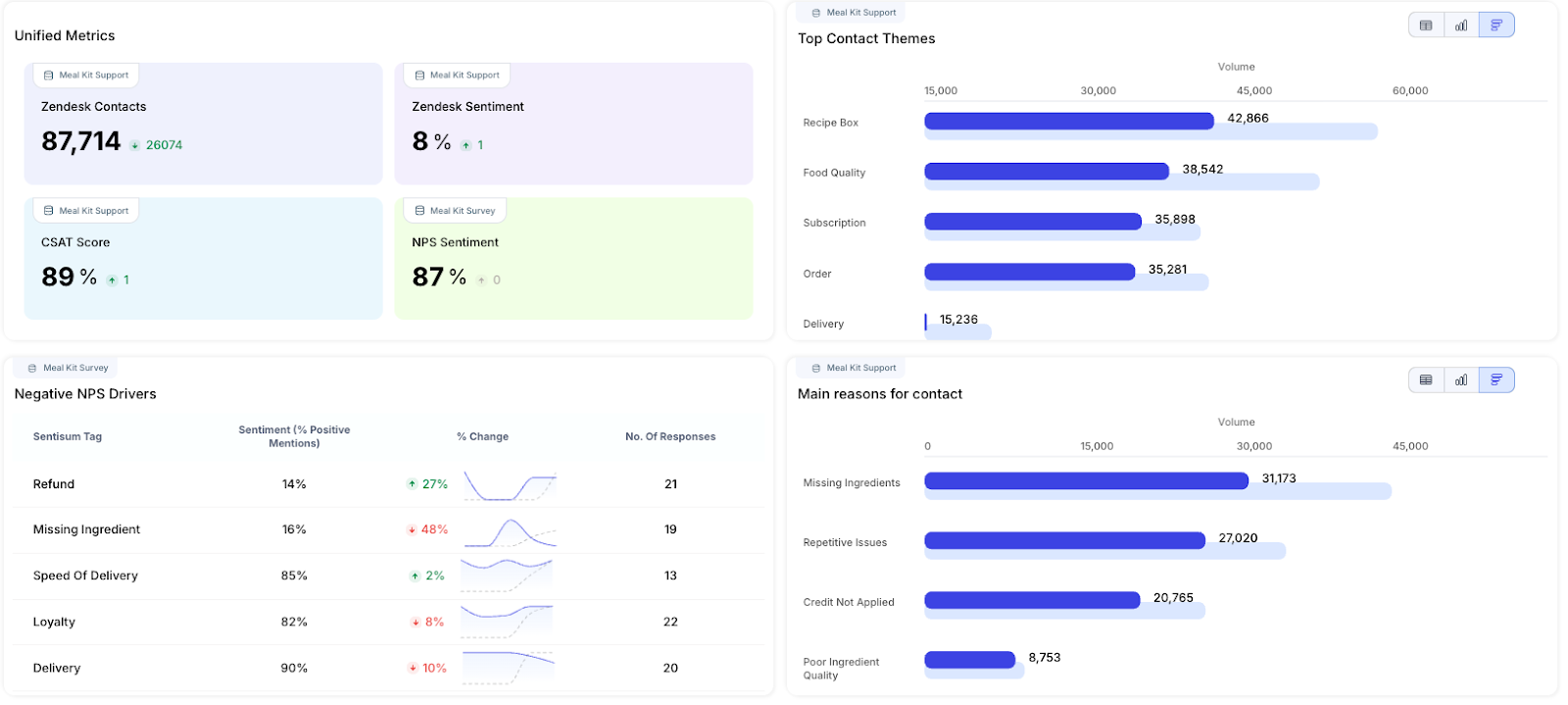
A product or support manager can understand the complete journey of a complaint: from a negative review to a support ticket, to a follow-up survey response, seeing the full story rather than a fragmented feedback call or comment.
Embedded Insights for CX and Retention Teams
SentiSum ensures real-time customer insights are delivered where work happens. Kyo’s findings can be configured to post summary alerts in a dedicated Slack channel. High-priority bugs can be auto-routed to Jira with relevant customer transcripts attached. Support supervisors can get daily digests on agent-specific sentiment trends.
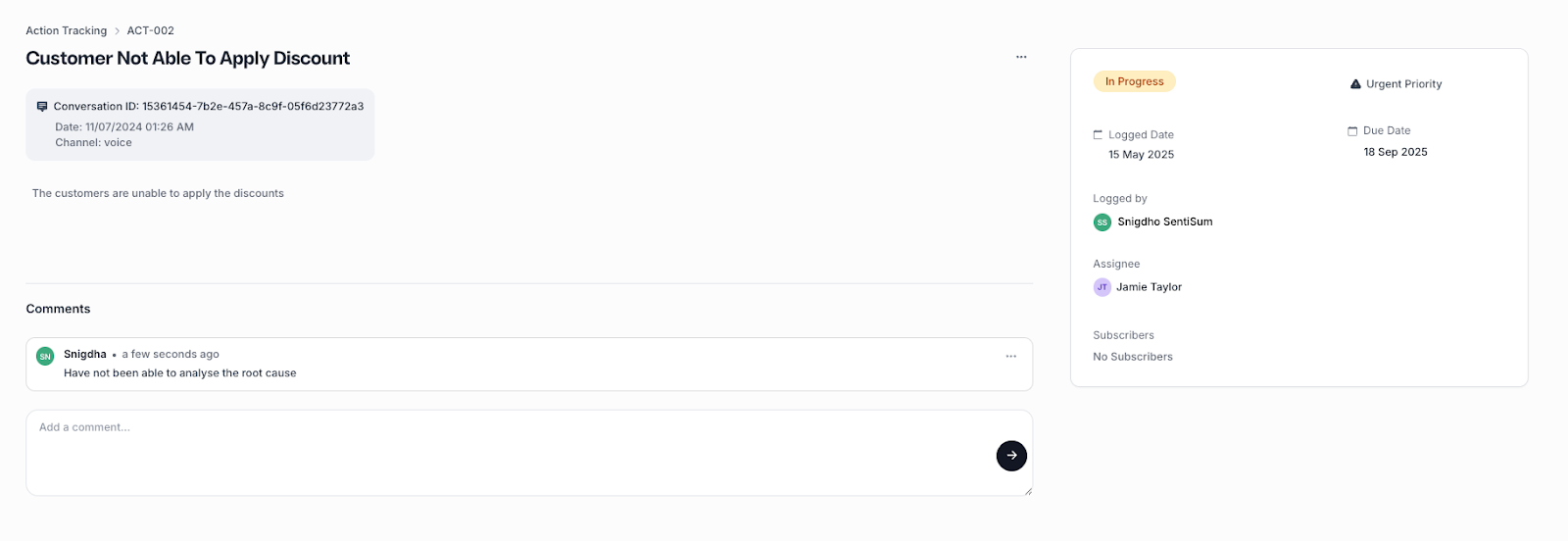
This enables faster intervention, clearer ownership, and moves insights from a separate 'report' to a part of the workflow.
➡️ Read More
From Siloed Feedback to Instant Action: How JustPark Fixed Problems Before They Cost Thousands
📽️You can also watch the full video here:
SentiSum x JustPark | JustPark Turns Driver Feedback Into Instant CX Wins (Case Study)
Best Practices for Building a Scalable, AI-Led Customer Insights Strategy
Transitioning to a customer intelligence strategy requires intentional redesign: continuous analysis, moving beyond everyday metrics, and measuring beyond KPIs and dashboards.
For leaders evaluating platforms and approaches, customer insights best practices are mentioned below:
- Design for continuous analysis, not reporting cycles: Choose platforms that analyze feedback in real-time or daily batches, not monthly exports. The goal is a live monitor, not a historical archive.
- Prioritize explanation and evidence over raw metrics: Demand platforms that provide 'why' behind the 'what.' Any spike in a chart should be clickable to reveal the underlying driver and supporting customer verbatim.
- Align insight outputs to specific operational decisions: Map your insights to actions. Will this alert trigger a process change, a bug fix, or a training update? Configure the system to deliver insights in the format that directly fuels those decisions (e.g., Jira tickets, Slack alerts, coaching notes).
- Measure success by action taken, not dashboards shipped: Change your KPIs. Track metrics like 'high-priority insights acted upon within 48 hours,' 'reduction in time from problem detection to resolution,' or 'decrease in repeat complaints on top issues.' Remember, value is created by closing the loop.
Turning Customer Feedback Into a Competitive Advantage With SentiSum
To succeed in the coming years, businesses must go beyond simply gathering customer feedback. The winning customer insight analytics strategy for the next decade is implementing systems that automatically interpret, rank, and convert this data into decisive action.
The right customer insights strategy will identify revenue-threatening issues while they are still small and fixable. It will discover unmet customer needs before their competitors do. Further, it will align the entire organization: Product, Marketing, Support, Success around a single, accurate, and real-time narrative of the customer experience.
SentiSum can be the best partner on this journey, moving all your customer insights from a passive library of reports into an active, intelligent layer that guides long-term strategy.
Want to build a solid Voice of the Customer strategy? Book a personalized demo now!
Frequently Asked Questions
SentiSum’s intelligent AI agent Kyo automates the analysis of vast volumes of unstructured feedback (tickets, calls, reviews), detects hidden patterns and trends across data sources, and identifies root causes of issues. It moves beyond simple tagging to provide explanatory insights and prioritized recommendations for teams in CX, Product, and Support.
AI is critical because human-scale analysis cannot handle the volume, velocity, and variety of modern customer feedback. AI customer analytics is further essential for processing 100% of data in real-time, uncovering complex root causes, and delivering proactive alerts.
Actionable insights provide clear context, root-cause explanation, and prioritized next steps tied to specific business outcomes. Analytics reports primarily describe what happened (e.g., 'Ticket volume increased'), while actionable insights explain why it happened and what to do about it (e.g., 'Volume spiked due to a checkout error; here is the bug report to fix it').
Teams can turn insights into action by integrating them directly into operational workflows (like Slack, Jira, Zendesk, etc.), establishing clear ownership for addressed issues, and measuring success based on the speed and impact of actions taken, rather than the volume of insights generated.
Explore Real Success Stories

Explore Success Stories


Talk to a Data Expert