.webp)



.webp)
.svg)


TL;DR
- Most customer problems don’t start as obvious incidents; they emerge through subtle shifts in volume, sentiment, and language that are easy to overlook.
- Dashboards collect valuable data but depend on someone actively checking them often too late for early intervention.
- Anomaly detection works by identifying meaningful deviations from normal behavior, not just spikes in ticket volume.
- Delivering early warning signals directly in Slack ensures teams notice changes in real time, where decisions already happen.
- Combining alerts with instant explanation through Kyo enables teams to move from signal to understanding to action without switching tools.
Most customer problems don’t arrive with loud signals. They don’t show up as a single catastrophic event, neatly labelled and impossible to miss. They start quietly. A few more tickets than usual on a topic. A subtle dip in sentiment. A recurring phrase that wasn’t there last month.
Individually, none of these things feel urgent. Collectively, they’re often the first steps toward churn, escalation, or a leadership question that starts with: “How did we miss this?”
The truth is that most teams don’t miss problems because they lack data. They miss them because signals arrive too quietly, too late, or in the wrong place.
This is a post about that gap and about why we’ve built SentiSum’s Anomaly Alerts and Kyo to live directly inside an everyday tool like Slack.
The dashboard paradox
Over the past decade, companies have become exceptionally good at collecting customer feedback.
Support tickets. NPS. CSAT. Reviews. Call transcripts. Social. Internal notes.
All of it ends up somewhere sensible: a dashboard.
And dashboards are useful. They’re precise. They’re comprehensive. They’re great when you know what you’re looking for.
But dashboards also have a flaw that’s rarely discussed: they rely on intention.
Someone has to:
- Decide to open them
- Know which view to check
- Notice that something looks “off”
- Do it early enough to matter
In practice, this means dashboards get checked:
- Weekly
- Before a meeting
- After a problem is already suspected
Which is exactly the wrong moment if your goal is early warning.
By the time a human thinks, “I should check if something’s changing,” something has usually already changed.
How problems actually unfold
When you look back at major customer issues such as churn spikes, product incidents, and trust erosion, a pattern emerges.
Rarely is there a single moment where everything breaks. Instead, there’s a sequence:
- A topic starts appearing slightly more often
- Sentiment around it shifts, subtly
- Language changes (“confusing” → “broken” → “unusable”)
- The issue spreads across segments or regions
- Only then does it become “obvious”
Each step is detectable. But none of them, on their own, feel worth interrupting someone’s day.
This is the gap we care about.
From monitoring to observing
There’s a difference between monitoring and observing.
Monitoring is passive. It assumes someone will look.
Observing is active. It assumes the system should speak up.
SentiSum has always been good at understanding customer feedback: classifying it, structuring it, connecting themes across sources.
What we wanted to solve next was simpler, and harder:
How do we make sure the right people notice unusual change at the moment it starts to matter?
That question led to Anomaly Alerts or as we like to call it, Early Warning Agent.
What an anomaly actually is (and isn’t)
An anomaly is not “a lot of tickets”.
Volume alone is noisy. Support ebbs and flows. Launches happen.
An anomaly is a meaningful deviation from normal behaviour, such as:
- A sudden spike in a specific topic relative to its baseline
- A sharp sentiment shift within an otherwise stable theme
- An emerging issue that grows faster than expected
- A pattern that breaks historical norms
In other words, something changed, and it didn’t change like this before.
SentiSum continuously models what “normal” looks like for your data - by topic, sentiment, source, and time. When reality diverges in a statistically meaningful way, that’s when an early warning is triggered.
No thresholds guessed by humans or static rules that age badly. Just change that’s worth paying attention to.
Why Slack, specifically
Once you accept that systems should surface change proactively, the next question becomes: where should that happen?
Email is too slow, dashboards are too quiet, and tickets create noise, not clarity.
Slack, for most of our customers, is where:
- Decisions are made
- Context is shared
- Issues are discussed in real time
Putting alerts anywhere else creates friction. Putting them in Slack makes them part of the flow of work.
That’s why early warning alerts appear directly in Slack channels or private messages where your team already coordinates.
Not as a report. Not as a file. As a signal.
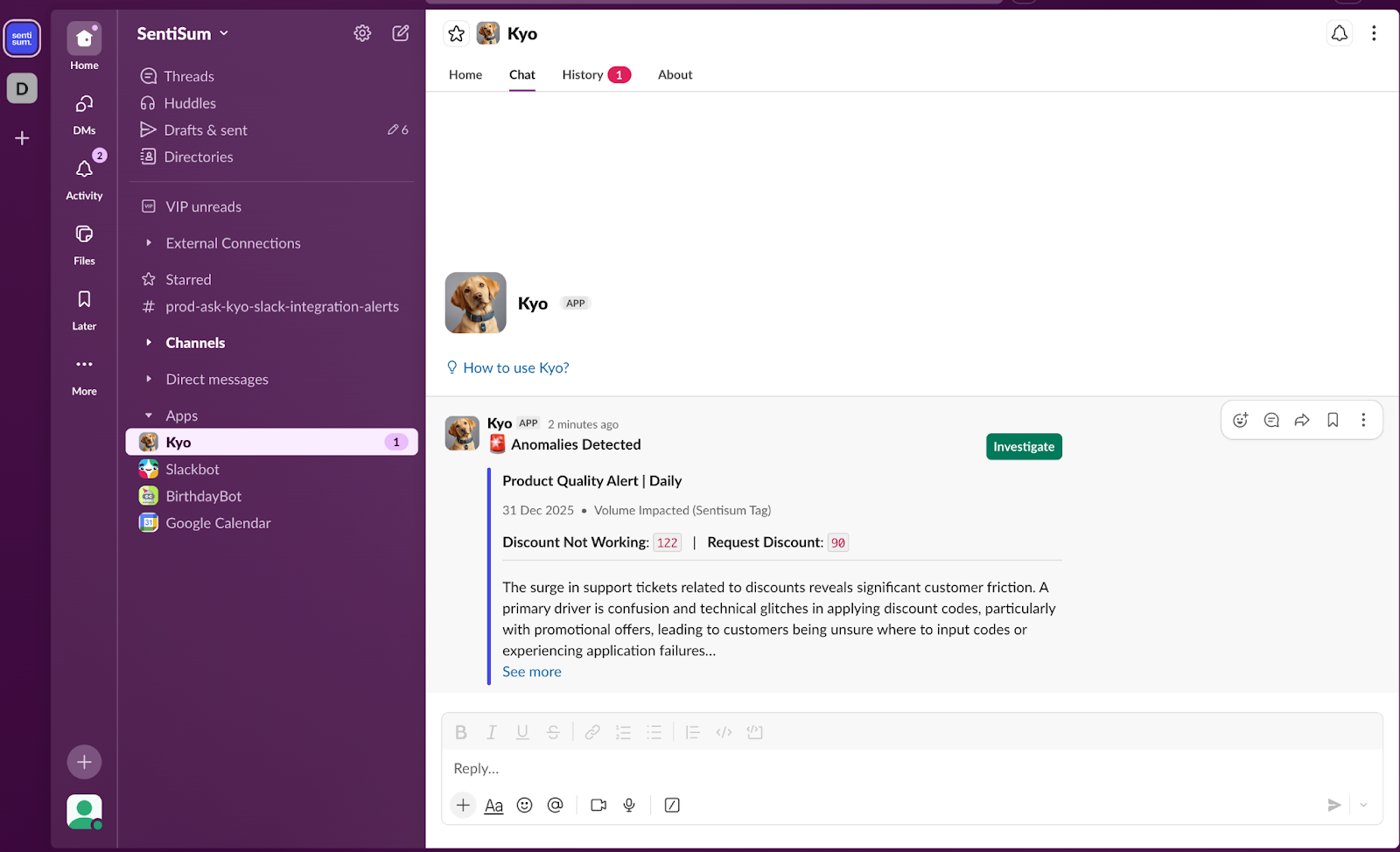
Alerts are only useful if you can ask “why”
Of course, an alert alone isn’t enough.
Being told “Something changed” without being able to understand it quickly just shifts the burden back to the human.
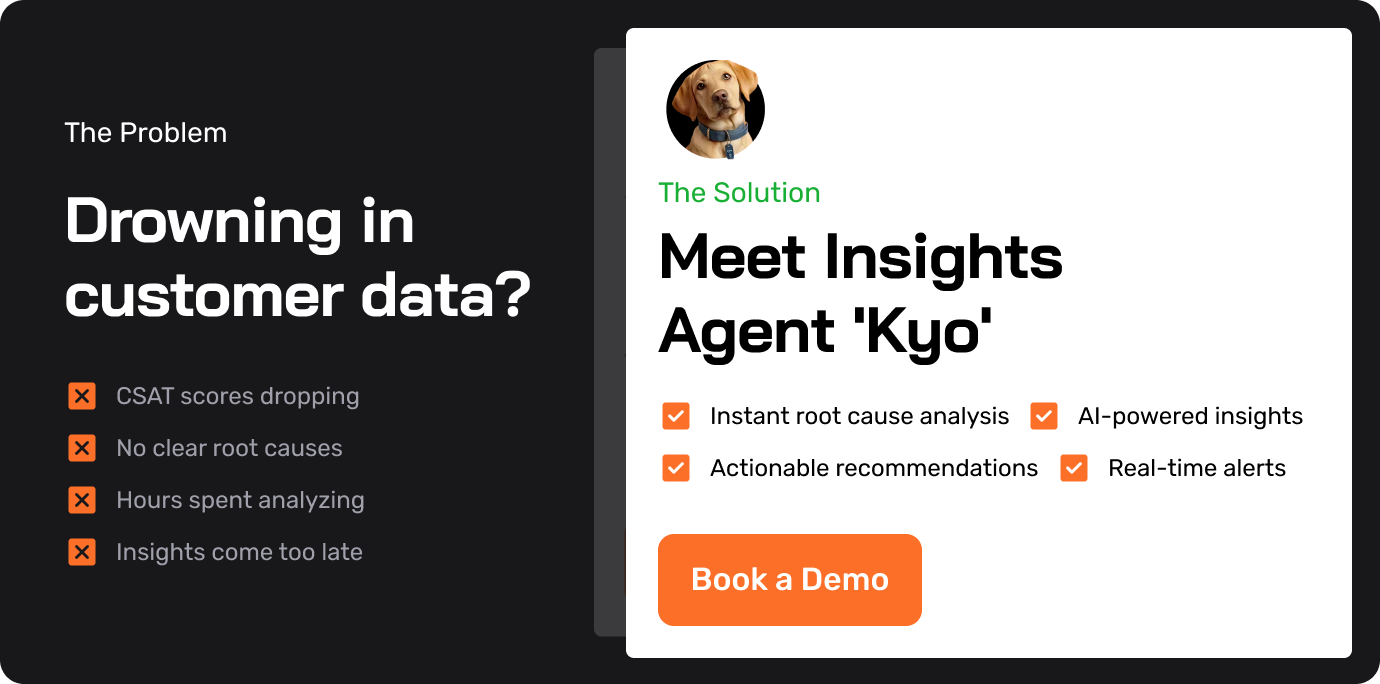
This is where Kyo in Slack matters.
When an anomaly appears, teams don’t have to switch tools to investigate. They can immediately ask:
- What’s driving this change?
- Which themes are contributing most?
- Is this isolated or spreading?
- When did it start?
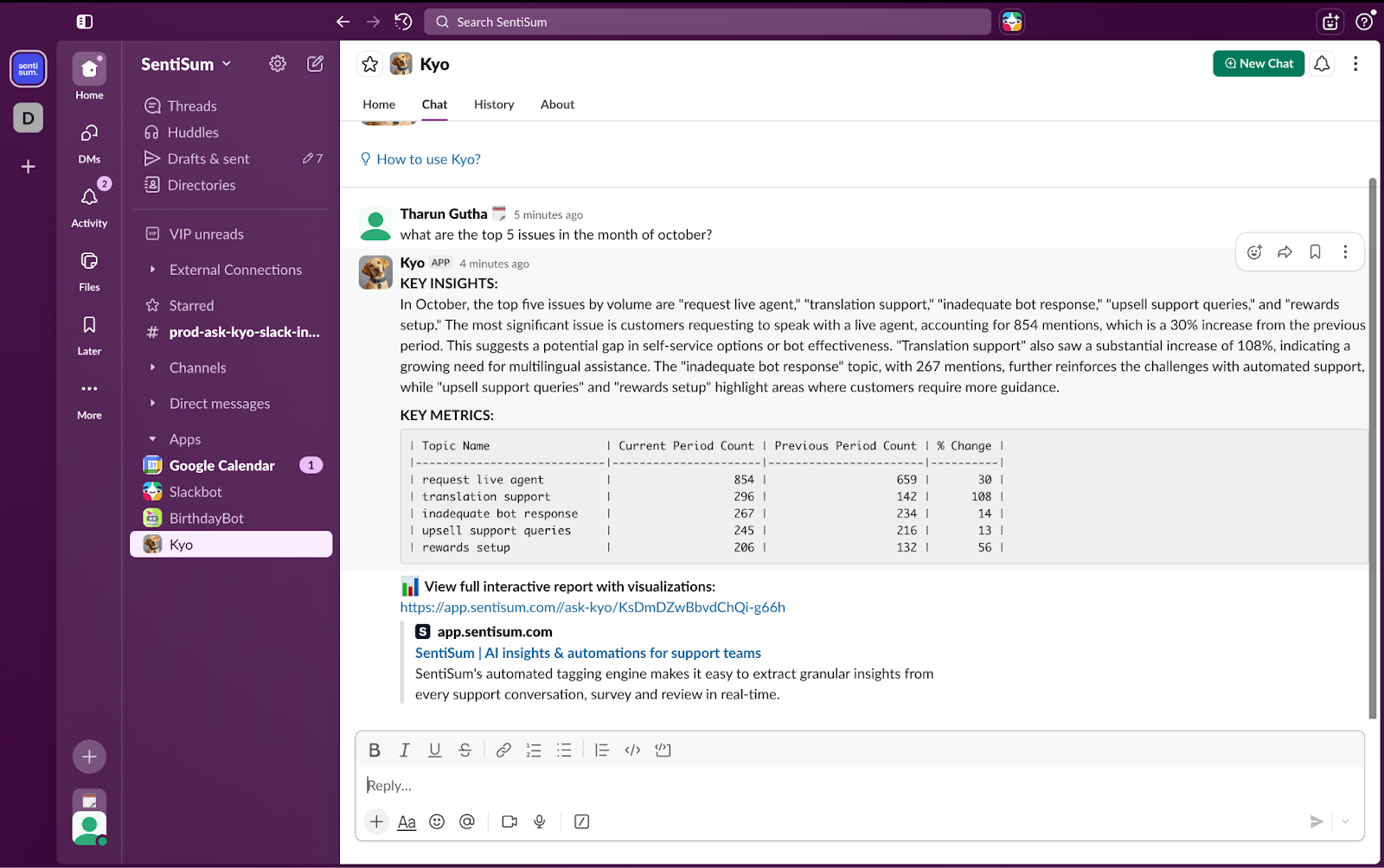
Kyo answers using verified, underlying customer data such as summaries grounded in real tickets, surveys, and comments, not speculative explanations.
The result is a tight loop:
signal → explanation → action, without context switching.
This changes the timing of decisions
The most important impact of this isn’t speed. It’s timing.
Teams move from:
- Reviewing issues after they escalate
- To discussing them while they’re still forming
From:
- “Why didn’t we catch this earlier?”
- To “We saw this starting last week.”
That difference compounds.
Small interventions early prevent large interventions later.
Quiet signals, noticed early, are easier to fix than loud ones.
A broader shift: insights should find teams
Anomaly Alerts and Kyo in Slack are part of a larger belief we hold:
Insights shouldn’t wait patiently in dashboards. They should go looking for the people who need them.
As work becomes more distributed and more real-time, the tools that win aren’t the ones with the most charts. They’re the ones that surface the right information at the right moment, in the right place.
Slack is one of those places. Kyo belongs there.
Getting started
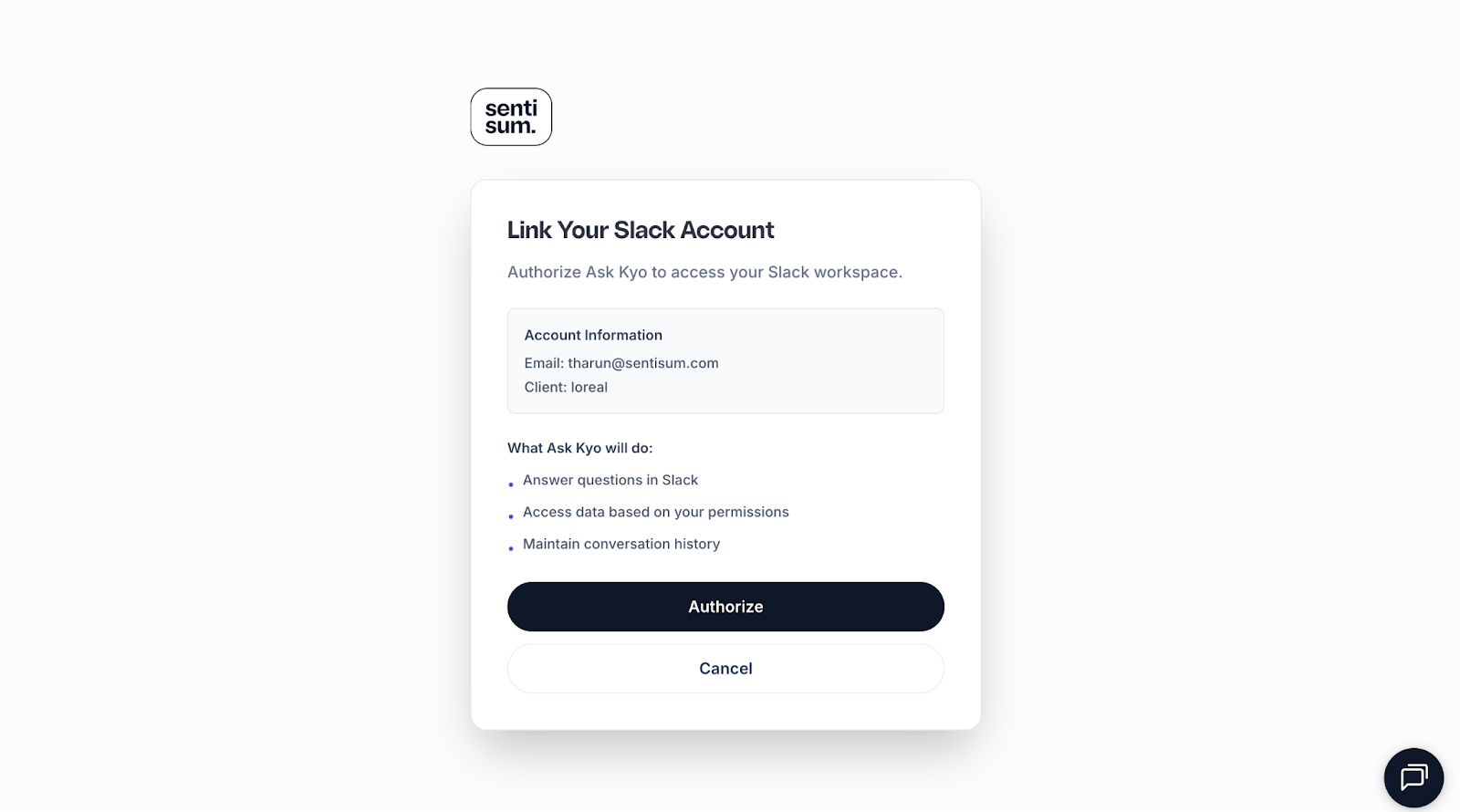
Connecting Slack to SentiSum is a one-time setup. Alerts can be routed to specific channels or individuals, and tuned to what each team cares about.
Once it’s live, nothing changes about how your data is collected or analysed. What changes is who notices what and when.
And that, more than any dashboard, is what prevents surprises.
Frequently Asked Questions
Explore Real Success Stories

Explore Success Stories


Talk to a Data Expert