Customer Experience

AI Customer Experience Insights: How to Use Real-Time Data for CX Optimization

AI Customer Experience Insights: How to Use Real-Time Data for CX Optimization
Marketing Director at SentiSum
LinkedIn icon
AI Customer Experience Insights: How to Use Real-Time Data for CX Optimization

You’re probably drowning in CX data. Support tickets pile up, survey responses go unread, and valuable customer feedback rarely reaches you in time. By the time insights get shared, it’s often too late.

Traditional CX reporting is too slow. You get monthly reports showing how customers felt weeks ago, charts oversimplify feedback, and trends only become visible after they start affecting retention and revenue. That delay is where you lose customers.

With real-time, AI-powered CX analytics, you can spot problems as they happen, understand the root cause immediately, and fix issues before small frustrations turn into big losses. Real-time insights make it possible to act proactively, keeping your customers satisfied and reducing churn.

Why Traditional Customer Experience Insights Don't Drive Action

Most customer feedback analysis happens after churn detection. This means you're looking at history instead of actionable intelligence. A report showing satisfaction dropped in Q2 doesn't help you prevent the same issues in Q3. It just confirms what already happened.

1. Static Reports Tell You What Happened, Not What to Do

Traditional CX reporting creates a disconnect between insight and action. By the time a monthly report reaches your desk, those customer experiences are weeks or months old. 

The frustrated customers either got help through emergency escalations or had already left. The product issues either escalated in another way or grew into bigger problems.
Predictive CX insights with AI identify emerging customer dissatisfaction patterns

A retrospective approach treats customer experience insights as records rather than guides for action. You understand what happened, but you can’t influence or improve those outcomes in real time. Insights become a reference instead of a tool for driving decisions.

2. Manual Analysis Can't Keep Up With Volume

Manual analysis breaks down when you have scale. When your support team receives hundreds or thousands of tickets daily, along with chat logs and survey responses, they face an impossible choice: read everything and analyze nothing, or sample a few and risk missing critical signals. Neither works.

You end up guessing what "most customers" are saying and hoping the patterns you spot are real. Reading qualitative feedback takes mental energy. One analyst might meaningfully process fifty complex tickets in a day. But when they face five hundred or five thousand? Deep analysis becomes impossible.

3. Early Warning Signs Disappear Across Channels

A customer might complain in a support ticket, leave a detailed negative review, and mention the same issue in a survey, but if each channel gets analyzed separately, you miss the pattern. 

What appear to be scattered complaints are actually a concentrated problem that three different teams are failing to recognize.

Channel silos prevent you from connecting the dots. Support sees one complaint. The review team sees another. The survey analyst sees a third. 

Each data point seems manageable, but together they show a real problem that nobody catches because no single team can see the full picture.

4. Poor Insights Lead To Churn And Reactive Cx

The insight gap quickly shows up in your metrics. Escalation rates climb because small issues aren’t caught early. Churn accelerates because early signals of dissatisfaction go unnoticed.

Product roadmaps don't align with customer needs because Voice of Customer insights are received too late. You end up reactive, not because your team doesn't care, but because your insight system was never built for speed.

When insights arrive late, you can only respond to problems that already exist, rather than preventing them from arising. 

This reactive approach incurs additional costs, as escalations require senior support, more churn necessitates aggressive retention efforts, and more misaligned features necessitate rework. The entire customer experience becomes more expensive while delivering worse results.

Why CX Teams Struggle to Turn Feedback Into Insight at Scale

Volume overwhelms the process. A mid-market SaaS company might handle 10,000 support interactions monthly, plus hundreds of reviews and surveys. An enterprise retail brand might see ten times that. Human analysis simply can't keep pace, not because teams lack skill, but because there isn't enough time.

1. Understanding Sentiment Across Multiple Sources

Qualitative customer feedback analysis needs interpretation. The same complaint might be phrased a dozen ways. A product issue could be referred to as a bug, a missing feature, or poor usability, depending on who's writing. 

Traditional tagging forces support agents to categorize complex feedback into rigid categories, which either oversimplifies the information or creates so many categories that the data becomes useless.

Each feedback source also carries a different context. A support ticket comes from someone actively seeking help, often frustrated. A review might be written weeks after purchase when emotions have cooled. A survey captures sentiment at one specific moment. Understanding what customers actually experience means bringing these different contexts together, something manual processes struggle to do consistently.

2. Inconsistent Tagging Hides Real Trends

If ten agents interpret "the checkout process is confusing" differently, some tag it "User Interface issue," others "payment problem," others "user error. Your dashboard will never show that checkout friction drives abandonment. 

The insight exists in the raw feedback. Your categorization system makes it invisible.
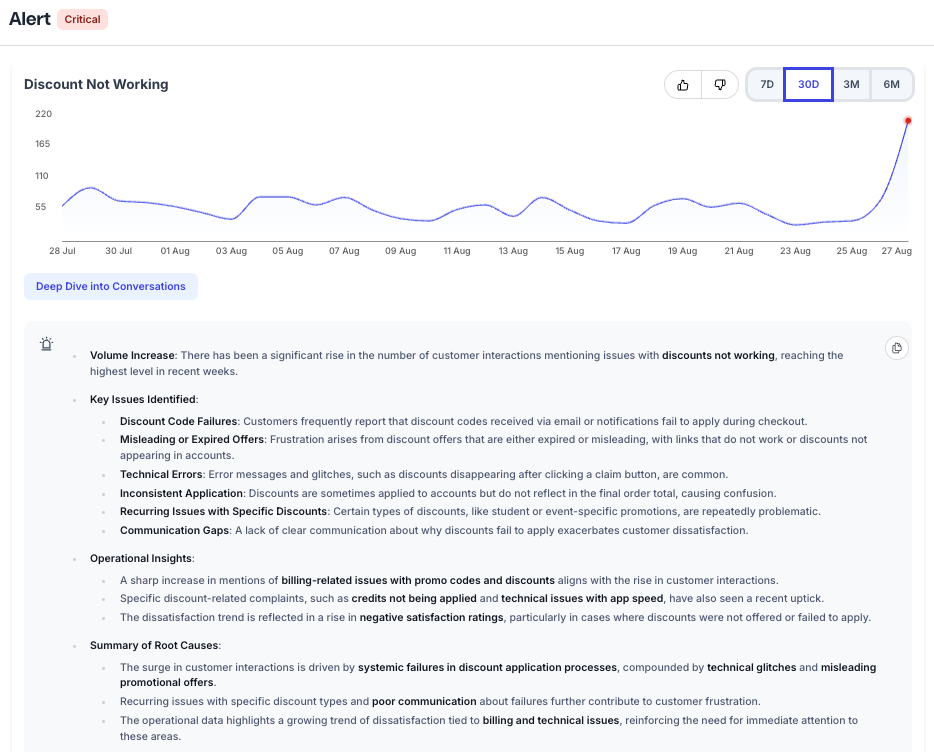
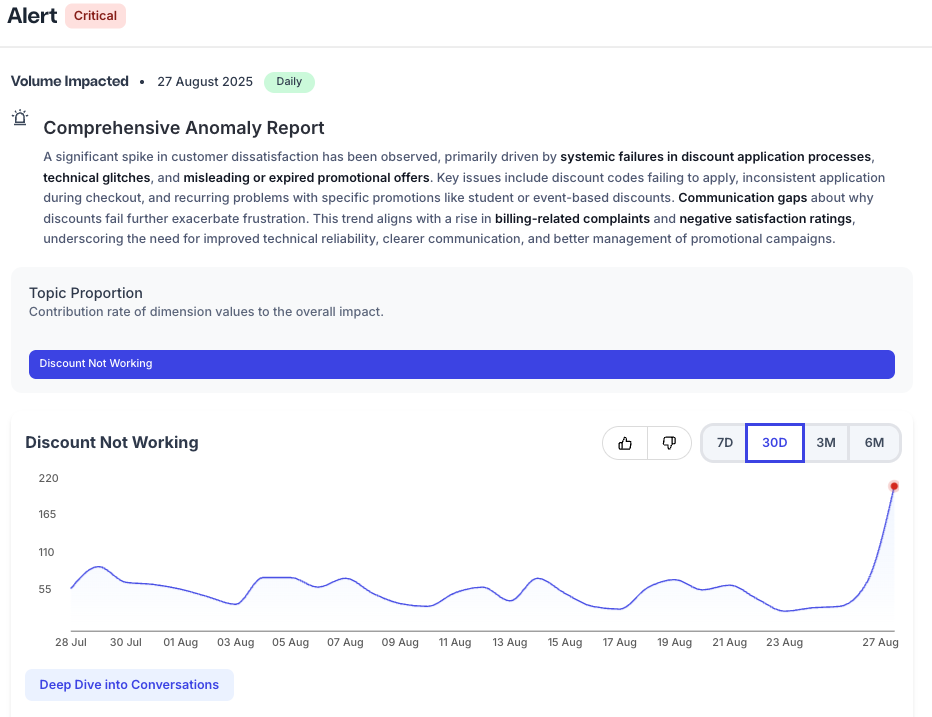
Real-time CX insights detect discount application issues immediately

Too many tags make this worse. Teams create new categories for specific issues, but without governance, those categories multiply until the system becomes unmanageable. 

Support agents face dozens of possible tags, make quick choices under pressure, and the data becomes too fragmented to show meaningful patterns.

3. Different Teams See Different Stories in the Same Data

Different teams often work from their own interpretations of the same customer data. Customer success looks for retention signals. Product filters for feature requests. Marketing analyzes sentiment for brand perception. 

Everyone thinks they understand what customers want, but they're looking at pieces of the same conversation through different filters.

This creates misalignment where everyone operates on "customer insights" that contradict each other. The product prioritizes features that marketing thinks will harm the brand. Customer success identifies churn drivers that the product hasn't yet addressed. 

Leadership receives conflicting recommendations because each department presents different conclusions based on the same feedback. 

How AI Changes the Nature of Customer Experience Insights

An AI-driven customer experience strategy doesn't just accelerate traditional analysis; it fundamentally changes what customer experience insights mean and how they inform your operations.

1. AI Processes All Feedback Continuously

Every support ticket, review, survey response, and social mention gets analyzed in real-time. When thousands of customers mention a specific product issue, AI-powered customer experience analytics spot the pattern immediately, not weeks later.

This continuous processing removes bias from manual sampling. Teams naturally focus on extreme feedback, the most positive or negative, or feedback that confirms what they already think. 

AI treats every data point equally, so subtle patterns that wouldn't catch a human's attention still get identified if they represent real trends.

2. Sentiment Shifts Get Caught as They Happen

AI customer experience insights can distinguish between "I love how fast this is" and "I love how you resolved this quickly," recognizing that one praises product performance while the other credits support responsiveness. 

This level of interpretation at scale reveals not only that sentiment is shifting, but also which specific aspects of the customer experience drive that shift.

Real-time sentiment tracking creates early warning systems. When baseline sentiment around a feature or process changes even slightly, AI flags it immediately. 

You can investigate whether a recent update introduced friction, whether a policy change confused customers, or whether outside factors are affecting perception. This detection occurs in hours or days, rather than weeks or months, allowing you to still prevent widespread problems.

3. AI Creates Direction Instead of Just Metrics

Real-time CX insights enable teams to move from hindsight to foresight. When AI learns what normal customer sentiment and behavior look like, it can flag changes as soon as they occur. A spike in complaints about a particular feature appears within hours. 

A rise in cancellation questions signals churn risk before customers leave. That early signal gives teams time to act by addressing issues, adjusting messaging, or engaging directly with at-risk customers.

This changes how teams operate. CX no longer has to read hundreds of tickets to find patterns. Product teams stop prioritizing based on the loudest feedback. Customer success teams typically stop discovering reasons for churn only after it has happened. Instead, clear insights flow continuously into daily workflows.

How SentiSum Delivers Actionable Customer Experience Insights

Manually reading and analyzing customer feedback is exhausting. Even with a small team, hundreds of conversations stack up every week. Many tools promise help but still leave teams sorting, tagging, and interpreting data. SentiSum’s AI engine, Kyo, goes further by handling the heavy lifting end to end, so your team can focus on what actually matters: taking action.

Here's how it works in practice.

1. Conversation Summarization

Kyo interprets customer conversations in real-time, extracting the most important themes and patterns from large volumes of feedback.

Instead of reading through 500 support tickets to understand why customers are frustrated with your checkout process. 

Kyo gives you a clear summary: 23% of tickets this week mention payment failures on mobile, with the issue spiking after your last app update. No manual tagging required. No waiting until the end of the quarter to spot the trend.

2. Real-Time Trend Detection and Anomaly Alerts

Kyo doesn't just tell you what's happening; it tells you when something changes. If customer sentiment suddenly drops in a specific area, or if a particular issue starts appearing more frequently than usual, Kyo flags it immediately. 

These anomaly alerts help you catch problems early, often before they've affected enough customers to show up in your standard metrics.

3. Root Cause Analysis Backed by Evidence

This is where most CX tools stop short. They'll tell you that sentiment is down, or satisfaction scores dropped, but they won't tell you why. 
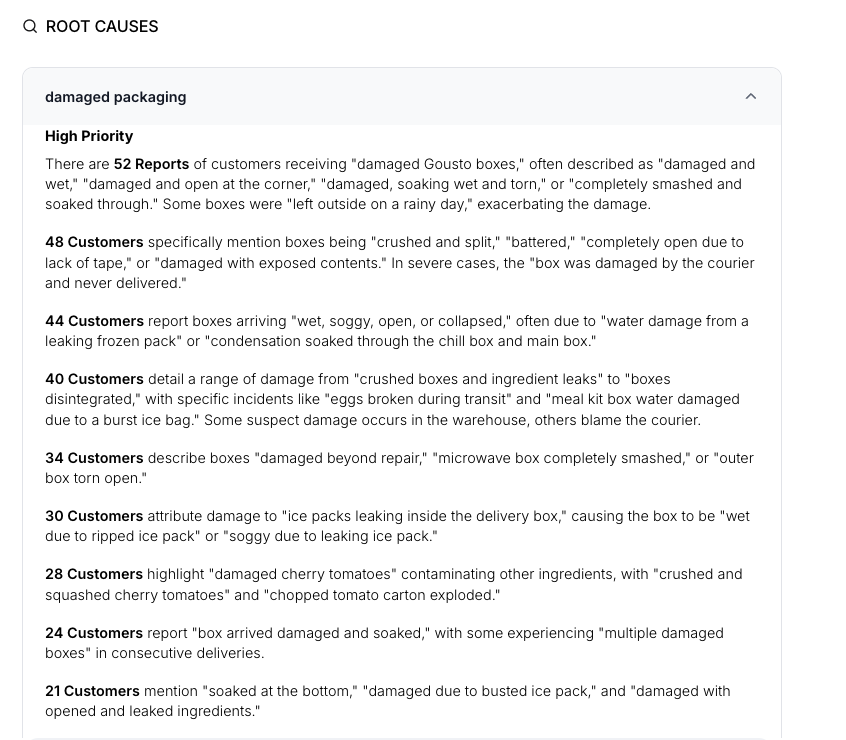
Actionable CX insights reveal root causes behind packaging damage complaints

Kyo digs into the actual feedback to surface root causes. You're not guessing you're seeing the evidence directly from your customers' own words. 

When Kyo identifies an issue, it displays the specific feedback that supports the finding, allowing your team to understand the context and severity.

Case Study: JustPark: Turning Customer Feedback into Real-Time Solutions

JustPark, used by 14 million drivers in the UK and North America, faced a problem: customer feedback was scattered across 5–6 platforms, leading to hundreds of frustrated journeys each week. By moving all feedback into SentiSum’s AI platform , they cut issue detection from weeks to hours.

The system quickly found a missing license plate update feature affecting dozens of drivers daily, saving around £15,000 in weekly revenue. Working closely with SentiSum, JustPark turned insights into real fixes, not just reports.

Executives now use this data in launches and client pitches. The platform helps prevent churn, fix problems fast, and turn customer feedback into clear business results.

How Different Teams Use CX Insights Across the Organization

Customer experience insights shouldn't live in a silo. When feedback is locked in one team's dashboard, everyone else makes decisions blind. SentiSum changes that by making insights accessible and relevant across your entire organization. Below is how different teams use those insights to drive better outcomes.

1. CX Leaders: Aligning Teams Around Real Customer Priorities

CX leaders are responsible for the big picture, understanding what drives satisfaction and retention across the entire customer journey. With SentiSum, they can see which issues are trending across all feedback channels and identify gaps between what customers expect and what they receive. 

This can help them make strategic decisions based on actual customer signals instead of assumptions. When everyone works from the same insights, it's easier to prioritize initiatives, allocate resources, and keep teams focused on what matters most to customers at this moment.

2. Customer Success Teams: Identifying At-Risk Customers Earlier

Customer success teams need to identify which accounts are at risk before those customers begin searching for alternatives. 

SentiSum's predictive insights help CS teams identify early warning signs such as a sudden drop in engagement, repeated support issues, or negative sentiment in recent interactions. 

Instead of reacting after a customer has already decided to leave, CS teams can reach out proactively with solutions, address concerns before they escalate, and focus attention on the accounts that need it most.

3. Support Operations Teams: Addressing Root Causes, Not Just Ticket Volume

Support teams are often measured on ticket volume and response times, but those metrics don't tell you if you're actually solving underlying problems. SentiSum helps support ops teams understand why tickets are coming in, not just how many. 

When Kyo identifies that 40% of your tickets this month are related to the same onboarding issue, your team can address the root cause instead of just closing tickets more quickly. 

This reduces repeat contacts, improves first-contact resolution, and makes support operations more efficient without adding headcount.

4. Product and Marketing Teams: Validating Strategy With Live Customer Signals

Product teams need to know which features cause friction and which ones customers actually care about. Marketing teams need to understand how messaging is landing and what drives conversions or churn. 

SentiSum gives teams direct access to customer feedback at scale. This helps them validate ideas and prioritize roadmap decisions. It also lets them refine their positioning based on what customers are actually saying, not just internal opinions.

When insights flow across teams like this, your entire organization becomes more customer-centric. Decisions get made faster, initiatives align around real customer needs, and everyone stops guessing about what customers want.

How to Evaluate AI-Powered Customer Experience Analytics Tools

Choosing the right AI CX analytics tool comes down to how well it turns raw feedback into fast, usable decisions. Focus on scale, speed, clarity, and how easily insights fit into daily work.

1. Ability to Analyze Unstructured Feedback at Scale

Most customer feedback is unstructured, coming from reviews, surveys, chats, and support tickets. A strong AI tool should process large volumes without manual tagging or constant rules. It must reliably group themes, detect sentiment, and surface patterns as data grows. If accuracy drops at higher volumes, the tool will not support long-term CX decisions.

2. Real-Time Insight Delivery Instead of Delayed Reporting

Customer issues need quick action. AI CX tools should deliver insights in near real time, not days or weeks later. This helps teams catch problems early and respond before they escalate. Real-time alerts are especially valuable during product changes or service disruptions. Delayed reports only explain what has already gone wrong.

3. Transparency of AI Explanations and Root Causes

Teams need to trust what the AI is telling them. The tool should clearly explain why an issue exists, not just show a score or trend. Look for root causes, clear labels, and real customer examples. When insights are easy to understand, teams act faster and leadership trusts the data.

4. Integration Into Workflows Where Teams Already Operate

Insights only matter if teams see them. The best tools integrate with platforms like Slack, CRM systems, or helpdesks. This keeps insights close to action and improves adoption. If teams must check separate dashboards, usage drops. Seamless integration turns insights into fixes, not just reports.

Why SentiSum Fits a Modern AI-Driven CX Strategy

Customer experience has changed. Collecting feedback, running reports, and reacting only after problems surface is an old approach that hurts retention and no longer works. 

SentiSum was designed AI-native from day one. 

Kyo continuously learns from your conversations, getting better at detecting patterns and surfacing what matters most. It spots emerging issues before they hit your metrics, explains why customers are dissatisfied, and guides your team on what to focus on next.

SentiSum isn't another dashboard where insights just lie; it's a decision infrastructure for your CX organization. When you need to understand what's driving churn or where to focus resources, SentiSum delivers answers backed by real customer feedback.

Learn how SentiSum drives retention by optimizing customer experience insights. Book a demo today!

Join a community of 2139+ customer-focused professionals and receive bi-weekly articles, podcasts, webinars, and more!

Trending articles

Customer Experience

AI Customer Experience Insights: How to Use Real-Time Data for CX Optimization

January 27, 2026
Stephen Christou
Marketing Director at SentiSum
In this article
Understand your customer’s problems and get actionable insights
Learn more

Is your AI accurate, or am I getting sold snake oil?

The accuracy of every NLP software depends on the context. Some industries and organisations have very complex issues, some are easier to understand.

Our technology surfaces more granular insights and is very accurate compared to (1) customer service agents, (2) built-in keyword tagging tools, (3) other providers who use more generic AI models or ask you to build a taxonomy yourself.

We build you a customised taxonomy and maintain it continuously with the help of our dedicated data scientists. That means the accuracy of your tags are not dependent on the work you put in.

Either way, we recommend you start a free trial. Included in the trial is historical analysis of your data—more than enough for you to prove it works.

You’re probably drowning in CX data. Support tickets pile up, survey responses go unread, and valuable customer feedback rarely reaches you in time. By the time insights get shared, it’s often too late.

Traditional CX reporting is too slow. You get monthly reports showing how customers felt weeks ago, charts oversimplify feedback, and trends only become visible after they start affecting retention and revenue. That delay is where you lose customers.

With real-time, AI-powered CX analytics, you can spot problems as they happen, understand the root cause immediately, and fix issues before small frustrations turn into big losses. Real-time insights make it possible to act proactively, keeping your customers satisfied and reducing churn.

Why Traditional Customer Experience Insights Don't Drive Action

Most customer feedback analysis happens after churn detection. This means you're looking at history instead of actionable intelligence. A report showing satisfaction dropped in Q2 doesn't help you prevent the same issues in Q3. It just confirms what already happened.

1. Static Reports Tell You What Happened, Not What to Do

Traditional CX reporting creates a disconnect between insight and action. By the time a monthly report reaches your desk, those customer experiences are weeks or months old. 

The frustrated customers either got help through emergency escalations or had already left. The product issues either escalated in another way or grew into bigger problems.

Predictive CX insights with AI identify emerging customer dissatisfaction patterns

A retrospective approach treats customer experience insights as records rather than guides for action. You understand what happened, but you can’t influence or improve those outcomes in real time. Insights become a reference instead of a tool for driving decisions.

2. Manual Analysis Can't Keep Up With Volume

Manual analysis breaks down when you have scale. When your support team receives hundreds or thousands of tickets daily, along with chat logs and survey responses, they face an impossible choice: read everything and analyze nothing, or sample a few and risk missing critical signals. Neither works.

You end up guessing what "most customers" are saying and hoping the patterns you spot are real. Reading qualitative feedback takes mental energy. One analyst might meaningfully process fifty complex tickets in a day. But when they face five hundred or five thousand? Deep analysis becomes impossible.

3. Early Warning Signs Disappear Across Channels

A customer might complain in a support ticket, leave a detailed negative review, and mention the same issue in a survey, but if each channel gets analyzed separately, you miss the pattern. 

What appear to be scattered complaints are actually a concentrated problem that three different teams are failing to recognize.

Channel silos prevent you from connecting the dots. Support sees one complaint. The review team sees another. The survey analyst sees a third. 

Each data point seems manageable, but together they show a real problem that nobody catches because no single team can see the full picture.

4. Poor Insights Lead To Churn And Reactive Cx

The insight gap quickly shows up in your metrics. Escalation rates climb because small issues aren’t caught early. Churn accelerates because early signals of dissatisfaction go unnoticed.

Product roadmaps don't align with customer needs because Voice of Customer insights are received too late. You end up reactive, not because your team doesn't care, but because your insight system was never built for speed.

When insights arrive late, you can only respond to problems that already exist, rather than preventing them from arising. 

This reactive approach incurs additional costs, as escalations require senior support, more churn necessitates aggressive retention efforts, and more misaligned features necessitate rework. The entire customer experience becomes more expensive while delivering worse results.

Why CX Teams Struggle to Turn Feedback Into Insight at Scale

Volume overwhelms the process. A mid-market SaaS company might handle 10,000 support interactions monthly, plus hundreds of reviews and surveys. An enterprise retail brand might see ten times that. Human analysis simply can't keep pace, not because teams lack skill, but because there isn't enough time.

1. Understanding Sentiment Across Multiple Sources

Qualitative customer feedback analysis needs interpretation. The same complaint might be phrased a dozen ways. A product issue could be referred to as a bug, a missing feature, or poor usability, depending on who's writing. 

Traditional tagging forces support agents to categorize complex feedback into rigid categories, which either oversimplifies the information or creates so many categories that the data becomes useless.

Each feedback source also carries a different context. A support ticket comes from someone actively seeking help, often frustrated. A review might be written weeks after purchase when emotions have cooled. A survey captures sentiment at one specific moment. Understanding what customers actually experience means bringing these different contexts together, something manual processes struggle to do consistently.

2. Inconsistent Tagging Hides Real Trends

If ten agents interpret "the checkout process is confusing" differently, some tag it "User Interface issue," others "payment problem," others "user error. Your dashboard will never show that checkout friction drives abandonment. 

The insight exists in the raw feedback. Your categorization system makes it invisible.

Real-time CX insights detect discount application issues immediately

Too many tags make this worse. Teams create new categories for specific issues, but without governance, those categories multiply until the system becomes unmanageable. 

Support agents face dozens of possible tags, make quick choices under pressure, and the data becomes too fragmented to show meaningful patterns.

3. Different Teams See Different Stories in the Same Data

Different teams often work from their own interpretations of the same customer data. Customer success looks for retention signals. Product filters for feature requests. Marketing analyzes sentiment for brand perception. 

Everyone thinks they understand what customers want, but they're looking at pieces of the same conversation through different filters.

This creates misalignment where everyone operates on "customer insights" that contradict each other. The product prioritizes features that marketing thinks will harm the brand. Customer success identifies churn drivers that the product hasn't yet addressed. 

Leadership receives conflicting recommendations because each department presents different conclusions based on the same feedback. 

How AI Changes the Nature of Customer Experience Insights

An AI-driven customer experience strategy doesn't just accelerate traditional analysis; it fundamentally changes what customer experience insights mean and how they inform your operations.

1. AI Processes All Feedback Continuously

Every support ticket, review, survey response, and social mention gets analyzed in real-time. When thousands of customers mention a specific product issue, AI-powered customer experience analytics spot the pattern immediately, not weeks later.

This continuous processing removes bias from manual sampling. Teams naturally focus on extreme feedback, the most positive or negative, or feedback that confirms what they already think. 

AI treats every data point equally, so subtle patterns that wouldn't catch a human's attention still get identified if they represent real trends.

2. Sentiment Shifts Get Caught as They Happen

AI customer experience insights can distinguish between "I love how fast this is" and "I love how you resolved this quickly," recognizing that one praises product performance while the other credits support responsiveness. 

This level of interpretation at scale reveals not only that sentiment is shifting, but also which specific aspects of the customer experience drive that shift.

Real-time sentiment tracking creates early warning systems. When baseline sentiment around a feature or process changes even slightly, AI flags it immediately. 

You can investigate whether a recent update introduced friction, whether a policy change confused customers, or whether outside factors are affecting perception. This detection occurs in hours or days, rather than weeks or months, allowing you to still prevent widespread problems.

3. AI Creates Direction Instead of Just Metrics

Real-time CX insights enable teams to move from hindsight to foresight. When AI learns what normal customer sentiment and behavior look like, it can flag changes as soon as they occur. A spike in complaints about a particular feature appears within hours. 

A rise in cancellation questions signals churn risk before customers leave. That early signal gives teams time to act by addressing issues, adjusting messaging, or engaging directly with at-risk customers.

This changes how teams operate. CX no longer has to read hundreds of tickets to find patterns. Product teams stop prioritizing based on the loudest feedback. Customer success teams typically stop discovering reasons for churn only after it has happened. Instead, clear insights flow continuously into daily workflows.

How SentiSum Delivers Actionable Customer Experience Insights

Manually reading and analyzing customer feedback is exhausting. Even with a small team, hundreds of conversations stack up every week. Many tools promise help but still leave teams sorting, tagging, and interpreting data. SentiSum’s AI engine, Kyo, goes further by handling the heavy lifting end to end, so your team can focus on what actually matters: taking action.

Here's how it works in practice.

1. Conversation Summarization

Kyo interprets customer conversations in real-time, extracting the most important themes and patterns from large volumes of feedback.

Instead of reading through 500 support tickets to understand why customers are frustrated with your checkout process. 

Kyo gives you a clear summary: 23% of tickets this week mention payment failures on mobile, with the issue spiking after your last app update. No manual tagging required. No waiting until the end of the quarter to spot the trend.

2. Real-Time Trend Detection and Anomaly Alerts

Kyo doesn't just tell you what's happening; it tells you when something changes. If customer sentiment suddenly drops in a specific area, or if a particular issue starts appearing more frequently than usual, Kyo flags it immediately. 

These anomaly alerts help you catch problems early, often before they've affected enough customers to show up in your standard metrics.

3. Root Cause Analysis Backed by Evidence

This is where most CX tools stop short. They'll tell you that sentiment is down, or satisfaction scores dropped, but they won't tell you why. 

Actionable CX insights reveal root causes behind packaging damage complaints

Kyo digs into the actual feedback to surface root causes. You're not guessing you're seeing the evidence directly from your customers' own words. 

When Kyo identifies an issue, it displays the specific feedback that supports the finding, allowing your team to understand the context and severity.

Case Study: JustPark: Turning Customer Feedback into Real-Time Solutions

JustPark, used by 14 million drivers in the UK and North America, faced a problem: customer feedback was scattered across 5–6 platforms, leading to hundreds of frustrated journeys each week. By moving all feedback into SentiSum’s AI platform , they cut issue detection from weeks to hours.

The system quickly found a missing license plate update feature affecting dozens of drivers daily, saving around £15,000 in weekly revenue. Working closely with SentiSum, JustPark turned insights into real fixes, not just reports.

Executives now use this data in launches and client pitches. The platform helps prevent churn, fix problems fast, and turn customer feedback into clear business results.

How Different Teams Use CX Insights Across the Organization

Customer experience insights shouldn't live in a silo. When feedback is locked in one team's dashboard, everyone else makes decisions blind. SentiSum changes that by making insights accessible and relevant across your entire organization. Below is how different teams use those insights to drive better outcomes.

1. CX Leaders: Aligning Teams Around Real Customer Priorities

CX leaders are responsible for the big picture, understanding what drives satisfaction and retention across the entire customer journey. With SentiSum, they can see which issues are trending across all feedback channels and identify gaps between what customers expect and what they receive. 

This can help them make strategic decisions based on actual customer signals instead of assumptions. When everyone works from the same insights, it's easier to prioritize initiatives, allocate resources, and keep teams focused on what matters most to customers at this moment.

2. Customer Success Teams: Identifying At-Risk Customers Earlier

Customer success teams need to identify which accounts are at risk before those customers begin searching for alternatives. 

SentiSum's predictive insights help CS teams identify early warning signs such as a sudden drop in engagement, repeated support issues, or negative sentiment in recent interactions. 

Instead of reacting after a customer has already decided to leave, CS teams can reach out proactively with solutions, address concerns before they escalate, and focus attention on the accounts that need it most.

3. Support Operations Teams: Addressing Root Causes, Not Just Ticket Volume

Support teams are often measured on ticket volume and response times, but those metrics don't tell you if you're actually solving underlying problems. SentiSum helps support ops teams understand why tickets are coming in, not just how many. 

When Kyo identifies that 40% of your tickets this month are related to the same onboarding issue, your team can address the root cause instead of just closing tickets more quickly. 

This reduces repeat contacts, improves first-contact resolution, and makes support operations more efficient without adding headcount.

4. Product and Marketing Teams: Validating Strategy With Live Customer Signals

Product teams need to know which features cause friction and which ones customers actually care about. Marketing teams need to understand how messaging is landing and what drives conversions or churn. 

SentiSum gives teams direct access to customer feedback at scale. This helps them validate ideas and prioritize roadmap decisions. It also lets them refine their positioning based on what customers are actually saying, not just internal opinions.

When insights flow across teams like this, your entire organization becomes more customer-centric. Decisions get made faster, initiatives align around real customer needs, and everyone stops guessing about what customers want.

How to Evaluate AI-Powered Customer Experience Analytics Tools

Choosing the right AI CX analytics tool comes down to how well it turns raw feedback into fast, usable decisions. Focus on scale, speed, clarity, and how easily insights fit into daily work.

1. Ability to Analyze Unstructured Feedback at Scale

Most customer feedback is unstructured, coming from reviews, surveys, chats, and support tickets. A strong AI tool should process large volumes without manual tagging or constant rules. It must reliably group themes, detect sentiment, and surface patterns as data grows. If accuracy drops at higher volumes, the tool will not support long-term CX decisions.

2. Real-Time Insight Delivery Instead of Delayed Reporting

Customer issues need quick action. AI CX tools should deliver insights in near real time, not days or weeks later. This helps teams catch problems early and respond before they escalate. Real-time alerts are especially valuable during product changes or service disruptions. Delayed reports only explain what has already gone wrong.

3. Transparency of AI Explanations and Root Causes

Teams need to trust what the AI is telling them. The tool should clearly explain why an issue exists, not just show a score or trend. Look for root causes, clear labels, and real customer examples. When insights are easy to understand, teams act faster and leadership trusts the data.

4. Integration Into Workflows Where Teams Already Operate

Insights only matter if teams see them. The best tools integrate with platforms like Slack, CRM systems, or helpdesks. This keeps insights close to action and improves adoption. If teams must check separate dashboards, usage drops. Seamless integration turns insights into fixes, not just reports.

Why SentiSum Fits a Modern AI-Driven CX Strategy

Customer experience has changed. Collecting feedback, running reports, and reacting only after problems surface is an old approach that hurts retention and no longer works. 

SentiSum was designed AI-native from day one. 

Kyo continuously learns from your conversations, getting better at detecting patterns and surfacing what matters most. It spots emerging issues before they hit your metrics, explains why customers are dissatisfied, and guides your team on what to focus on next.

SentiSum isn't another dashboard where insights just lie; it's a decision infrastructure for your CX organization. When you need to understand what's driving churn or where to focus resources, SentiSum delivers answers backed by real customer feedback.

Learn how SentiSum drives retention by optimizing customer experience insights. Book a demo today!

Heading 1

Heading 2

Heading 3

Heading 4

Heading 5
Heading 6

Lorem ipsum dolor sit amet, consectetur adipiscing elit, sed do eiusmod tempor incididunt ut labore et dolore magna aliqua. Ut enim ad minim veniam, quis nostrud exercitation ullamco laboris nisi ut aliquip ex ea commodo consequat. Duis aute irure dolor in reprehenderit in voluptate velit esse cillum dolore eu fugiat nulla pariatur.

Block quote

Ordered list

  1. Item 1
  2. Item 2
  3. Item 3

Unordered list

  • Item A
  • Item B
  • Item C

Text link

Bold text

Emphasis

Superscript

Subscript

Frequently asked questions

Is your AI accurate, or am I getting sold snake oil?

The accuracy of every NLP software depends on the context. Some industries and organisations have very complex issues, some are easier to understand.

Our technology surfaces more granular insights and is very accurate compared to (1) customer service agents, (2) built-in keyword tagging tools, (3) other providers who use more generic AI models or ask you to build a taxonomy yourself.

We build you a customised taxonomy and maintain it continuously with the help of our dedicated data scientists. That means the accuracy of your tags are not dependent on the work you put in.

Either way, we recommend you start a free trial. Included in the trial is historical analysis of your data—more than enough for you to prove it works.

Do you integrate with my systems? How long is that going to take?

Lorem ipsum dolor sit amet, consectetur adipiscing elit. Suspendisse varius enim in eros elementum tristique. Duis cursus, mi quis viverra ornare, eros dolor interdum nulla, ut commodo diam libero vitae erat. Aenean faucibus nibh et justo cursus id rutrum lorem imperdiet. Nunc ut sem vitae risus tristique posuere.

What size company do you usually work with? Is this valuable for me?

Lorem ipsum dolor sit amet, consectetur adipiscing elit. Suspendisse varius enim in eros elementum tristique. Duis cursus, mi quis viverra ornare, eros dolor interdum nulla, ut commodo diam libero vitae erat. Aenean faucibus nibh et justo cursus id rutrum lorem imperdiet. Nunc ut sem vitae risus tristique posuere.

What is your term of the contract?

Lorem ipsum dolor sit amet, consectetur adipiscing elit. Suspendisse varius enim in eros elementum tristique. Duis cursus, mi quis viverra ornare, eros dolor interdum nulla, ut commodo diam libero vitae erat. Aenean faucibus nibh et justo cursus id rutrum lorem imperdiet. Nunc ut sem vitae risus tristique posuere.

How do you keep my data private?

Lorem ipsum dolor sit amet, consectetur adipiscing elit. Suspendisse varius enim in eros elementum tristique. Duis cursus, mi quis viverra ornare, eros dolor interdum nulla, ut commodo diam libero vitae erat. Aenean faucibus nibh et justo cursus id rutrum lorem imperdiet. Nunc ut sem vitae risus tristique posuere.

Support Insights Community
Join a community of 2200+ customer-focused professionals and receive bi-weekly articles, podcasts, webinars, and more!

Lorem ipsum dolor sit amet, consectetur adipiscing elit. Suspendisse varius enim in eros elementum tristique. Duis cursus, mi quis viverra ornare, eros dolor interdum nulla, ut commodo diam libero vitae erat. Aenean faucibus nibh et justo cursus id rutrum lorem imperdiet. Nunc ut sem vitae risus tristique posuere.

Lorem ipsum dolor sit amet, consectetur adipiscing elit. Suspendisse varius enim in eros elementum tristique. Duis cursus, mi quis viverra ornare, eros dolor interdum nulla, ut commodo diam libero vitae erat. Aenean faucibus nibh et justo cursus id rutrum lorem imperdiet. Nunc ut sem vitae risus tristique posuere.

Lorem ipsum dolor sit amet, consectetur adipiscing elit. Suspendisse varius enim in eros elementum tristique. Duis cursus, mi quis viverra ornare, eros dolor interdum nulla, ut commodo diam libero vitae erat. Aenean faucibus nibh et justo cursus id rutrum lorem imperdiet. Nunc ut sem vitae risus tristique posuere.

Thank you! Your submission has been received!
Oops! Something went wrong while submitting the form.

Frequently Asked Questions

Why do CX insights fail to prevent churn?

Most insights arrive too late or lack context. By the time teams spot trends in monthly reports, customers have already left. Without understanding root causes or knowing which issues are urgent, teams can't prioritize fixes that actually prevent churn before it happens.

How does AI improve the speed and quality of CX insights?

AI analyzes conversations instantly, detecting patterns humans would miss or take weeks to find. It connects feedback across channels, identifies sentiment shifts in real time, and surfaces root causes with supporting evidence, delivering insights when they're still actionable, not after the damage is done.

What makes CX insights actionable rather than descriptive?

Actionable CX insights explain why problems exist and what to do next, not just what's happening. They prioritize issues by impact, provide evidence from actual customer feedback, and guide teams toward specific solutions, eliminating guesswork and analysis paralysis that keeps descriptive insights stuck in dashboards.

How do real-time insights change CX decision-making?

Real-time CX insights enable teams to address customer issues before they escalate into churn. Teams can spot problems early, test solutions quickly, and adjust strategies based on current customer needs. This makes CX operations proactive instead of reactive, avoiding constant catch-up.

What should teams look for in AI-powered customer experience analytics?

Look for platforms that consolidate feedback from all channels, spot anomalies automatically, and explain root causes with evidence. The top CX analytics tools suggest next steps, fit into your existing workflows, and learn from your data. They deliver actionable insights, not just dashboards that go unused.

What are customer experience insights

Customer experience insights are the understanding a business gains from analyzing customer interactions, feedback, and behavior. They reveal patterns, preferences, pain points, and opportunities, helping companies improve satisfaction, loyalty, and overall service by making informed, data-driven decisions.

What is real-time customer experience analysis?

Real-time customer experience analysis is the process of monitoring and evaluating customer interactions as they happen. It provides instant insights into behavior, satisfaction, and issues, enabling businesses to respond quickly, improve experiences, and make immediate, data-driven decisions.

Is your AI accurate, or am I getting sold snake oil?

The accuracy of every NLP software depends on the context. Some industries and organisations have very complex issues, some are easier to understand.

Our technology surfaces more granular insights and is very accurate compared to (1) customer service agents, (2) built-in keyword tagging tools, (3) other providers who use more generic AI models or ask you to build a taxonomy yourself.

We build you a customised taxonomy and maintain it continuously with the help of our dedicated data scientists. That means the accuracy of your tags are not dependent on the work you put in.

Either way, we recommend you start a free trial. Included in the trial is historical analysis of your data—more than enough for you to prove it works.

Customer Experience
January 27, 2026
7
min read.

AI Customer Experience Insights: How to Use Real-Time Data for CX Optimization

Stephen Christou
Marketing Director at SentiSum
Table of contents
Understand your customer’s problems and get actionable insight
Share

TL;DR

  • Detect and address emerging dissatisfaction before customers leave, reducing churn across support, product, and marketing touchpoints.
  • Surface root causes of complaints instantly, enabling proactive retention strategies and improving long-term customer loyalty.
  • Provide CX leaders with a single, actionable view of priorities, aligning teams around decisions that directly impact revenue and customer satisfaction.
  • Help customer success teams identify at-risk accounts early, allowing targeted interventions that preserve key relationships.
  • Enable support operations to solve underlying issues, not just tickets, increasing first-contact resolution and reducing repeat escalations.
  • Provide product and marketing teams with live insights to validate strategies, prioritize features, and prevent experience-driven churn.

You’re probably drowning in CX data. Support tickets pile up, survey responses go unread, and valuable customer feedback rarely reaches you in time. By the time insights get shared, it’s often too late.

Traditional CX reporting is too slow. You get monthly reports showing how customers felt weeks ago, charts oversimplify feedback, and trends only become visible after they start affecting retention and revenue. That delay is where you lose customers.

With real-time, AI-powered CX analytics, you can spot problems as they happen, understand the root cause immediately, and fix issues before small frustrations turn into big losses. Real-time insights make it possible to act proactively, keeping your customers satisfied and reducing churn.

Why Traditional Customer Experience Insights Don't Drive Action

Most customer feedback analysis happens after churn detection. This means you're looking at history instead of actionable intelligence. A report showing satisfaction dropped in Q2 doesn't help you prevent the same issues in Q3. It just confirms what already happened.

1. Static Reports Tell You What Happened, Not What to Do

Traditional CX reporting creates a disconnect between insight and action. By the time a monthly report reaches your desk, those customer experiences are weeks or months old. 

The frustrated customers either got help through emergency escalations or had already left. The product issues either escalated in another way or grew into bigger problems.

Predictive CX insights with AI identify emerging customer dissatisfaction patterns

A retrospective approach treats customer experience insights as records rather than guides for action. You understand what happened, but you can’t influence or improve those outcomes in real time. Insights become a reference instead of a tool for driving decisions.

2. Manual Analysis Can't Keep Up With Volume

Manual analysis breaks down when you have scale. When your support team receives hundreds or thousands of tickets daily, along with chat logs and survey responses, they face an impossible choice: read everything and analyze nothing, or sample a few and risk missing critical signals. Neither works.

You end up guessing what "most customers" are saying and hoping the patterns you spot are real. Reading qualitative feedback takes mental energy. One analyst might meaningfully process fifty complex tickets in a day. But when they face five hundred or five thousand? Deep analysis becomes impossible.

3. Early Warning Signs Disappear Across Channels

A customer might complain in a support ticket, leave a detailed negative review, and mention the same issue in a survey, but if each channel gets analyzed separately, you miss the pattern. 

What appear to be scattered complaints are actually a concentrated problem that three different teams are failing to recognize.

Channel silos prevent you from connecting the dots. Support sees one complaint. The review team sees another. The survey analyst sees a third. 

Each data point seems manageable, but together they show a real problem that nobody catches because no single team can see the full picture.

4. Poor Insights Lead To Churn And Reactive Cx

The insight gap quickly shows up in your metrics. Escalation rates climb because small issues aren’t caught early. Churn accelerates because early signals of dissatisfaction go unnoticed.

Product roadmaps don't align with customer needs because Voice of Customer insights are received too late. You end up reactive, not because your team doesn't care, but because your insight system was never built for speed.

When insights arrive late, you can only respond to problems that already exist, rather than preventing them from arising. 

This reactive approach incurs additional costs, as escalations require senior support, more churn necessitates aggressive retention efforts, and more misaligned features necessitate rework. The entire customer experience becomes more expensive while delivering worse results.

Why CX Teams Struggle to Turn Feedback Into Insight at Scale

Volume overwhelms the process. A mid-market SaaS company might handle 10,000 support interactions monthly, plus hundreds of reviews and surveys. An enterprise retail brand might see ten times that. Human analysis simply can't keep pace, not because teams lack skill, but because there isn't enough time.

1. Understanding Sentiment Across Multiple Sources

Qualitative customer feedback analysis needs interpretation. The same complaint might be phrased a dozen ways. A product issue could be referred to as a bug, a missing feature, or poor usability, depending on who's writing. 

Traditional tagging forces support agents to categorize complex feedback into rigid categories, which either oversimplifies the information or creates so many categories that the data becomes useless.

Each feedback source also carries a different context. A support ticket comes from someone actively seeking help, often frustrated. A review might be written weeks after purchase when emotions have cooled. A survey captures sentiment at one specific moment. Understanding what customers actually experience means bringing these different contexts together, something manual processes struggle to do consistently.

2. Inconsistent Tagging Hides Real Trends

If ten agents interpret "the checkout process is confusing" differently, some tag it "User Interface issue," others "payment problem," others "user error. Your dashboard will never show that checkout friction drives abandonment. 

The insight exists in the raw feedback. Your categorization system makes it invisible.

Real-time CX insights detect discount application issues immediately

Too many tags make this worse. Teams create new categories for specific issues, but without governance, those categories multiply until the system becomes unmanageable. 

Support agents face dozens of possible tags, make quick choices under pressure, and the data becomes too fragmented to show meaningful patterns.

3. Different Teams See Different Stories in the Same Data

Different teams often work from their own interpretations of the same customer data. Customer success looks for retention signals. Product filters for feature requests. Marketing analyzes sentiment for brand perception. 

Everyone thinks they understand what customers want, but they're looking at pieces of the same conversation through different filters.

This creates misalignment where everyone operates on "customer insights" that contradict each other. The product prioritizes features that marketing thinks will harm the brand. Customer success identifies churn drivers that the product hasn't yet addressed. 

Leadership receives conflicting recommendations because each department presents different conclusions based on the same feedback. 

How AI Changes the Nature of Customer Experience Insights

An AI-driven customer experience strategy doesn't just accelerate traditional analysis; it fundamentally changes what customer experience insights mean and how they inform your operations.

1. AI Processes All Feedback Continuously

Every support ticket, review, survey response, and social mention gets analyzed in real-time. When thousands of customers mention a specific product issue, AI-powered customer experience analytics spot the pattern immediately, not weeks later.

This continuous processing removes bias from manual sampling. Teams naturally focus on extreme feedback, the most positive or negative, or feedback that confirms what they already think. 

AI treats every data point equally, so subtle patterns that wouldn't catch a human's attention still get identified if they represent real trends.

2. Sentiment Shifts Get Caught as They Happen

AI customer experience insights can distinguish between "I love how fast this is" and "I love how you resolved this quickly," recognizing that one praises product performance while the other credits support responsiveness. 

This level of interpretation at scale reveals not only that sentiment is shifting, but also which specific aspects of the customer experience drive that shift.

Real-time sentiment tracking creates early warning systems. When baseline sentiment around a feature or process changes even slightly, AI flags it immediately. 

You can investigate whether a recent update introduced friction, whether a policy change confused customers, or whether outside factors are affecting perception. This detection occurs in hours or days, rather than weeks or months, allowing you to still prevent widespread problems.

3. AI Creates Direction Instead of Just Metrics

Real-time CX insights enable teams to move from hindsight to foresight. When AI learns what normal customer sentiment and behavior look like, it can flag changes as soon as they occur. A spike in complaints about a particular feature appears within hours. 

A rise in cancellation questions signals churn risk before customers leave. That early signal gives teams time to act by addressing issues, adjusting messaging, or engaging directly with at-risk customers.

This changes how teams operate. CX no longer has to read hundreds of tickets to find patterns. Product teams stop prioritizing based on the loudest feedback. Customer success teams typically stop discovering reasons for churn only after it has happened. Instead, clear insights flow continuously into daily workflows.

How SentiSum Delivers Actionable Customer Experience Insights

Manually reading and analyzing customer feedback is exhausting. Even with a small team, hundreds of conversations stack up every week. Many tools promise help but still leave teams sorting, tagging, and interpreting data. SentiSum’s AI engine, Kyo, goes further by handling the heavy lifting end to end, so your team can focus on what actually matters: taking action.

Here's how it works in practice.

1. Conversation Summarization

Kyo interprets customer conversations in real-time, extracting the most important themes and patterns from large volumes of feedback.

Instead of reading through 500 support tickets to understand why customers are frustrated with your checkout process. 

Kyo gives you a clear summary: 23% of tickets this week mention payment failures on mobile, with the issue spiking after your last app update. No manual tagging required. No waiting until the end of the quarter to spot the trend.

2. Real-Time Trend Detection and Anomaly Alerts

Kyo doesn't just tell you what's happening; it tells you when something changes. If customer sentiment suddenly drops in a specific area, or if a particular issue starts appearing more frequently than usual, Kyo flags it immediately. 

These anomaly alerts help you catch problems early, often before they've affected enough customers to show up in your standard metrics.

3. Root Cause Analysis Backed by Evidence

This is where most CX tools stop short. They'll tell you that sentiment is down, or satisfaction scores dropped, but they won't tell you why. 

Actionable CX insights reveal root causes behind packaging damage complaints

Kyo digs into the actual feedback to surface root causes. You're not guessing you're seeing the evidence directly from your customers' own words. 

When Kyo identifies an issue, it displays the specific feedback that supports the finding, allowing your team to understand the context and severity.

Case Study: JustPark: Turning Customer Feedback into Real-Time Solutions

JustPark, used by 14 million drivers in the UK and North America, faced a problem: customer feedback was scattered across 5–6 platforms, leading to hundreds of frustrated journeys each week. By moving all feedback into SentiSum’s AI platform , they cut issue detection from weeks to hours.

The system quickly found a missing license plate update feature affecting dozens of drivers daily, saving around £15,000 in weekly revenue. Working closely with SentiSum, JustPark turned insights into real fixes, not just reports.

Executives now use this data in launches and client pitches. The platform helps prevent churn, fix problems fast, and turn customer feedback into clear business results.

How Different Teams Use CX Insights Across the Organization

Customer experience insights shouldn't live in a silo. When feedback is locked in one team's dashboard, everyone else makes decisions blind. SentiSum changes that by making insights accessible and relevant across your entire organization. Below is how different teams use those insights to drive better outcomes.

1. CX Leaders: Aligning Teams Around Real Customer Priorities

CX leaders are responsible for the big picture, understanding what drives satisfaction and retention across the entire customer journey. With SentiSum, they can see which issues are trending across all feedback channels and identify gaps between what customers expect and what they receive. 

This can help them make strategic decisions based on actual customer signals instead of assumptions. When everyone works from the same insights, it's easier to prioritize initiatives, allocate resources, and keep teams focused on what matters most to customers at this moment.

2. Customer Success Teams: Identifying At-Risk Customers Earlier

Customer success teams need to identify which accounts are at risk before those customers begin searching for alternatives. 

SentiSum's predictive insights help CS teams identify early warning signs such as a sudden drop in engagement, repeated support issues, or negative sentiment in recent interactions. 

Instead of reacting after a customer has already decided to leave, CS teams can reach out proactively with solutions, address concerns before they escalate, and focus attention on the accounts that need it most.

3. Support Operations Teams: Addressing Root Causes, Not Just Ticket Volume

Support teams are often measured on ticket volume and response times, but those metrics don't tell you if you're actually solving underlying problems. SentiSum helps support ops teams understand why tickets are coming in, not just how many. 

When Kyo identifies that 40% of your tickets this month are related to the same onboarding issue, your team can address the root cause instead of just closing tickets more quickly. 

This reduces repeat contacts, improves first-contact resolution, and makes support operations more efficient without adding headcount.

4. Product and Marketing Teams: Validating Strategy With Live Customer Signals

Product teams need to know which features cause friction and which ones customers actually care about. Marketing teams need to understand how messaging is landing and what drives conversions or churn. 

SentiSum gives teams direct access to customer feedback at scale. This helps them validate ideas and prioritize roadmap decisions. It also lets them refine their positioning based on what customers are actually saying, not just internal opinions.

When insights flow across teams like this, your entire organization becomes more customer-centric. Decisions get made faster, initiatives align around real customer needs, and everyone stops guessing about what customers want.

How to Evaluate AI-Powered Customer Experience Analytics Tools

Choosing the right AI CX analytics tool comes down to how well it turns raw feedback into fast, usable decisions. Focus on scale, speed, clarity, and how easily insights fit into daily work.

1. Ability to Analyze Unstructured Feedback at Scale

Most customer feedback is unstructured, coming from reviews, surveys, chats, and support tickets. A strong AI tool should process large volumes without manual tagging or constant rules. It must reliably group themes, detect sentiment, and surface patterns as data grows. If accuracy drops at higher volumes, the tool will not support long-term CX decisions.

2. Real-Time Insight Delivery Instead of Delayed Reporting

Customer issues need quick action. AI CX tools should deliver insights in near real time, not days or weeks later. This helps teams catch problems early and respond before they escalate. Real-time alerts are especially valuable during product changes or service disruptions. Delayed reports only explain what has already gone wrong.

3. Transparency of AI Explanations and Root Causes

Teams need to trust what the AI is telling them. The tool should clearly explain why an issue exists, not just show a score or trend. Look for root causes, clear labels, and real customer examples. When insights are easy to understand, teams act faster and leadership trusts the data.

4. Integration Into Workflows Where Teams Already Operate

Insights only matter if teams see them. The best tools integrate with platforms like Slack, CRM systems, or helpdesks. This keeps insights close to action and improves adoption. If teams must check separate dashboards, usage drops. Seamless integration turns insights into fixes, not just reports.

Why SentiSum Fits a Modern AI-Driven CX Strategy

Customer experience has changed. Collecting feedback, running reports, and reacting only after problems surface is an old approach that hurts retention and no longer works. 

SentiSum was designed AI-native from day one. 

Kyo continuously learns from your conversations, getting better at detecting patterns and surfacing what matters most. It spots emerging issues before they hit your metrics, explains why customers are dissatisfied, and guides your team on what to focus on next.

SentiSum isn't another dashboard where insights just lie; it's a decision infrastructure for your CX organization. When you need to understand what's driving churn or where to focus resources, SentiSum delivers answers backed by real customer feedback.

Learn how SentiSum drives retention by optimizing customer experience insights. Book a demo today!

Frequently Asked Questions

Why do CX insights fail to prevent churn?

Most insights arrive too late or lack context. By the time teams spot trends in monthly reports, customers have already left. Without understanding root causes or knowing which issues are urgent, teams can't prioritize fixes that actually prevent churn before it happens.

How does AI improve the speed and quality of CX insights?

AI analyzes conversations instantly, detecting patterns humans would miss or take weeks to find. It connects feedback across channels, identifies sentiment shifts in real time, and surfaces root causes with supporting evidence, delivering insights when they're still actionable, not after the damage is done.

What makes CX insights actionable rather than descriptive?

Actionable CX insights explain why problems exist and what to do next, not just what's happening. They prioritize issues by impact, provide evidence from actual customer feedback, and guide teams toward specific solutions, eliminating guesswork and analysis paralysis that keeps descriptive insights stuck in dashboards.

How do real-time insights change CX decision-making?

Real-time CX insights enable teams to address customer issues before they escalate into churn. Teams can spot problems early, test solutions quickly, and adjust strategies based on current customer needs. This makes CX operations proactive instead of reactive, avoiding constant catch-up.

What should teams look for in AI-powered customer experience analytics?

Look for platforms that consolidate feedback from all channels, spot anomalies automatically, and explain root causes with evidence. The top CX analytics tools suggest next steps, fit into your existing workflows, and learn from your data. They deliver actionable insights, not just dashboards that go unused.

What are customer experience insights

Customer experience insights are the understanding a business gains from analyzing customer interactions, feedback, and behavior. They reveal patterns, preferences, pain points, and opportunities, helping companies improve satisfaction, loyalty, and overall service by making informed, data-driven decisions.

What is real-time customer experience analysis?

Real-time customer experience analysis is the process of monitoring and evaluating customer interactions as they happen. It provides instant insights into behavior, satisfaction, and issues, enabling businesses to respond quickly, improve experiences, and make immediate, data-driven decisions.

Explore Real Success Stories

Explore Success Stories

Curious how leading consumer brands like Ticketmaster, Gousto, JustPark are turning Voice of Customer data into faster fixes and lower churn?

Talk to a Data Expert

30-min free product walkthrough to see how CX and retention teams are using SentiSum to lower churn
Written By
Stephen Christou
I lead marketing at SentiSum, drawing on more than 15 years’ experience at Cohesity, TIBCO, and HPE. My focus has always been on aligning sales and marketing to unlock growth. I am especially interested in how AI is changing customer experience and creating new ways for businesses to scale.