Customer Experience

Retail Customer Experience: Your Dashboard Is Green, Your P&L Is Red

Retail Customer Experience: Your Dashboard Is Green, Your P&L Is Red
Founder & CEO, SentiSum
LinkedIn icon
Retail Customer Experience: Your Dashboard Is Green, Your P&L Is Red

You can have a healthy dashboard and a sick business at the same time. In retail customer experience, that happens more than anyone admits.

CSAT is up. NPS is holding. The review stars look fine. Then refunds creep up, repeat purchase slides, and the support queue fills with tickets that all rhyme. The dashboard says you are winning. The P&L says otherwise.

I have spent the last few years inside the data of some of the largest retailers in the UK and Europe. Grocery, beauty, footwear, supplements, subscription. Different categories, different scale, the same problem every time. The numbers these teams use to measure customer experience are not the numbers that move it.

Their agents are good. Their intentions are good. So this was never really about service. It was about how they measure. And you cannot fix what your instruments do not show you.

What retail customer experience actually is

Retail customer experience is the sum of every operational decision a customer feels. Your return window. Your delivery promise. Your payment-retry logic. The script your bot follows. The gaps between web, store, and app.

A customer never rates your strategy. They rate the exact moment your strategy broke in their hands. The renewal that failed. The parcel that did not arrive. The refund the policy would not allow.

Most definitions of CX stop at "touchpoints" and "emotions." That framing feels nice and does nothing. It tells you to be nicer. It never tells you what to fix.

The lie of the average score

A 4.6 CSAT is an average. And averages are where bad news hides.

Survey response rates in retail run 5 to 15% on a good day. The people who reply already love you or already hate you. The 80% in the middle decide your year. They tell the survey nothing, then leave. So you tune the whole operation around the customers who shout. And you stay blind to the majority who actually pay the bills.

It gets worse. Even your bad-news signal is usually undercounted. At one retailer, "low CSAT" was split across three fields (a 0 to 10 score, a separate rating, and an answered-survey flag). Read any one of them alone and you miss more than half your unhappy customers. The team had been reporting a dissatisfaction number that was wrong by around 60%. They had no idea. They were not careless. The measurement was built to flatter.

The signal already sitting in your building

Every retailer owns one honest data source. It is unfiltered and refreshed by the hour. It is what customers actually say. Tickets, chats, emails, reviews, calls, social DMs.

A customer who contacts support is not being polite. They are telling you, in their own words, exactly what broke. With a timestamp. An order number. The product they bought. The policy that failed them. It is the most precise operational feedback you will ever get. And you already pay to collect it.

Most retailers treat it like exhaust. They hand-tag a sample, pull the top three contact reasons each quarter, and call it insight. Meanwhile the story that explains how refunds and CSAT climb together sits in 40,000 conversations no one read.

Five things the conversations say that your dashboard never will

Read all of it instead of a sample, and the same shapes show up again and again.

A big slice of subscription cancellations traces back to one thing. A renewal payment that fails on a specific card type or retry window. Churn rate tells you customers left. Their words tell you why. And that it is a billing bug you can fix this week, not a loyalty crisis you will agonise over for a quarter.

Refunds get rejected because a return window built for one category punishes another. A 30-day apparel rule applied to someone who bought supplements. Nothing looked wrong on paper. It was wrong in one aisle.

Delivery complaints triple in 72 hours, all pointing at one courier in one region. CSAT has not moved yet. By the time it does, the parcels are already late and the one-star reviews are already written.

The bot "resolves 80% of queries." Healthy headline. It also fails most billing questions that need a human to change an account. Those customers wait, escalate, and churn. The 80% is hiding the people the 80% cannot help.

Refund inquiries jump in a single day, right after a pricing change goes live. The pricing team did not know. The conversations knew hours before any score moved.

None of this shows up in a satisfaction number. All of it shows up in what customers said.

The automation that flatters you

I see this trap constantly. A retailer routes nearly half its contacts through a self-service refund flow. On the dashboard that reads as a brilliant deflection rate and a clean queue. Read the conversations and it is the opposite. Half your customers never spoke to anyone. And the refund itself is the symptom. It is the downstream cost of an upstream failure the bot keeps paying out, claim after claim, while no one upstream ever gets the message.

That kind of automation does not remove the problem. It removes the evidence.

What one brand found when it actually looked

A fast-growing wellness retailer had everything a board likes to see. Strong brand, loyal base, healthy scores. Returns were assumed to be a product-quality issue. That had been the working theory for the better part of a year.

We read its full conversation history instead of a quarterly sample. The returns had almost nothing to do with product quality. They traced back to one confusing step in the cancellation-and-renewal flow. And that single root cause had been splitting itself across five different ticket categories. Apart, they looked like five problems with five owners. Together, they were one. One fix closed all five.

A national footwear retailer arrived at the same place from a different door. What its dashboard logged as "delivery complaints" was, in the customers' own words, checkout friction. Different category, same principle. Neither team worked harder. They stopped scoring how customers felt and started reading what customers said.

Stop scoring. Start reading.

If you want to improve retail customer experience in 2026, go upstream. Forget the next survey and the personalisation engine bolted onto a foundation you cannot see. Read every conversation. Find the operational failures buried inside. Fix the root cause. The score will follow.

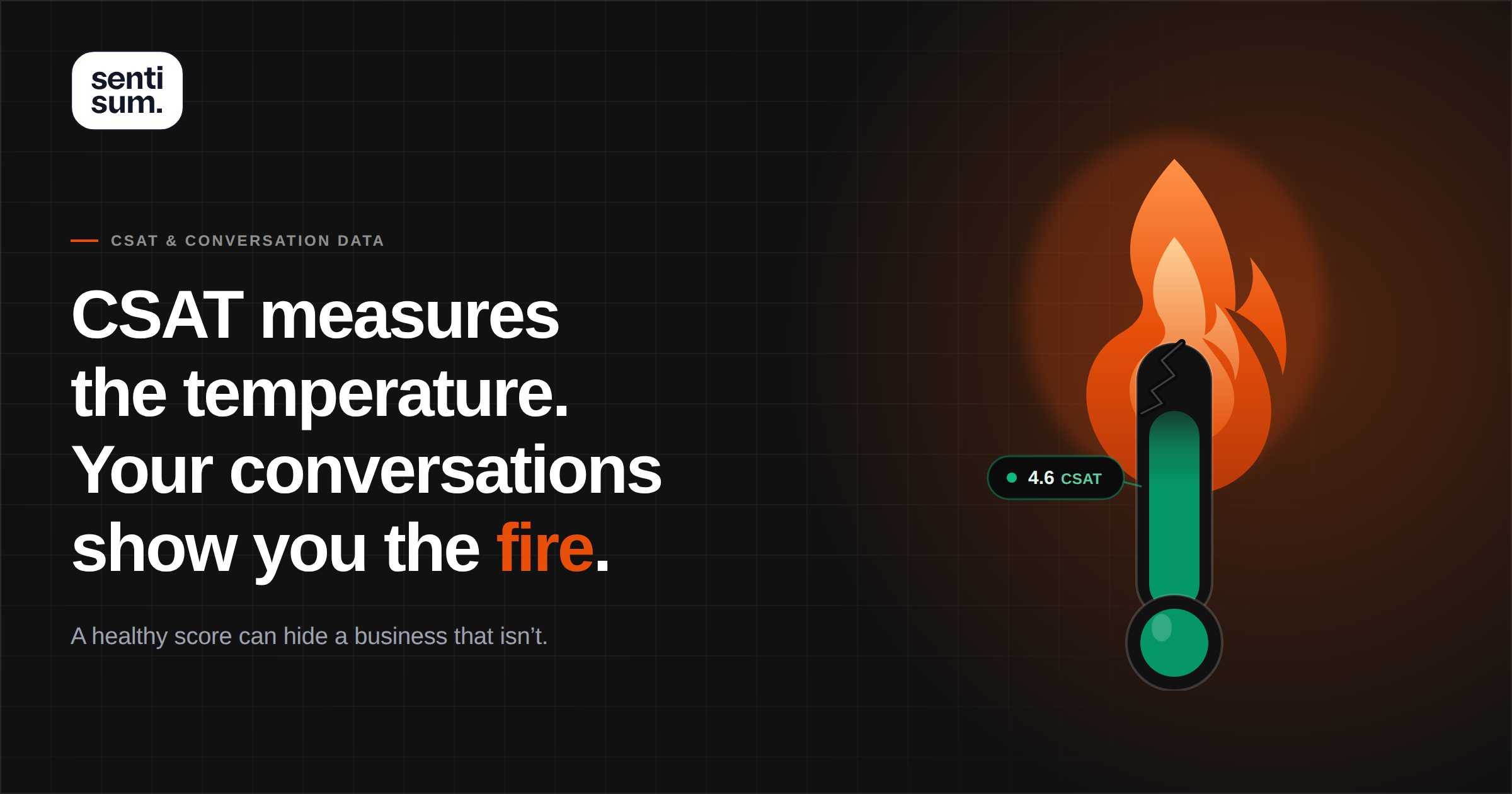
Your CSAT measures the temperature. Your conversations are the fire.

Request a free pilot and we will read a slice of your conversations with you.

Join a community of 2139+ customer-focused professionals and receive bi-weekly articles, podcasts, webinars, and more!

Trending articles

Customer Experience
June 19, 2026
4
min read.

Retail Customer Experience: Your Dashboard Is Green, Your P&L Is Red

Sharad Khandelwal
Founder & CEO, SentiSum
Table of contents
Understand your customer’s problems and get actionable insight
Share

TL;DR

Your CX dashboard can look healthy while the business bleeds. CSAT and NPS are averages built on a 5 to 15% survey response, so they flatter you and hide the silent majority who leave without a word. The honest signal is what customers actually say in tickets, chats, and reviews. Read all of it instead of a sample and the same operational failures surface: failed renewals, mismatched return windows, one bad courier, a pricing change no one flagged. Fix the root cause upstream and the score follows. Stop scoring. Start reading.

You can have a healthy dashboard and a sick business at the same time. In retail customer experience, that happens more than anyone admits.

CSAT is up. NPS is holding. The review stars look fine. Then refunds creep up, repeat purchase slides, and the support queue fills with tickets that all rhyme. The dashboard says you are winning. The P&L says otherwise.

I have spent the last few years inside the data of some of the largest retailers in the UK and Europe. Grocery, beauty, footwear, supplements, subscription. Different categories, different scale, the same problem every time. The numbers these teams use to measure customer experience are not the numbers that move it.

Their agents are good. Their intentions are good. So this was never really about service. It was about how they measure. And you cannot fix what your instruments do not show you.

What retail customer experience actually is

Retail customer experience is the sum of every operational decision a customer feels. Your return window. Your delivery promise. Your payment-retry logic. The script your bot follows. The gaps between web, store, and app.

A customer never rates your strategy. They rate the exact moment your strategy broke in their hands. The renewal that failed. The parcel that did not arrive. The refund the policy would not allow.

Most definitions of CX stop at "touchpoints" and "emotions." That framing feels nice and does nothing. It tells you to be nicer. It never tells you what to fix.

The lie of the average score

A 4.6 CSAT is an average. And averages are where bad news hides.

Survey response rates in retail run 5 to 15% on a good day. The people who reply already love you or already hate you. The 80% in the middle decide your year. They tell the survey nothing, then leave. So you tune the whole operation around the customers who shout. And you stay blind to the majority who actually pay the bills.

It gets worse. Even your bad-news signal is usually undercounted. At one retailer, "low CSAT" was split across three fields (a 0 to 10 score, a separate rating, and an answered-survey flag). Read any one of them alone and you miss more than half your unhappy customers. The team had been reporting a dissatisfaction number that was wrong by around 60%. They had no idea. They were not careless. The measurement was built to flatter.

The signal already sitting in your building

Every retailer owns one honest data source. It is unfiltered and refreshed by the hour. It is what customers actually say. Tickets, chats, emails, reviews, calls, social DMs.

A customer who contacts support is not being polite. They are telling you, in their own words, exactly what broke. With a timestamp. An order number. The product they bought. The policy that failed them. It is the most precise operational feedback you will ever get. And you already pay to collect it.

Most retailers treat it like exhaust. They hand-tag a sample, pull the top three contact reasons each quarter, and call it insight. Meanwhile the story that explains how refunds and CSAT climb together sits in 40,000 conversations no one read.

Five things the conversations say that your dashboard never will

Read all of it instead of a sample, and the same shapes show up again and again.

A big slice of subscription cancellations traces back to one thing. A renewal payment that fails on a specific card type or retry window. Churn rate tells you customers left. Their words tell you why. And that it is a billing bug you can fix this week, not a loyalty crisis you will agonise over for a quarter.

Refunds get rejected because a return window built for one category punishes another. A 30-day apparel rule applied to someone who bought supplements. Nothing looked wrong on paper. It was wrong in one aisle.

Delivery complaints triple in 72 hours, all pointing at one courier in one region. CSAT has not moved yet. By the time it does, the parcels are already late and the one-star reviews are already written.

The bot "resolves 80% of queries." Healthy headline. It also fails most billing questions that need a human to change an account. Those customers wait, escalate, and churn. The 80% is hiding the people the 80% cannot help.

Refund inquiries jump in a single day, right after a pricing change goes live. The pricing team did not know. The conversations knew hours before any score moved.

None of this shows up in a satisfaction number. All of it shows up in what customers said.

The automation that flatters you

I see this trap constantly. A retailer routes nearly half its contacts through a self-service refund flow. On the dashboard that reads as a brilliant deflection rate and a clean queue. Read the conversations and it is the opposite. Half your customers never spoke to anyone. And the refund itself is the symptom. It is the downstream cost of an upstream failure the bot keeps paying out, claim after claim, while no one upstream ever gets the message.

That kind of automation does not remove the problem. It removes the evidence.

What one brand found when it actually looked

A fast-growing wellness retailer had everything a board likes to see. Strong brand, loyal base, healthy scores. Returns were assumed to be a product-quality issue. That had been the working theory for the better part of a year.

We read its full conversation history instead of a quarterly sample. The returns had almost nothing to do with product quality. They traced back to one confusing step in the cancellation-and-renewal flow. And that single root cause had been splitting itself across five different ticket categories. Apart, they looked like five problems with five owners. Together, they were one. One fix closed all five.

A national footwear retailer arrived at the same place from a different door. What its dashboard logged as "delivery complaints" was, in the customers' own words, checkout friction. Different category, same principle. Neither team worked harder. They stopped scoring how customers felt and started reading what customers said.

Stop scoring. Start reading.

If you want to improve retail customer experience in 2026, go upstream. Forget the next survey and the personalisation engine bolted onto a foundation you cannot see. Read every conversation. Find the operational failures buried inside. Fix the root cause. The score will follow.

Your CSAT measures the temperature. Your conversations are the fire.

Request a free pilot and we will read a slice of your conversations with you.

Frequently Asked Questions

No items found.

Explore Real Success Stories

Explore Success Stories

Curious how leading consumer brands like Ticketmaster, Gousto, JustPark are turning Voice of Customer data into faster fixes and lower churn?

Talk to a Data Expert

30-min free product walkthrough to see how CX and retention teams are using SentiSum to lower churn
Written By
Sharad Khandelwal
I founded SentiSum to change how brands understand and improve customer experience. My work with Just Eat, DHL, Nestlé, and British Airways revealed how brands are stuck with outdated tools and methods. With deep expertise in CX and AI, I’m obsessed with simplifying how brands fix their customer experience.