.webp)



.webp)
.svg)


TL;DR
- The Core Metrics: Track a mix of CSAT (transactional satisfaction), NPS (loyalty), CES (ease of use), CLV (long-term value), and Churn (retention) for a complete view of customer health.
- The Critical 'Why': Scores alone are not enough. The real value comes from understanding the qualitative reasons behind the numbers to drive targeted improvements.
- Unify and Analyze: An AI-native VoC platform like SentiSum breaks down data silos by bringing all feedback channels (support, surveys, reviews, calls) into one platform and uses its intelligent AI agent, Kyo, to uncover root causes.
- Act with Speed: Modern customer experience demands real-time insights and proactive action to resolve issues before they lead to widespread churn.
Your customer support team is handling thousands of tickets. Your latest NPS survey came back with a decent score. On the surface, everything seems fine. Great. But then, you notice a slow, steady drip of customers leaving for a competitor.
The reason? A recurring bug in your checkout process that dozens of customers have mentioned in support chats, but no one ever connected the dots. Now, the problem wasn't a lack of feedback; it was a lack of understanding.
This is the gap that Voice of the Customer (VoC) metrics exist to fill. This blog breaks down the core VoC metrics you already use, but with a deeper lens on what they actually expose about customer intent, pain points and hidden friction. Also, learn how SentiSum's AI-native VoC platform is turning this data into your most powerful asset for customer retention.
What Are Voice of the Customer (VoC) Metrics?
Here is a quick refresher. Voice of Customer Metrics are the core signals that show what your customers actually feel at every touchpoint. They take the comments, complaints, praise, and frustration your customers already share and convert them into numbers you can act on.
NPS, CSAT, CES, and similar indicators all sit under the VoC metrics umbrella. Each one captures a different layer of sentiment: loyalty, satisfaction, effort, intent, or friction, so you’re not guessing what customers mean.
For teams already deep in CX, VoC metrics for customer retention simply sharpen the picture: they reveal what’s working, what’s slipping, and what customers keep hinting at long before churn shows up in your dashboards.
Now, the next question you may want to ask is ‘What are these metrics and how to measure them?’ We explore this in detail below.
Key Voice of the Customer (VoC) Metrics to Track
To build a customer-first business, you need to know what to measure. Relying on a single number gives you a narrow view. A balanced portfolio of Voice of the Customer (VoC) metrics provides a complete picture of your customer's journey.
Let’s go over the most popular VoC metrics:
1. Customer Satisfaction Score (CSAT)
This is one of the most straightforward and widely used VoC metrics for customer retention. CSAT measures a customer's satisfaction with a specific interaction, transaction, or experience.
It’s typically measured with a simple question:
'How satisfied were you with your experience?'
And this is answered on a 1-3, 1-5, or 1-10 scale, often ranging from 'Very Unsatisfied' to 'Very Satisfied.'
The score is calculated as the percentage of positive responses (e.g., 4s and 5s) out of the total responses.
- When to use it: CSAT is perfect for measuring micro-moments in the customer journey. Use it after a support ticket is resolved, following a purchase, or after a product onboarding session.
For example, a SaaS company might send a CSAT survey after a customer success call to gauge the immediate effectiveness of the advice given.
Limitation to know: CSAT is a transactional metric. It captures a sentiment at a single point in time and doesn't necessarily reflect overall loyalty. A customer can be satisfied with a support agent's help (high CSAT) but still be planning to leave because of product limitations.
2. Net Promoter Score®
Net Promoter Score® or NPS, created by Bain and Company in 2003, is the go-to metric for gauging overall customer loyalty and the likelihood of growth through word-of-mouth. It is measured by asking one core question:
'On a scale of 0-10, how likely are you to recommend our company/product/service to a friend or colleague?'
Based on their ratings, customers are segmented into three groups:
- Promoters (9-10): Loyal enthusiasts who will keep buying and refer others.
- Passives (7-8): Satisfied but unenthusiastic customers who are vulnerable to competitive offerings.
- Detractors (0-6): Unhappy customers who can damage your brand through negative word-of-mouth.
The NPS is calculated by subtracting the percentage of Detractors from the percentage of Promoters. The score can range from -100 to +100. Companies with industry-leading NPS scores tend to grow at more than twice the rate of their competitors.
- When to use it: NPS is best used as a relational, high-level health check. Send it periodically (e.g., quarterly or biannually) to understand the overall strength of your customer relationships and your brand's reputation.
- Limitation to know: A high-level NPS score doesn't tell you why someone is a Promoter or a Detractor. The crucial follow-up question is always,
'What is the primary reason for your score?'
Without this qualitative data, you're left with a number but no direction.
3. Customer Effort Score (CES)
Developed by the Corporate Executive Board, CES measures how much effort a customer had to expend to get an issue resolved, a request fulfilled, or a question answered.
The typical question is:
'How easy was it to resolve your issue today?'
This is measured on a scale from 'Very Difficult' to 'Very Easy.'
The philosophy is simple: reducing customer effort is a powerful driver of loyalty. Per the book, The Effortless Experience, 96% of customers who had high-effort experiences are more disloyal, compared to only 9% who had low-effort experiences.
- When to use it: CES is critical for evaluating efficiency-focused processes like customer support interactions, returns, onboarding, or navigating your website's help center. If a customer finds it difficult to use your product or get help, they are unlikely to stay.
- Limitation to know: Like CSAT, CES is often a transactional metric. It's excellent for optimizing specific processes, but should be combined with NPS and CLV to understand the long-term impact of that effort on the relationship.
4. Customer Lifetime Value (CLV)
While CSAT, NPS, and CES are perception metrics, CLV is a hard business outcome metric. It represents the total revenue a business can reasonably expect from a single customer account throughout their relationship.
Calculating CLV involves understanding the average purchase value, purchase frequency, and customer lifespan. A high CLV indicates that you are not only acquiring customers but also successfully retaining and growing them over time.
- When to use it: CLV should be a north-star metric for your entire business. It helps you make strategic decisions about how much to spend on customer acquisition, which customer segments to focus retention efforts on, and how successful your product and service teams are at fostering long-term value.
- The VoC connection: The true power of CLV is revealed when you correlate it with other VoC metrics for customer retention.
For instance:- Do your Promoters have a significantly higher CLV than your Detractors?
- Does a high-effort support interaction lead to a decrease in a customer's projected CLV?
- These connections make your VoC program financially compelling.
5. Churn Rate and Retention Metrics
Churn rate, another top VoC metric for customer retention, is the percentage of customers who stop doing business with you over a given period.
It is the ultimate metric of failure in customer retention. Retention rate is its positive counterpart: the percentage of customers you keep.
Tracking churn is non-negotiable, but understanding the reasons for churn is where VoC comes in. Why did they leave? Was it due to price, a poor product experience, or high-effort support?
- When to use it: Monitor churn and retention rates continuously. They are lagging indicators that tell you the outcome of your customer experience efforts.
- The VoC connection: Conducting exit interviews or analyzing feedback from a customer's final support tickets before churning can be highly effective. This data, when aggregated, reveals the systemic issues driving customers away.
For example, if 30% of churning customers cite 'missing feature X' as their reason, you have a clear directive for your product team.
6. Sentiment Analysis and Customer Sentiment Metrics
This metric is different from the others because it's often not gathered through a direct survey. Sentiment analysis uses AI and natural language processing (NLP) to automatically detect the emotional tone, positive, negative, or neutral, behind customer words.
You can apply it to support tickets, live chat transcripts, phone calls, product reviews, and social media comments. So, rather than a single score, you have a dynamic, real-time pulse on customer emotion across all your channels.
- When to use it: Use sentiment analysis to monitor 100% of your unstructured customer feedback. A human team can't read every ticket and review, but AI can do it instantly. A sudden spike in negative sentiment around a specific topic, like 'shipping delay,' can alert you to an operational problem before it spirals into a crisis.
- Limitation to know: Basic sentiment analysis can sometimes miss nuance, like sarcasm or context. The technology's accuracy is highly dependent on the sophistication of the underlying AI model.
How Does SentiSum Help Measure VoC Metrics for Customer Retention?
Most VoC platforms show you the numbers. They tell you your NPS dropped or your CSAT improved. But rarely does a platform show you the ‘cause.’ As an AI-native VoC built for subscription businesses, SentiSum is built to diagnose this cause. Here’s how:
1. From survey scores to the stories behind them
A low NPS score is a starting point, not an answer. The real value is in the open-ended feedback that comes with it.
SentiSum’s intelligent AI agent Kyo reads every survey response, whether it's from an NPS, CSAT, or CES survey, and automatically identifies the precise topics and sentiments within that text.
Now, instead of just seeing that you have 50 Detractors, you see that 22 of them mentioned 'checkout error,' 15 complained about 'slow shipping,' and 13 were frustrated by 'confusing pricing.'
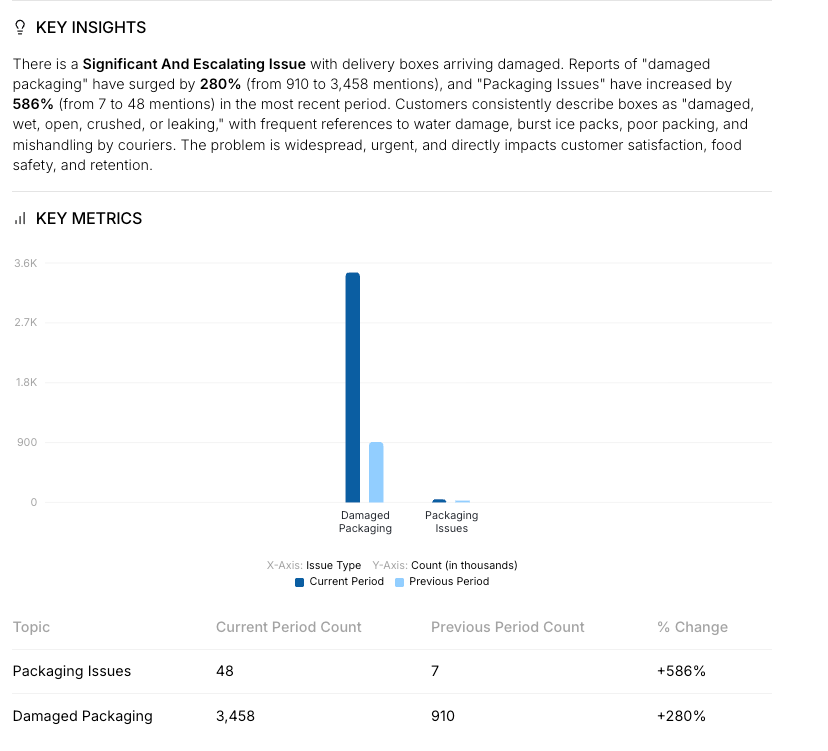
This moves your team from a generic problem ('NPS is down') to a set of specific, actionable tasks. You can understand why a score was given, even when the customer doesn't explicitly state it in their rating.
2. Turning support tickets into a quantitative dataset
Support tickets are a goldmine of unsolicited VoC data, but they are traditionally qualitative and overwhelming.
SentiSum applies consistent, AI-powered tags to 100% of your tickets, from emails and chats to phone call transcripts. This transforms thousands of individual conversations into a quantitative dataset.
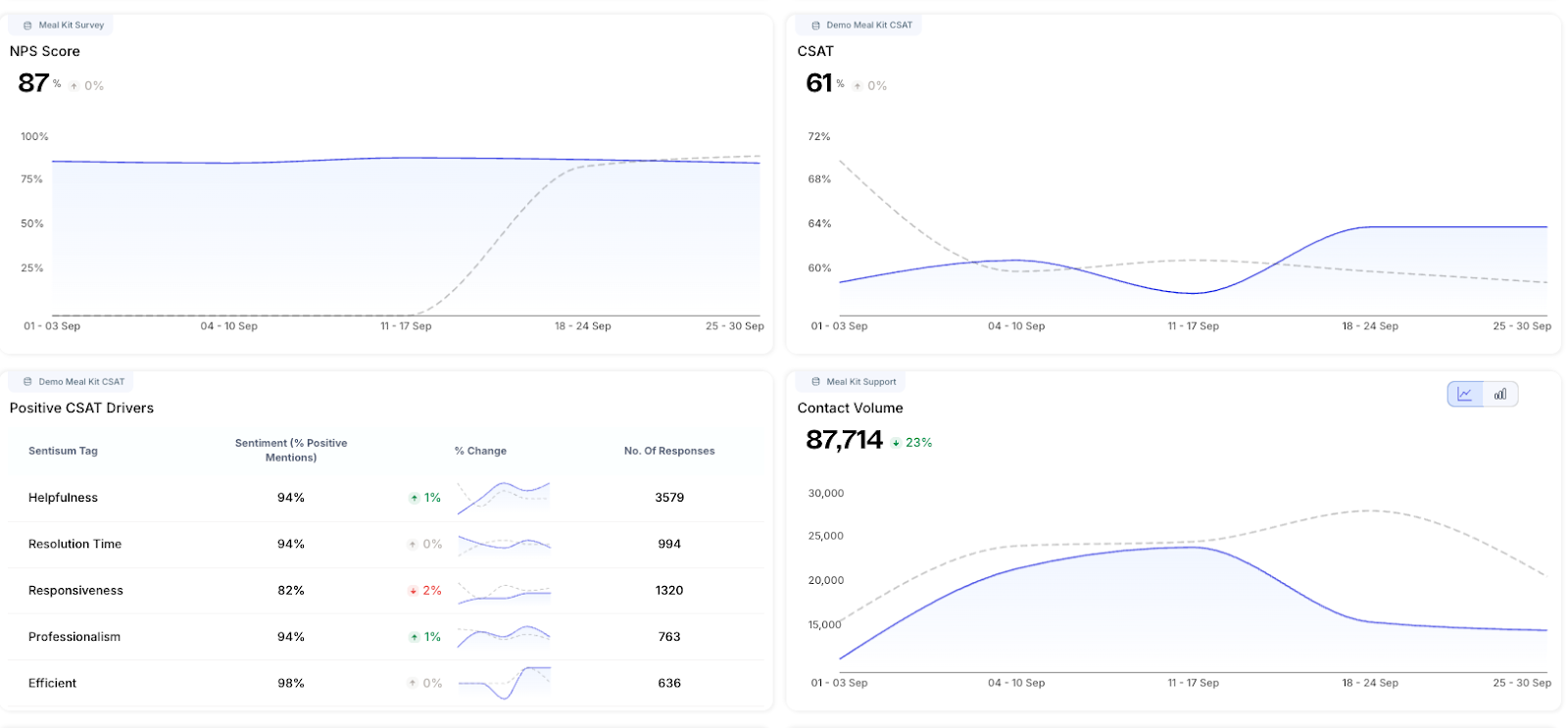
More importantly, you can correlate this quantitative dataset with other metrics. For instance, you can see that tickets tagged 'billing issue' have a 40% lower CSAT score than average, proving the direct financial and experiential impact of that specific problem.
3. Connecting customer sentiment to specific product features
Sentiment is a powerful VoC metric, but it's useless if it isn't tied to a specific topic. SentiSum’s customer sentiment analysis links negative, neutral, and positive sentiment directly to the features or issues customers are discussing.
This allows you to move beyond knowing that 'sentiment dropped 10% this month' to understanding that 'negative sentiment around the new notification feature increased by 10%.'
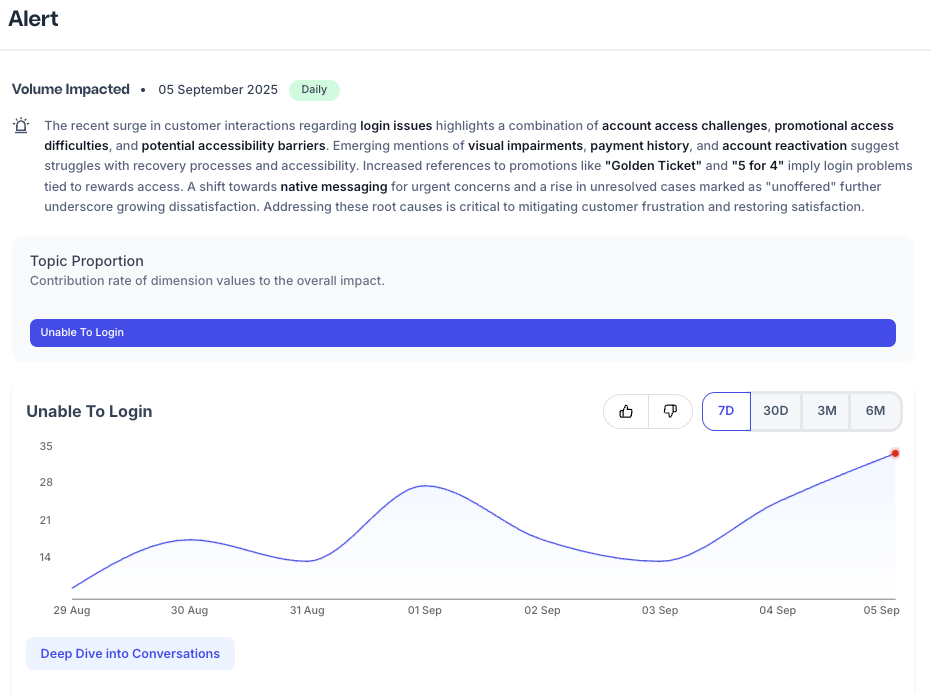
This precise connection gives product teams undeniable evidence about what is frustrating users and what is delighting them, directly informing the product roadmap and prioritization based on real customer impact.
4. Unifying feedback channels to find the root cause
Customers complain about the same issue in different places: a bug reported in a support ticket, a complaint in an App Store review, and a mention in a survey response. When these channels are siloed, you see three small, isolated problems.
SentiSum unifies all these conversations, allowing you to see the complete context.
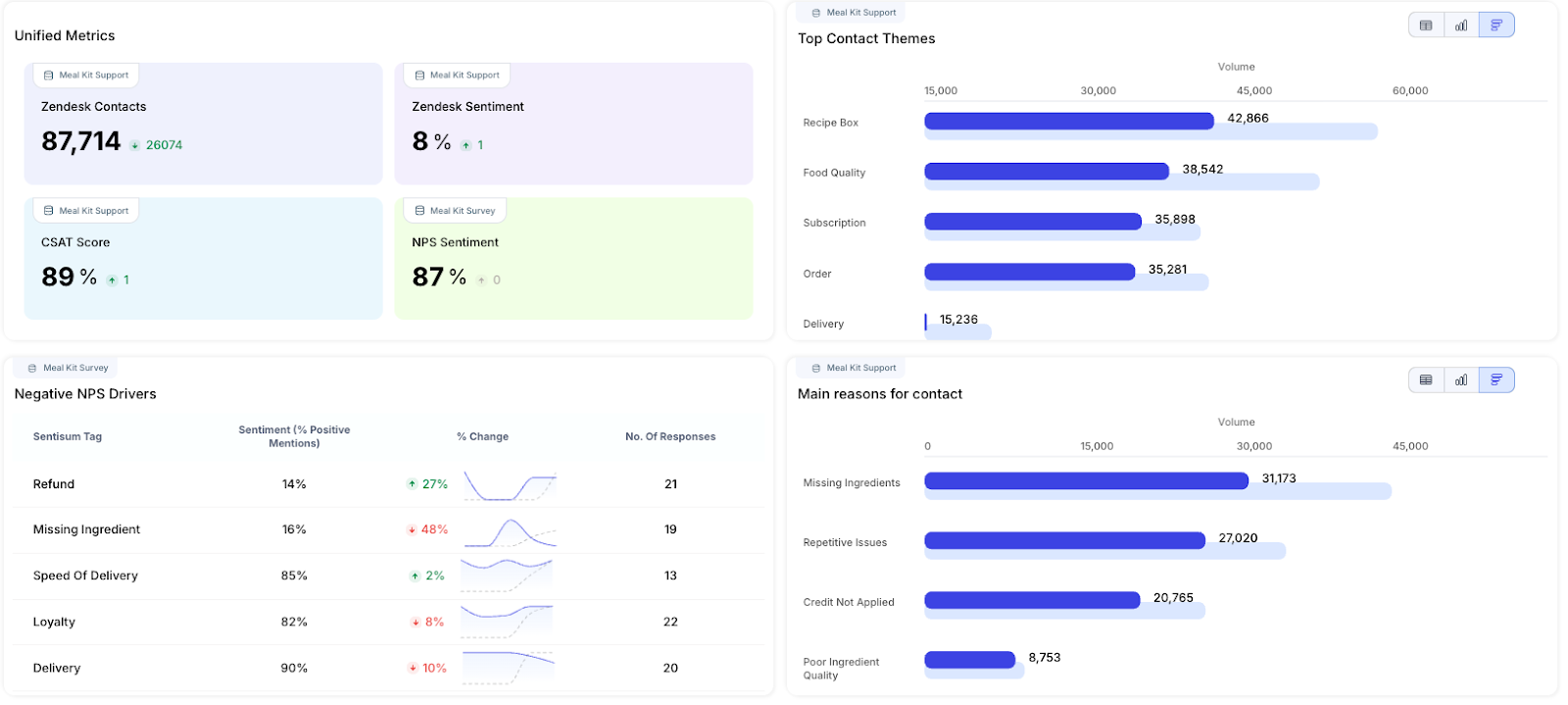
This reveals the true scale and urgency of a problem, moving it from a minor ticket driver to a company-wide priority that is actively harming retention and your public reputation.
5. Making VoC data accessible
The final barrier to measuring VoC is often accessibility. Complex dashboards and required SQL knowledge lock insights away from the teams that need them.
To solve this, SentiSum acts as a searchable brain for all your customer conversations.
Anyone in the company can ask a simple question like, 'What are the top reasons promoters are leaving us?' and get an immediate, data-backed answer.

This democratizes AI-driven VoC metrics, ensuring that decisions in marketing, product, and support are all informed by the same deep, qualitative understanding of the customer.
Best Practices for Tracking Voice of the Customer (VoC) Metrics
If your VoC metrics are already in place, some best practices mentioned below will show you how to push your program further and uncover deeper customer signals.
1. Close the loop with customers and internal teams
Measuring a metric is pointless if no one acts on the information. Establish a clear process for ‘closing the loop.’
- With customers: If a customer gives a low CSAT score, have a system to automatically alert a manager to personally follow up. This shows the customer they are heard and can rescue a potentially churning account.
- With internal teams: Route specific feedback directly to the teams that can fix the problem. Negative feedback about a checkout bug should go straight to the product and engineering teams, tagged with high priority.
2. Connect VoC data to business outcomes
Don't just report that NPS increased by 5 points. Show that the cohorts with the highest NPS also have a 20% higher Customer Lifetime Value.
Prove that by reducing CES in the support department, you decreased the support ticket volume by 15%, saving the company high operational costs. This connects customer experience directly to the bottom line.
3. Choose the right moments to listen
Survey fatigue is real. Bombarding customers with feedback requests after every minor interaction will lead to ignored surveys and frustrated customers.
So, be strategic.
- Trigger CSAT surveys after meaningful interactions, like a support resolution or a major onboarding milestone.
- Send relational NPS surveys only a few times a year.
- Use passive listening, like analyzing all support tickets and reviews, to gather feedback without adding any burden to the customer.
4. Move beyond dashboards to actionable intelligence
VoC dashboard metrics are useful for high-level reporting, but they often require manual digging to find insights. The future of VoC is proactive, intelligent systems that tell you what's wrong and suggest what to do next.
This is where an AI-native platform like SentiSum becomes indispensable. It acts as a customer intelligence layer across your entire organization, automatically surfacing root causes, so your teams spend less time analyzing and more time improving.
➡️ Read More
From Siloed Feedback to Instant Action: How JustPark Fixed Problems Before They Cost Thousands
📽️You can also watch the full video here:
SentiSum x JustPark | JustPark Turns Driver Feedback Into Instant CX Wins (Case Study)
Moving from Voice of the Customer (VoC) Metrics to Retention Measures
Most CX teams deeply study all their VoC metrics. But the real challenge is spotting the trigger behind a shift before it turns into churn.
Now, teams see the pattern late because feedback lives across channels, and no one has time to dig through it at speed. Kyo changes that. It connects every signal: surveys, chats, calls, reviews, and explains exactly why customers feel a certain way.
A drop in NPS becomes a set of clear themes you can act on the same day. That speed turns feedback into not just cleanup but prevention. If your goal is to protect loyalty by catching problems early, SentiSum gives you the visibility to do it with confidence.
Book a demo to turn your VoC dashboard metrics into retention measures.
Frequently Asked Questions
NPS, CSAT, CES, sentiment score, intent signals, and product-level feedback trends are some of the most important VoC metrics. These show how customers feel, what frustrates them, and what drives loyalty.
Track what customers say across calls, chats, emails, and surveys. Then map their feedback to touchpoints. Look for patterns: pain points, intent, tone, and the moments that create delight or friction.
Besides NPS, CSAT, CES, Sentiment, effort score, theme frequency, issue recurrence, and resolution quality are some key metrics for customer feedback analysis.
Sentisum’s intelligent AI agent, Kyo, analyzes 100% of qualitative feedback (tickets, reviews, calls) to find the root causes behind metric changes. This uncovers trends humans miss, turning data into precise action.
Churn prediction is identifying at-risk customers before they leave. You gauge it by tracking negative sentiment, repeated complaints, unresolved issues, and drops in satisfaction. Metrics like NPS, CSAT, exit surveys, and more can help you measure churn.
Explore Real Success Stories

Explore Success Stories


Talk to a Data Expert