.webp)




.webp)
.svg)


TL;DR
- CX Leaders: Detect churn signals than survey-based tools to prevent customer loss before revenue impact.
- AI-Native Platform: Analyze real-time support conversations instead of waiting for periodic survey responses.
- Cross-Functional Teams: Eliminate data silos with a unified feedback view across Support, Product, CS, and Marketing.
- Subscription Businesses: Reduce churn by increasing profits with retention-focused intelligence.
- Immediate Value: Deploy AI tagging with accuracy without manual taxonomy setup or training delays.
How many customers churned last quarter because support saw one problem, customer success (CS) saw another, and product saw a third, but nobody realized they were all connected?
Subscription businesses lose revenue due to this exact scenario.
Feedback scattered across tickets, surveys, reviews, and chats creates blind spots that hide churn drivers until it's too late to save the account.
A unified customer experience eliminates these blind spots. In fact, platforms like SentiSum bring all customer signals into one AI-native platform that detects patterns in real time.
Whereas traditional survey-based tools take weeks to surface issues, SentiSum spots churn risks , giving your teams the visibility and action items they need to prevent losses. In this guide, let’s take a closer look.
What Is a Unified Customer Experience?
A unified customer experience means your teams stop working from siloed platforms tools that hide churn signals until cancellations arrive. Support, CS, product, and marketing refer to a single real-time intelligence source instead of separate dashboards, where a critical billing bug appears as 'normal ticket volume' to support but 'usage decline' to CS.
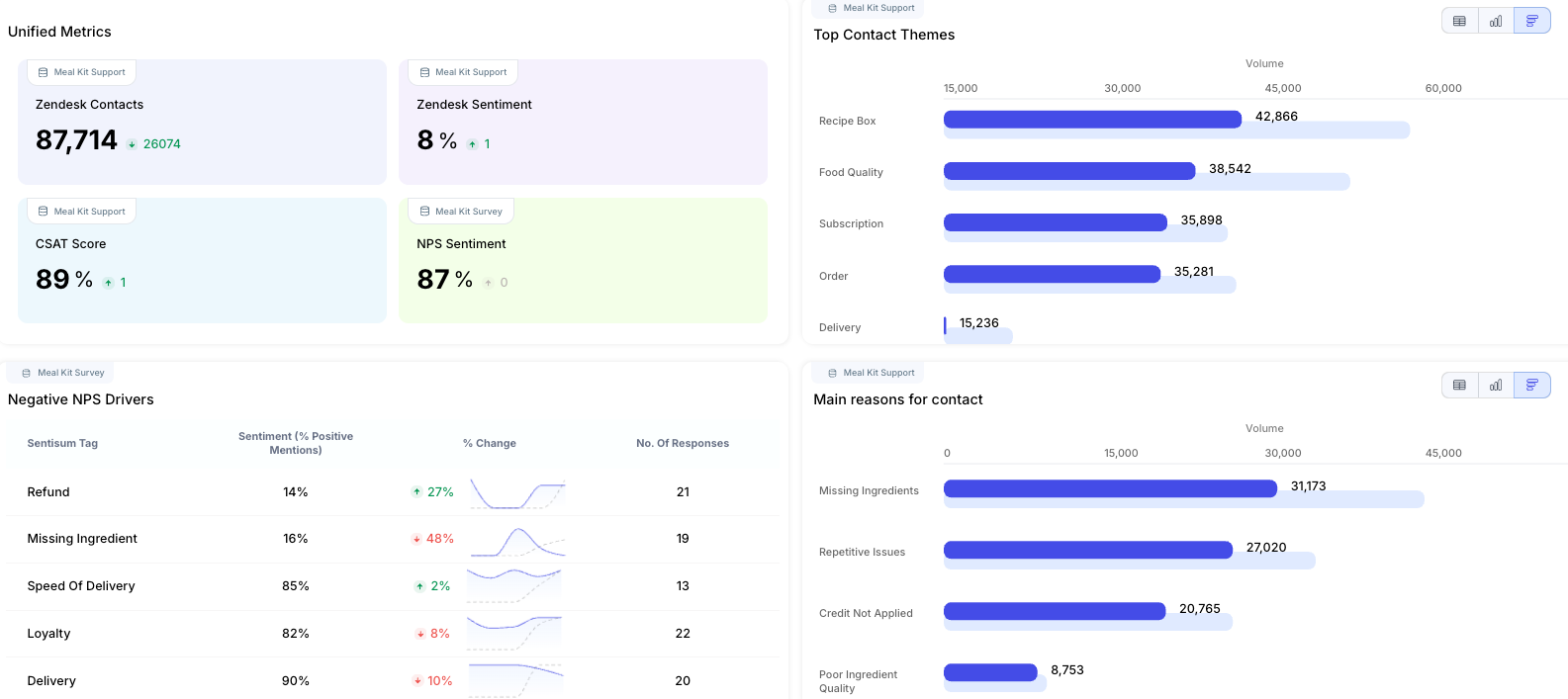
To put it simply, customer signals from tickets, reviews, surveys, social comments, and product interactions flow into one real-time intelligence layer.
The challenge for subscription businesses is what happens when it is missing. Churn rarely shows up as a single, obvious problem. It builds quietly.
- Support sees more “account issues.”
- Customer Success notices usage slipping.
- Product logs bug reports. Reviews turn negative.
Each signal looks manageable on its own, so no one escalates it. By the time these signals connect, customers have already cancelled, and revenue is gone.
In this context, a unified customer experience excels because it goes beyond better reporting and focuses on early detection. Connect signals while you can still intervene, so your teams can prevent churn instead of just measuring it after MRR walks out the door.
Why Subscription Businesses Need a Unified Customer Experience
In subscription businesses, churn is rarely caused by one visible failure. Revenue erodes when small, unresolved issues accumulate across the customer lifecycle without triggering ownership or urgency. When customer signals remain scattered across tools and teams, leadership loses both insight and time. A unified customer experience is not a reporting upgrade. It is a retention control system.
1. Manual analysis collapses at subscription scale
Insight delays become structural once a subscription business reaches scale. At 1,000 or more customer conversations per month, manual tagging, sampling, and reporting cannot keep pace with customer behaviour.
By the time analysts extract themes and leadership reviews dashboards, the window for intervention has already closed.
Traditional Voice of Customer programs worsen this gap. Survey-based tools rely on lagging indicators such as quarterly NPS or post-interaction feedback. These signals arrive weeks after the underlying problem surfaced and often after churn intent is already formed.
Subscription businesses do not lose revenue because they lack data. They lose revenue because insight arrives too late to act. Unified, AI-driven customer experience platforms analyze every conversation as it happens, across channels and teams. Patterns emerge in hours, not quarters, giving leadership time to course-correct before churn shows up in forecasts.
2. Siloed feedback hides churn risk until it is too late
Subscription companies generate customer signals continuously through support tickets, usage data, billing events, reviews, surveys, and customer success touchpoints. Each system captures a narrow view of the customer, but none shows how risk is building across the account.
Support teams monitor ticket volume and resolution metrics. Product teams prioritize bugs based on frequency and severity. Customer success tracks adoption ahead of renewals. Finance flags failed payments.
Leadership reviews churn and NRR after the fact. Every view is valid in isolation, but no one sees how these signals combine into early churn risk.
This is how churn hides in plain sight. A recurring billing issue increases support contacts but never crosses alert thresholds. Usage dips but does not yet trigger a renewal risk flag. A negative review is treated as anecdotal and never tied back to an active account.
With no shared context, no team owns escalation. By the time these signals converge in churn reports, the renewal conversation is lost.
A unified customer experience connects these signals in real time. It exposes how risk accumulates across touchpoints, allowing teams to intervene while customers are still engaged and retention outcomes can still change.
3. Teams fix visible symptoms instead of retention drivers
When customer feedback remains disconnected, teams respond to what they can see. Support reduces ticket volume. Product ships isolated fixes. Customer success pushes adoption campaigns. These actions may reduce noise in the short term but fail to address what is actually driving churn.
Without a unified view, teams treat symptoms independently. A spike in tickets looks like an operational issue. Declining sentiment appears to be a training problem. Rising churn is blamed on pricing or competition. The underlying cause, such as a broken workflow or billing experience affecting multiple segments, remains unresolved.
A unified customer experience platform links tickets, reviews, surveys, and behavioural signals into a single intelligence layer. Root causes become clear quickly, not through post-mortems but while customers are still active. This allows subscription leaders to prioritise fixes that protect renewals, expansions, and long-term lifetime value rather than reacting after loss of revenue.
How Artificial Intelligence Transforms Unified Customer Experience in Businesses
In industries like SaaS, retail, financial services, and e-commerce, customer expectations change quickly. AI turns raw feedback into clear, real-time insights that CX, product, support, operations, and marketing teams can act on immediately.
Real-Time Sentiment Analysis vs. Quarterly NPS
Traditional Voice of Customer programs rely heavily on quarterly or biannual NPS surveys. Even with strong response rates, insights arrive weeks after surveys close and months after the underlying issues begin. By that point, frustration has already affected renewals, expansion opportunities, and customer trust.
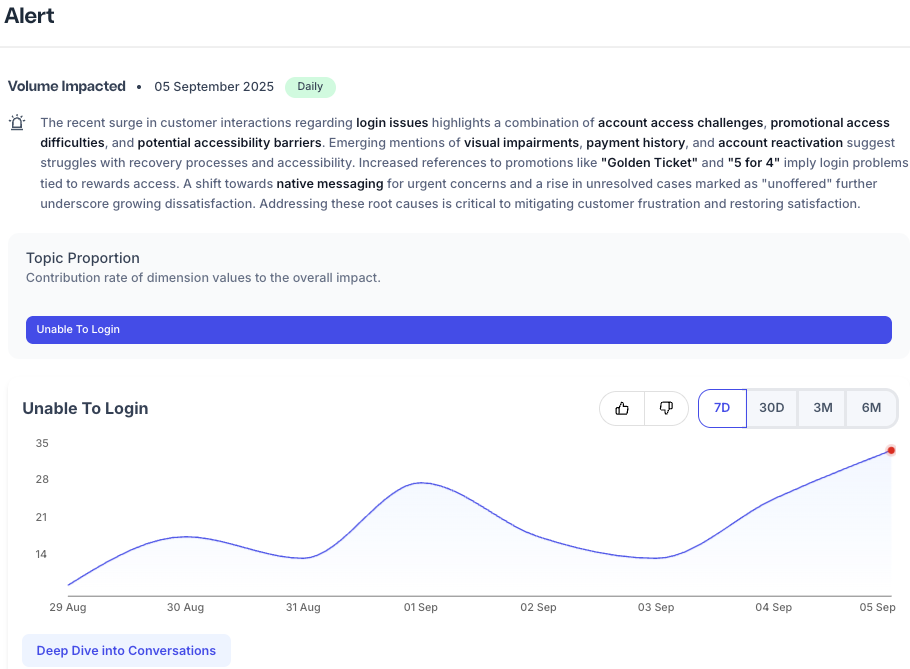
AI-native platforms analyze sentiment continuously across every customer interaction, including support tickets, chats, reviews, and open-text feedback. Negative shifts in sentiment surface within hours or days.
CX and support leaders can quickly see rising frustration around billing, login issues, performance slowdowns, or new releases while customers are still actively engaged. For subscription businesses, this timing directly affects revenue protection, turning early signals into actionable retention wins.
Continuous Churn Detection vs. Retrospective Reporting
Legacy CX reporting explains churn after customers have already left. Quarterly churn reports and cohort analyses offer clarity on what happened, but they provide no opportunity to save those accounts.
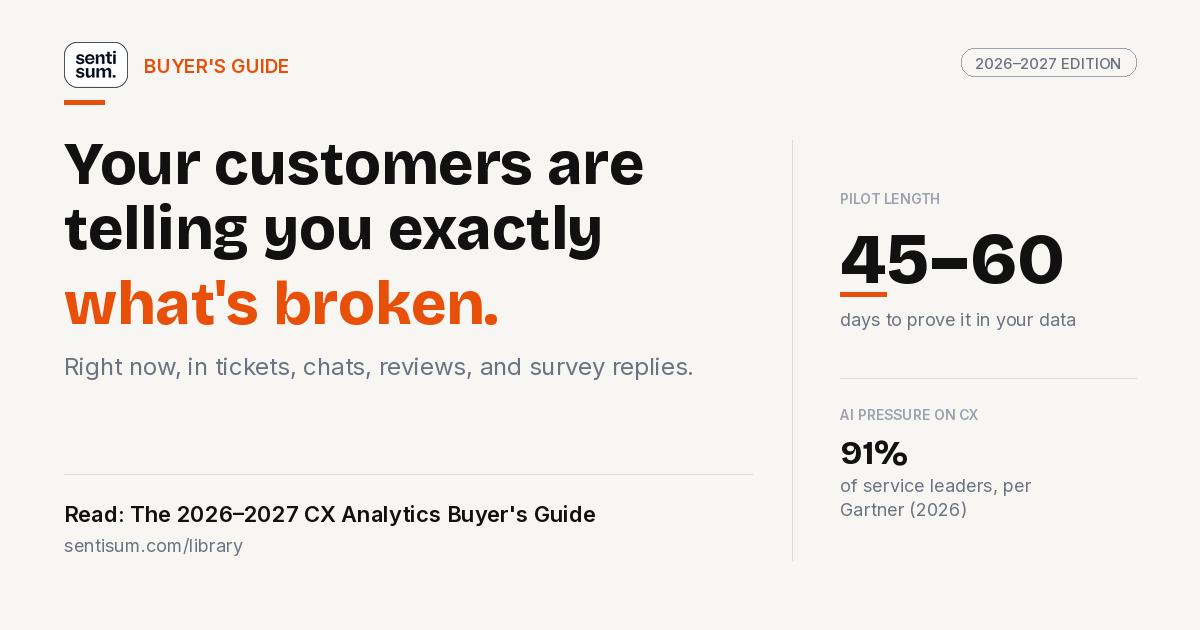
AI-native platforms detect churn risk while customers are still 45–60 days away from renewal. By analyzing sentiment trends, escalation patterns, language changes, and engagement behavior, these systems flag at-risk accounts early.
Customer success teams gain the time they need to intervene with targeted outreach, product fixes, or support escalation, transforming churn analysis into an active revenue protection strategy.
Automated Pattern Recognition vs. Manual Sampling
Manual analysis does not scale. Analysts typically review small samples of tickets or feedback due to time constraints, which causes early warning signs to go unnoticed until issues become widespread.
AI-native platforms analyze 100% of customer conversations in real time. Emerging patterns surface as soon as they form, even when only a small number of customers are affected.
A bug tied to a specific OS version, feature, or customer segment can be identified after a handful of interactions. Product and engineering teams can respond, reducing customer impact, support volume, and long-term churn risk.
Predictive Alerting vs. Reactive Metrics
Traditional CX teams rely on lagging indicators such as monthly churn reports, declining NPS, or missed revenue targets. These metrics confirm damage after it has already occurred.
AI-native systems continuously track deviations from normal behavior. Alerts trigger when sentiment drops, escalations spike, or complaint volumes rise above baseline. CX, operations, and product teams can act while issues are still contained.
It shifts customer experience from reactive problem-solving to proactive churn prevention.
Cross-Channel Correlation vs. Siloed Analysis
Customer signals are often fragmented across teams. Support analyzes tickets, product reviews, and usage data, marketing monitors public reviews, and CX tracks surveys. Critical connections are missed because no single team sees the full picture.
AI-native platforms automatically correlate signals across channels. Support complaints connect with usage drops, sentiment declines, and review feedback to reveal how issues impact customer behavior end to end.
Leaders gain one unified view of risk and opportunity, enabling alignment and clearer decision-making across teams.
How SentiSum Enables a Unified Customer Experience
SentiSum is AI-native and built for customer retention and churn prevention, not just reporting. Unlike survey-based or legacy analytics tools, it analyzes customer conversations in real time, making it up to 95% more than survey-led CX platforms.
This gives CX, product, support, operations, and marketing teams immediate visibility into what’s driving dissatisfaction, churn, and loyalty across every touchpoint.
By unifying feedback from tickets, reviews, chats, surveys, and in-app conversations, SentiSum enables teams to act on live customer signals rather than static reports.
1. Unified feedback ingestion across channels
SentiSum solves it by consolidating feedback from every channel into a single Voice of the Customer (VoC) dashboard, including:
- Support tickets from Zendesk, Intercom, and Freshdesk
- CSAT, NPS, and CES surveys
- App store reviews, G2, and Trustpilot feedback
- Social media comments and customer posts
- Chat and email conversations
This all-in-one view removes data silos and gives CX teams, product managers, and analysts the full context needed to understand customer pain points, feature gaps, and sentiment trends across the entire experience.
2. Kyo: The AI agent for in-depth customer insights
Every team struggles with the same bottleneck: there’s too much feedback and not enough time to interpret it. Kyo, SentiSum’s AI agent, eliminates the problem.
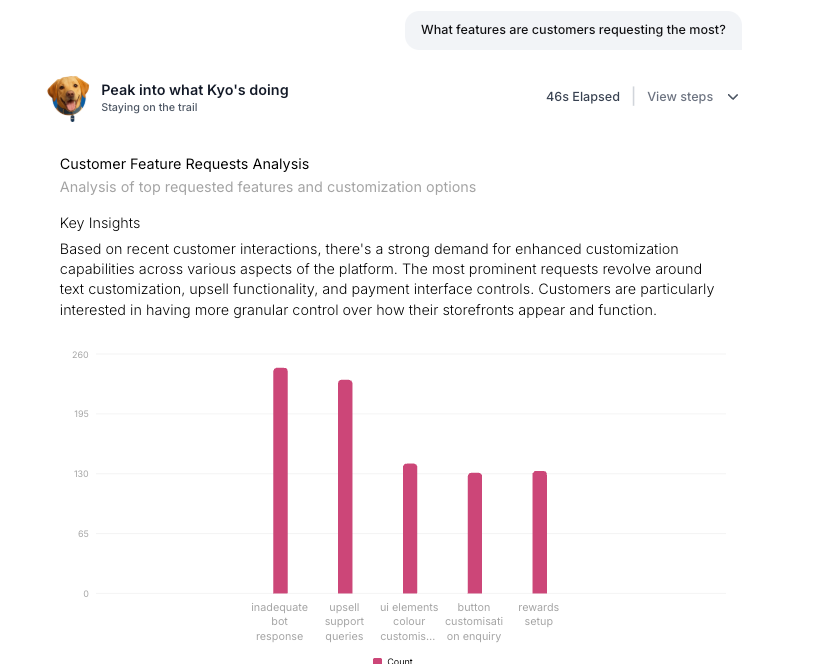
Kyo operates through three specialized AI agents, each designed to support a critical CX outcome:
- Early Warning Agent: Detects anomalies and churn signals as they emerge, allowing teams to intervene before issues escalate
- Insights Agent: Analyzes themes, trends, and root causes across all feedback to explain why customers are frustrated, stuck, or at risk
Together, these agents ensure that insights are not only surfaced quickly but also delivered in a way each team can act on immediately.
All in all, Kyo helps your teams by:
- Interpreting conversations instantly, without manual reading
- Summarizing themes and highlighting emerging issues
- Identifying anomalies the moment they appear
- Recommending next-best actions for CX, Product, and Support
- Keeping Marketing and Leadership aligned with clear, directional insights
- Freeing analysts from hours of manual tagging and reporting
3. Predictive churn detection
Customer Success teams and retention-focused leaders need early warning, not post-mortem analysis. SentiSum’s AI models identify early churn indicators long before customers disengage.
The platform detects churn risks using signals like:
- Negative or declining sentiment across interactions
- Repeated complaints about the same issue
- Frustration with specific features or updates
- Slow or unresolved support experiences
- Sharp declines in usage or engagement
Teams receive actionable alerts to intervene early with personalized outreach, product fixes, or proactive communication.
4. Automated ticket tagging & sentiment clustering
Support teams and CX analysts often waste hours manually tagging tickets, which leads to inconsistent categories and unreliable reports. SentiSum removes that burden with AI-driven tagging and clustering.
SentiSum automatically:
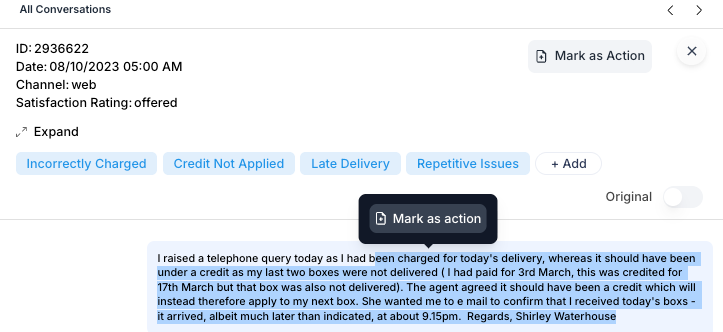
- Tags every ticket accurately
- Group similar issues together
- Detects sentiment behind each interaction
- Routes tickets to the right team or specialist
- Generates clean data for reporting and prioritization
5. Trend detection and intelligent alerts
Marketing teams, product managers, and CX leaders can’t wait for monthly reports to understand what’s changing. SentiSum surfaces issues in real time.
It detects:
- Sudden spikes in complaints
- New bugs or feature issues
- Operational disruptions (delivery delays, outages, payment failures)
- Fraud or billing anomalies
- Negative sentiment clusters that could damage brand perception
These insights ensure cross-functional teams stay aligned and respond before issues escalate into churn, negative reviews, or social backlash.
The Future of Customer Experience Is Unified and AI-Powered
For subscription businesses, a fragmented customer experience leads to missed churn signals, slower responses, and lost recurring revenue. Customers compare experiences across brands, and teams that rely on disconnected feedback tools fall behind competitors who act on insights in real time.
A unified, AI-powered CX approach changes this. When all customer feedback is analysed together, teams can detect churn risks earlier, fix high-impact issues, and improve retention at scale. The result is measurable ROI: lower churn, stronger loyalty, and better lifetime value.
SentiSum makes this possible by unifying customer feedback, applying AI to reveal root causes, and activating insights through Kyo so teams move from reacting to problems to preventing them.
If reducing churn and protecting revenue matter, it’s time to use SentiSum
Book a demo to see how SentiSum transforms your customer experience.
Frequently Asked Questions
A unified customer experience connects all customer interactions and feedback into one system, giving teams a single, consistent view of customer needs. It aligns Support, Product, CX, Operations, and Marketing around shared insights to deliver seamless, personalized experiences across every channel.
Create a unified customer experience by centralizing feedback from all channels, integrating systems, and using AI to analyze conversations in real time. Ensure every team, Support, CX, Product, and Marketing works from shared insights, enabling decisions, consistent communication, and proactive experience improvements across the whole customer journey.
Unifying customer feedback removes data silos, reveals root causes, and provides real-time visibility into customer sentiment and issues. Teams can prioritize more effectively, reduce churn, improve product decisions, enhance satisfaction, and deliver consistent experiences across all touchpoints by using a single accurate source of customer truth.
AI improves CX management by analyzing feedback instantly, detecting trends, predicting churn, surfacing anomalies, and automating ticket tagging. It helps teams understand customer needs, resolve issues earlier, personalize engagement, and shift from reactive problem-solving to data-driven, omnichannel customer experience improvement at scale.
Tools like unified customer experience platforms, VoC systems, AI-powered real-time feedback analysis tools, customer feedback management systems, and omnichannel insight dashboards help create unified CX. These tools centralize data, automate analysis, reveal trends, and give teams one shared view of customer behavior and sentiment.
Explore Real Success Stories

Explore Success Stories


Talk to a Data Expert