Customer Sentiment

Omnichannel Customer Feedback: How to Optimize CX and Retention with Real-Time AI Insights

Omnichannel Customer Feedback: How to Optimize CX and Retention with Real-Time AI Insights
Marketing Director at SentiSum
LinkedIn icon
Omnichannel Customer Feedback: How to Optimize CX and Retention with Real-Time AI Insights

Your legacy dashboard is a liability if it shows you a solid NPS score but fails to flag the ten tweets calling out a product failure.

It is the reality of siloed feedback. 

One team sees a high satisfaction score, while another tackles relentless complaints that they cannot connect to the broader narrative. As a result, critical customer experience (CX)decisions are made with incomplete, outdated information. 

This is a direct threat to retention and business revenue. 

Omnichannel customer feedback solves the problem. It integrates every customer interaction point into a single, coherent view. Breaking down data walls, it reveals the complete story behind important VoC metrics and other numbers. 

This guide details why siloed data cripples decision-making and how an omnichannel customer feedback system like SentiSum solves it.

Why Does Siloed Feedback Break Omnichannel CX?

When feedback is locked away in channel-specific tools, teams misalign, preventable churn escalates, and customer experience becomes inconsistent. This fragmentation directly blocks unified customer feedback across channels, which is needed to understand how issues compound across the journey.

Here are the direct operational costs of these critical failures: 

1. Misinterpretation of Feedback 

Consider a customer who tweets a frustration after a difficult support call. Viewed in isolation, the social team sees a brand reputation issue, while the support manager sees a technically "resolved" ticket. 

Without connecting these two signals, the organization misses the reality: a recurring product bug is driving users to vent publicly, and the root cause remains hidden while teams celebrate partial wins.

2. Invisible Churn Signals

Churn is rarely a single event; it is a process that spans multiple touchpoints. A customer might leave a negative survey response, ask support for a workaround the next day, and later ask sales about competitor pricing. 

Siloed systems treat these as unrelated incidents, missing the compounding signal. When the cancellation arrives, the window to save the account has already closed.

3. Inconsistent CX

Silos guarantee inconsistent experiences because teams operate on different versions of the truth. As a case in point, marketing teams might see positive engagement on a new feature campaign, unaware that the support team is simultaneously drowning in tickets about that very feature crashing. 

This disconnect burns your acquisition budget and erodes trust, as the company effectively pays to acquire customers only to disappoint them with a broken experience.

Now, most teams may immediately think that dashboards may be the answer to the ‘siloed feedback’ problem. 

It’s not. Why do we say so?

👀 Did you know?

Most brands still don’t see the full customer picture. Even after years of investment, only 13% of companies (per a survey) can carry customer data, history, and context smoothly across every interaction and channel, making true omnichannel personalization rare.

Why ‘More Dashboards’ Don’t Fix Omnichannel Feedback Problems

The instinctive response to data fragmentation is to build another dashboard. But dashboards, in traditional setups, fail to drive action because they are built for consumption, not for execution. Here’s why:

Time-consuming and Retrospective Analysis

Most dashboards are fed by data that requires manual tagging, inconsistent categorization, and lengthy aggregation. The process is slow and inherently flawed. 

Teams have to spend days tagging tickets or parsing surveys, leading to insights that are already outdated. 

A static report showing last month's top complaint is useless when a new, critical issue erupted yesterday on social media. Most of these dashboards cannot support real-time omnichannel feedback analysis at the speed modern CX teams need.

Lack of Leadership Alignment

When the support director’s dashboard shows ticket resolution times are improving, but the customer success director’s dashboard shows NPS is plummeting, there is no single source of truth to reconcile the contradiction. 

CX leaders would agree that the goal is not more dashboards; it is immediate, accurate answers and clear next steps embedded directly into team workflows. 

Many teams and businesses have already moved beyond lagging dashboards to omnichannel feedback experience optimization. Let’s go over how. 

How High-Performing CX Teams Use Omnichannel Feedback Differently

Leading organizations have moved beyond simply collecting feedback. Teams are now unifying data, analyzing real sentiment, and focusing beyond tickets and plain insights. 

Here’s a breakdown of the approach: 

1. Unify Feedback Before Analyzing It

High-performing teams start by cracking down on data silos. They integrate every feedback channel: support tickets, NPS/CSAT surveys, app store reviews, social media comments, and call transcripts into a single platform. 

The approach enables customer feedback management in omnichannel environments to shift from just being reactive check-ins. 

2. Focus on Directional Trends Instead of Isolated Tickets

CX teams are more focused on trends and not just tickets. The focus is less on a single angry tweet and more on a rising trend of complaints about a specific feature. 

By analyzing aggregated sentiment and topic data in real-time, these teams are successfully spotting macro shifts, allowing them to be proactive. 

So, if 'checkout errors' as a topic sees a 200% sentiment negativity spike in 24 hours, these teams can investigate and resolve a critical revenue-blocking bug before it escalates.

3. Connect Sentiment to Journey Stages and Outcomes

Many successful product teams are mapping omnichannel VoC strategies to specific stages of the customer journey (onboarding, adoption, renewal).

For example, they can see that negative sentiment in the 'activation' stage correlates strongly with 90-day churn. They then focus improvement efforts precisely there, directly impacting retention metrics.

4. Shift from Insight Consumption to Action Execution

For successful CX teams, the cycle doesn’t end with a report. Insights automatically trigger workflows. A pattern of complaints about a delivery partner is routed directly to the logistics team’s Slack channel. 

Confused questions about a new feature auto-create a task for the documentation team. 

To take efficiency a notch higher and scale faster, many of these teams are also successfully deploying AI at every stage and department. Let’s break it down. 

How AI and Omnichannel CX are Reshaping Core Customer Experience Roles

Constantly changing customer demands and communication channels are elevating the importance of omnichannel CX analysis with AI for CX leaders, support leaders, and product teams. This is how each role is reshaping: 

CX Leaders

The role is shifting from retroactive reporting to real-time orchestration. Instead of just presenting monthly CSAT decks, modern CX leaders use AI to architect connected journeys across every touchpoint. 

With an AI-powered omnichannel insights strategy, they synthesize data into immediate action plans—for example, identifying a support trend and directing product teams to adjust a feature before it damages the wider brand perception

Customer Success

For Customer Success teams, AI transforms the workflow from reactive firefighting to proactive prevention. Rather than waiting for a renewal conversation to discover dissatisfaction, AI analyzes usage patterns and community sentiment to flag churn risks early. 

Additionally, success managers receive alerts to engage customers with hyper-personalized guidance, preventing issues before they ever become escalations.

Support Leaders

Support leadership is moving beyond managing ticket queues to optimizing for deflection and accuracy. The new mandate is training AI models on rich omnichannel data (chat transcripts, call logs, and video sessions) to improve service quality. 

It shifts the focus from "how many tickets did we close?" to "how well are we automating the routine to focus on the complex?"

Product Teams

For Product Teams, AI is bringing a continuous stream of prioritized, contextual feedback. 

An effective customer insights strategy feeds them unified data: feature requests from support, usage patterns from success, and sentiment from social channels. 

This allows for decisions based on the voice of the customer across omnichannel platforms and channels, not just isolated feedback points.

If your team is looking to deploy the power of AI and omnichannel customer feedback together, SentiSum can be the perfect solution. 

Best practices to improve CX in 2026

How SentiSum Solves Omnichannel Feedback at the Workflow Level

AI-native VoC platform SentiSum solves scattered feedback through its unified dashboard, AI agent Kyo, and deep data unification. It delivers precise, contextual insights, enabling teams to act on root causes, not just random tickets and data points. 

Let’s go over SentiSum’s advanced features and what they can do for you: 

Dashboards Designed for Answers and Actions Over Reports

SentiSum’s interface is fundamentally different. Instead of requiring you to build reports, it is built to answer questions. 
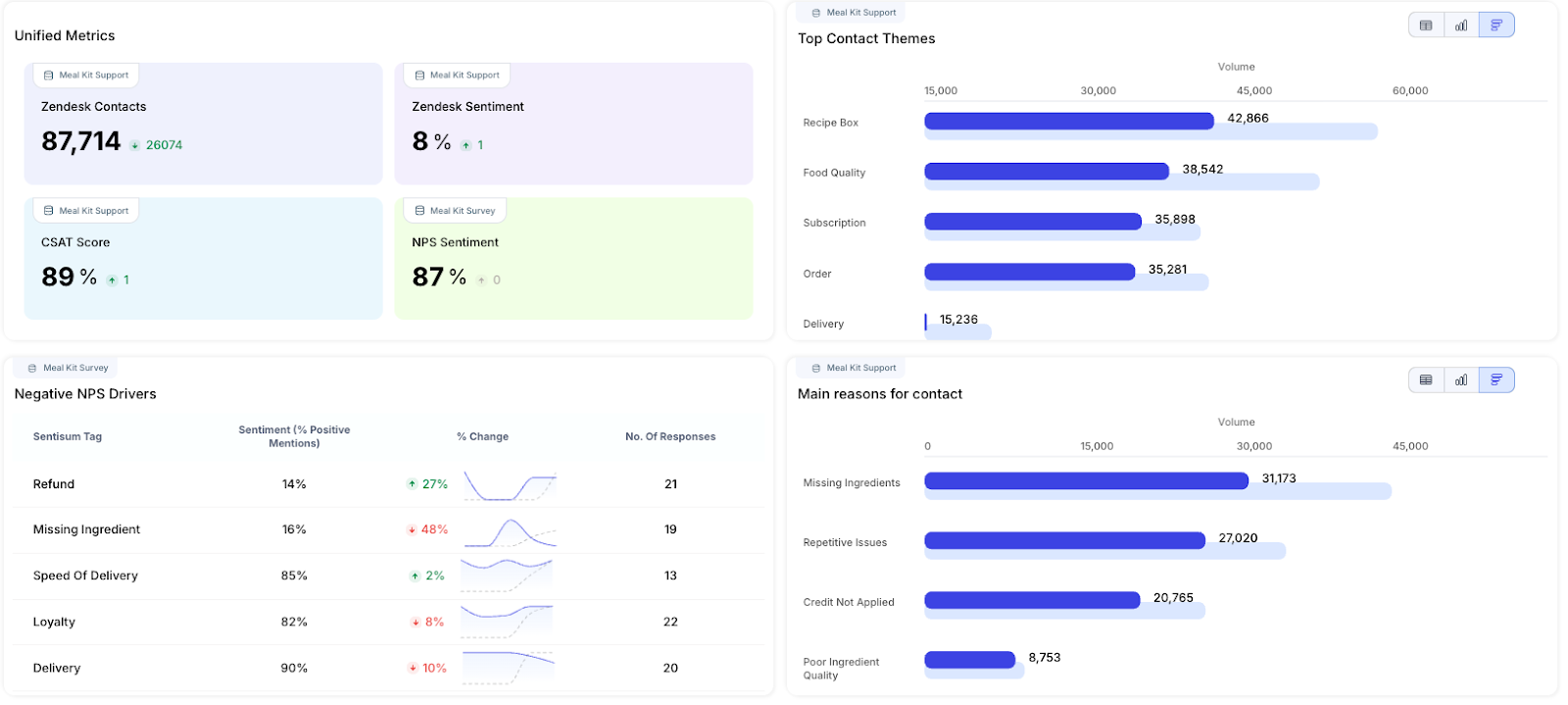
SentiSum dashboard integrating all key VoC metrics and customer feedback
Consolidate every voice of customer data point into one view

You see the drivers of CX metrics, such as CSAT and NPS, in real-time, with clear and prioritized root causes. 

The focus here is on surfacing the 'why' and recommending the 'what next,' reducing time-to-insight from weeks to minutes.

Kyo, the AI Engine: Your Continuous Signal Interpreter

Kyo, SentiSum’s intelligent AI Engine, is domain-trained and works continuously in the background. While generic tools wrap ChatGPT and guess at meaning, Kyo is purpose-built for Voice of the Customer (VoC) analysis. 

It acts as an autonomous Early Warning Agent that monitors your support, social, and survey channels 24/7, detecting "pre-churn" signals with enterprise-grade accuracy.

Kyo also summarizes key conversation themes, highlights anomalies as they emerge (such as a rapid increase in login errors), and supports omnichannel analytics in customer feedback by learning from patterns over time.

For each issue, Kyo provides a root cause explanation with direct evidence from customer conversations. Most importantly, the AI agent surfaces the next recommended action, like 'notify the product team about the login error spike', directly in tools like Slack or Microsoft Teams. 
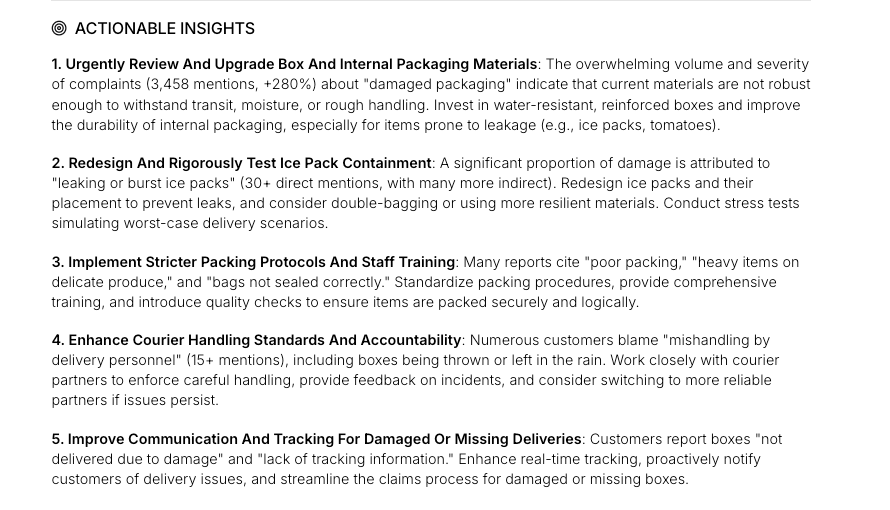
Kyo AI agent breaking insights into a proper action strategy 
Ask Kyo, SentiSum's intelligent AI engine, for actionable insights on any feedback trend

It shifts the team’s effort from manual analysis to strategic action, eliminating analysis paralysis.

Unifying Feedback from Tickets, Surveys, Reviews, Social, and Calls

SentiSum provides a true single source of truth by integrating with 50+ platforms, including Zendesk, Intercom, Dixa, Salesforce, Trustpilot, Apple Store, and call centers via speech analytics. 
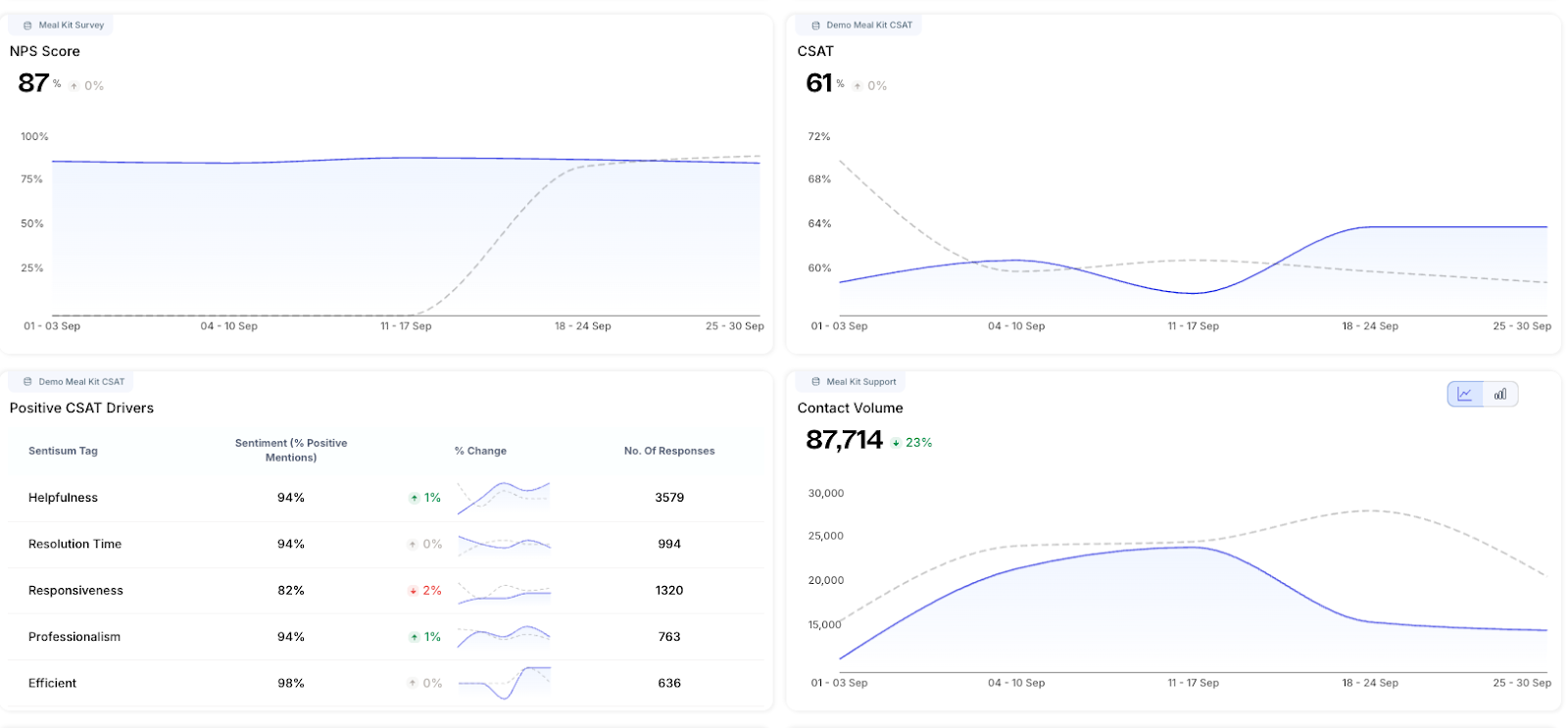
SentiSum interface showing a unified display of all important voice of customer metrics
Identify top priorities and emerging issues instantly on SentiSum

Every piece of feedback is ingested, transcribed (in the case of calls), and analyzed cohesively. This eliminates blind spots and ensures that the insights you act on reflect the complete customer voice.

Insights that Surface Inside Daily CX and Support Workflows

SentiSum pushes intelligence directly into the platforms your teams use daily. Negative reviews can auto-create prioritized tickets in Zendesk. Rising customer pain points can be alerted in a dedicated Slack channel. 
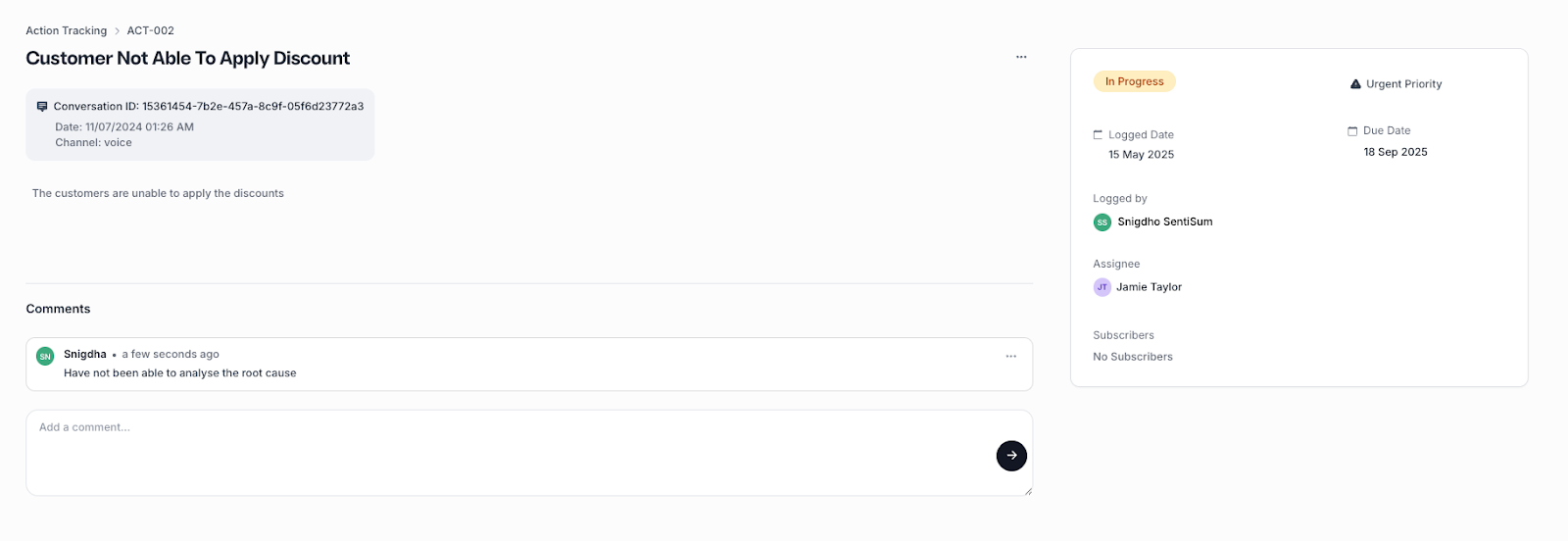
SentiSum analyzing the transcript and sentiment of a customer service call
Understand the full story behind every customer interaction with SentiSum

This ensures that the right person gets the right insight at the right moment, within their existing workflow.

➡️ Read More

From Siloed Feedback to Instant Action: How JustPark Fixed Problems Before They Cost Thousands
📽️You can also watch the full video here:
SentiSum x JustPark | JustPark Turns Driver Feedback Into Instant CX Wins (Case Study)

Case Study

Butternut Box , a direct-to-consumer pet food company, used SentiSum to transform its customer feedback analysis. Before, its Customer Love team manually managed over 200 tags in its Dixa support software, which was time-consuming and failed to deliver clear priorities.

By integrating SentiSum, the team automated tagging, reduced wrap-up time, and gained a unified view of feedback across channels. This allowed them to identify root causes of issues, such as value-for-money concerns, before they impacted NPS scores or triggered negative reviews.

Leadership now uses these precise insights to retain promoters, convert passive customers, and reduce churn—moving NPS from a vague metric to a direct lever for revenue retention and proactive experience management.

If you wish to compare SentiSum’s advanced features against other VoC platforms, let’s focus on how you should evaluate the right platform for your business needs. 

How to Evaluate an Omnichannel Feedback Platform for CX Optimization

Optimizing omnichannel experience with customer feedback is not an easy task. Thus, when you evaluate a platform, consider features such as the ability to unify data, provide in-depth analysis, expand on root causes, and produce actionable insights. 

Let's walk through how this works:

1. Ability to Unify Unstructured Feedback Across Channels

The platform must seamlessly integrate with all your key feedback sources, including help desks, survey tools, review sites, social media, and call centers. 

Critically, it must deeply analyze unstructured data from each, not just aggregate scores. Ask for a demonstration using your own data channels to see the unification in action.

2. Real-Time Analysis Instead of Delayed Reporting

Evaluate the latency of insights. Can it detect and alert you to a sentiment shift today, not next week? 

The platform should provide live dashboards and proactive alerts, not just scheduled reports. The speed of insight directly correlates to your ability to retain at-risk customers.

3. Explainability of AI Insights And Root Causes

Any AI can generate a topic tag. You need a platform that explains its conclusions. How did it determine that 'payment failures' are the root cause of a churn spike? It should provide evidence, like relevant verbatim and trend data. 

4. Workflow Integration

The ultimate test is whether insights lead to action. Assess how easily the platform integrates with your operational tools like Jira, Slack, or your CRM. Can it trigger automated workflows? 

Your goal is to close the loop from feedback to fix, and the platform should be the engine that drives that cycle.

AI-native VoC platform SentiSum is that engine. 

Why SentiSum Fits Modern Omnichannel CX and Retention Strategies

Manual sampling misses critical signals, leaving predictive churn models underfed and inaccurate. Your team cannot manually parse thousands of daily interactions to find the root cause patterns. But SentiSum can. 

The platform utilizes a continuously learning AI model to analyze all omnichannel data, including tickets, surveys, calls, and reviews. It further performs granular intent and sentiment analysis at scale, identifying precise risk factors like recurring product errors or support escalation paths. 

These machine-generated drivers integrate directly into tools like Zendesk, Slack, and Jira, empowering teams to act before issues escalate. This creates a cohesive CX engine where every team operates from the same intelligence. 

Looking to strengthen your retention and close the insight gap? 

Book a personalized demo today.

Join a community of 2139+ customer-focused professionals and receive bi-weekly articles, podcasts, webinars, and more!

Trending articles

Customer Sentiment

Omnichannel Customer Feedback: How to Optimize CX and Retention with Real-Time AI Insights

January 27, 2026
Stephen Christou
Marketing Director at SentiSum
In this article
Understand your customer’s problems and get actionable insights
Learn more

Is your AI accurate, or am I getting sold snake oil?

The accuracy of every NLP software depends on the context. Some industries and organisations have very complex issues, some are easier to understand.

Our technology surfaces more granular insights and is very accurate compared to (1) customer service agents, (2) built-in keyword tagging tools, (3) other providers who use more generic AI models or ask you to build a taxonomy yourself.

We build you a customised taxonomy and maintain it continuously with the help of our dedicated data scientists. That means the accuracy of your tags are not dependent on the work you put in.

Either way, we recommend you start a free trial. Included in the trial is historical analysis of your data—more than enough for you to prove it works.

Your legacy dashboard is a liability if it shows you a solid NPS score but fails to flag the ten tweets calling out a product failure.

It is the reality of siloed feedback. 

One team sees a high satisfaction score, while another tackles relentless complaints that they cannot connect to the broader narrative. As a result, critical customer experience (CX)decisions are made with incomplete, outdated information. 

This is a direct threat to retention and business revenue. 

Omnichannel customer feedback solves the problem. It integrates every customer interaction point into a single, coherent view. Breaking down data walls, it reveals the complete story behind important VoC metrics and other numbers. 

This guide details why siloed data cripples decision-making and how an omnichannel customer feedback system like SentiSum solves it.

Why Does Siloed Feedback Break Omnichannel CX?

When feedback is locked away in channel-specific tools, teams misalign, preventable churn escalates, and customer experience becomes inconsistent. This fragmentation directly blocks unified customer feedback across channels, which is needed to understand how issues compound across the journey.

Here are the direct operational costs of these critical failures: 

1. Misinterpretation of Feedback 

Consider a customer who tweets a frustration after a difficult support call. Viewed in isolation, the social team sees a brand reputation issue, while the support manager sees a technically "resolved" ticket. 

Without connecting these two signals, the organization misses the reality: a recurring product bug is driving users to vent publicly, and the root cause remains hidden while teams celebrate partial wins.

2. Invisible Churn Signals

Churn is rarely a single event; it is a process that spans multiple touchpoints. A customer might leave a negative survey response, ask support for a workaround the next day, and later ask sales about competitor pricing. 

Siloed systems treat these as unrelated incidents, missing the compounding signal. When the cancellation arrives, the window to save the account has already closed.

3. Inconsistent CX

Silos guarantee inconsistent experiences because teams operate on different versions of the truth. As a case in point, marketing teams might see positive engagement on a new feature campaign, unaware that the support team is simultaneously drowning in tickets about that very feature crashing. 

This disconnect burns your acquisition budget and erodes trust, as the company effectively pays to acquire customers only to disappoint them with a broken experience.

Now, most teams may immediately think that dashboards may be the answer to the ‘siloed feedback’ problem. 

It’s not. Why do we say so?

👀 Did you know?

Most brands still don’t see the full customer picture. Even after years of investment, only 13% of companies (per a survey) can carry customer data, history, and context smoothly across every interaction and channel, making true omnichannel personalization rare.

Why ‘More Dashboards’ Don’t Fix Omnichannel Feedback Problems

The instinctive response to data fragmentation is to build another dashboard. But dashboards, in traditional setups, fail to drive action because they are built for consumption, not for execution. Here’s why:

Time-consuming and Retrospective Analysis

Most dashboards are fed by data that requires manual tagging, inconsistent categorization, and lengthy aggregation. The process is slow and inherently flawed. 

Teams have to spend days tagging tickets or parsing surveys, leading to insights that are already outdated. 

A static report showing last month's top complaint is useless when a new, critical issue erupted yesterday on social media. Most of these dashboards cannot support real-time omnichannel feedback analysis at the speed modern CX teams need.

Lack of Leadership Alignment

When the support director’s dashboard shows ticket resolution times are improving, but the customer success director’s dashboard shows NPS is plummeting, there is no single source of truth to reconcile the contradiction. 

CX leaders would agree that the goal is not more dashboards; it is immediate, accurate answers and clear next steps embedded directly into team workflows. 

Many teams and businesses have already moved beyond lagging dashboards to omnichannel feedback experience optimization. Let’s go over how. 

How High-Performing CX Teams Use Omnichannel Feedback Differently

Leading organizations have moved beyond simply collecting feedback. Teams are now unifying data, analyzing real sentiment, and focusing beyond tickets and plain insights. 

Here’s a breakdown of the approach: 

1. Unify Feedback Before Analyzing It

High-performing teams start by cracking down on data silos. They integrate every feedback channel: support tickets, NPS/CSAT surveys, app store reviews, social media comments, and call transcripts into a single platform. 

The approach enables customer feedback management in omnichannel environments to shift from just being reactive check-ins. 

2. Focus on Directional Trends Instead of Isolated Tickets

CX teams are more focused on trends and not just tickets. The focus is less on a single angry tweet and more on a rising trend of complaints about a specific feature. 

By analyzing aggregated sentiment and topic data in real-time, these teams are successfully spotting macro shifts, allowing them to be proactive. 

So, if 'checkout errors' as a topic sees a 200% sentiment negativity spike in 24 hours, these teams can investigate and resolve a critical revenue-blocking bug before it escalates.

3. Connect Sentiment to Journey Stages and Outcomes

Many successful product teams are mapping omnichannel VoC strategies to specific stages of the customer journey (onboarding, adoption, renewal).

For example, they can see that negative sentiment in the 'activation' stage correlates strongly with 90-day churn. They then focus improvement efforts precisely there, directly impacting retention metrics.

4. Shift from Insight Consumption to Action Execution

For successful CX teams, the cycle doesn’t end with a report. Insights automatically trigger workflows. A pattern of complaints about a delivery partner is routed directly to the logistics team’s Slack channel. 

Confused questions about a new feature auto-create a task for the documentation team. 

To take efficiency a notch higher and scale faster, many of these teams are also successfully deploying AI at every stage and department. Let’s break it down. 

How AI and Omnichannel CX are Reshaping Core Customer Experience Roles

Constantly changing customer demands and communication channels are elevating the importance of omnichannel CX analysis with AI for CX leaders, support leaders, and product teams. This is how each role is reshaping: 

CX Leaders

The role is shifting from retroactive reporting to real-time orchestration. Instead of just presenting monthly CSAT decks, modern CX leaders use AI to architect connected journeys across every touchpoint. 

With an AI-powered omnichannel insights strategy, they synthesize data into immediate action plans—for example, identifying a support trend and directing product teams to adjust a feature before it damages the wider brand perception

Customer Success

For Customer Success teams, AI transforms the workflow from reactive firefighting to proactive prevention. Rather than waiting for a renewal conversation to discover dissatisfaction, AI analyzes usage patterns and community sentiment to flag churn risks early. 

Additionally, success managers receive alerts to engage customers with hyper-personalized guidance, preventing issues before they ever become escalations.

Support Leaders

Support leadership is moving beyond managing ticket queues to optimizing for deflection and accuracy. The new mandate is training AI models on rich omnichannel data (chat transcripts, call logs, and video sessions) to improve service quality. 

It shifts the focus from "how many tickets did we close?" to "how well are we automating the routine to focus on the complex?"

Product Teams

For Product Teams, AI is bringing a continuous stream of prioritized, contextual feedback. 

An effective customer insights strategy feeds them unified data: feature requests from support, usage patterns from success, and sentiment from social channels. 

This allows for decisions based on the voice of the customer across omnichannel platforms and channels, not just isolated feedback points.

If your team is looking to deploy the power of AI and omnichannel customer feedback together, SentiSum can be the perfect solution. 

Best practices to improve CX in 2026

How SentiSum Solves Omnichannel Feedback at the Workflow Level

AI-native VoC platform SentiSum solves scattered feedback through its unified dashboard, AI agent Kyo, and deep data unification. It delivers precise, contextual insights, enabling teams to act on root causes, not just random tickets and data points. 

Let’s go over SentiSum’s advanced features and what they can do for you: 

Dashboards Designed for Answers and Actions Over Reports

SentiSum’s interface is fundamentally different. Instead of requiring you to build reports, it is built to answer questions. 

SentiSum dashboard integrating all key VoC metrics and customer feedback
Consolidate every voice of customer data point into one view

You see the drivers of CX metrics, such as CSAT and NPS, in real-time, with clear and prioritized root causes. 

The focus here is on surfacing the 'why' and recommending the 'what next,' reducing time-to-insight from weeks to minutes.

Kyo, the AI Engine: Your Continuous Signal Interpreter

Kyo, SentiSum’s intelligent AI Engine, is domain-trained and works continuously in the background. While generic tools wrap ChatGPT and guess at meaning, Kyo is purpose-built for Voice of the Customer (VoC) analysis. 

It acts as an autonomous Early Warning Agent that monitors your support, social, and survey channels 24/7, detecting "pre-churn" signals with enterprise-grade accuracy.

Kyo also summarizes key conversation themes, highlights anomalies as they emerge (such as a rapid increase in login errors), and supports omnichannel analytics in customer feedback by learning from patterns over time.

For each issue, Kyo provides a root cause explanation with direct evidence from customer conversations. Most importantly, the AI agent surfaces the next recommended action, like 'notify the product team about the login error spike', directly in tools like Slack or Microsoft Teams. 

Kyo AI agent breaking insights into a proper action strategy 
Ask Kyo, SentiSum's intelligent AI engine, for actionable insights on any feedback trend

It shifts the team’s effort from manual analysis to strategic action, eliminating analysis paralysis.

Unifying Feedback from Tickets, Surveys, Reviews, Social, and Calls

SentiSum provides a true single source of truth by integrating with 50+ platforms, including Zendesk, Intercom, Dixa, Salesforce, Trustpilot, Apple Store, and call centers via speech analytics. 

SentiSum interface showing a unified display of all important voice of customer metrics
Identify top priorities and emerging issues instantly on SentiSum

Every piece of feedback is ingested, transcribed (in the case of calls), and analyzed cohesively. This eliminates blind spots and ensures that the insights you act on reflect the complete customer voice.

Insights that Surface Inside Daily CX and Support Workflows

SentiSum pushes intelligence directly into the platforms your teams use daily. Negative reviews can auto-create prioritized tickets in Zendesk. Rising customer pain points can be alerted in a dedicated Slack channel. 

SentiSum analyzing the transcript and sentiment of a customer service call
Understand the full story behind every customer interaction with SentiSum

This ensures that the right person gets the right insight at the right moment, within their existing workflow.

➡️ Read More

From Siloed Feedback to Instant Action: How JustPark Fixed Problems Before They Cost Thousands
📽️You can also watch the full video here:
SentiSum x JustPark | JustPark Turns Driver Feedback Into Instant CX Wins (Case Study)

Case Study

Butternut Box , a direct-to-consumer pet food company, used SentiSum to transform its customer feedback analysis. Before, its Customer Love team manually managed over 200 tags in its Dixa support software, which was time-consuming and failed to deliver clear priorities.

By integrating SentiSum, the team automated tagging, reduced wrap-up time, and gained a unified view of feedback across channels. This allowed them to identify root causes of issues, such as value-for-money concerns, before they impacted NPS scores or triggered negative reviews.

Leadership now uses these precise insights to retain promoters, convert passive customers, and reduce churn—moving NPS from a vague metric to a direct lever for revenue retention and proactive experience management.

If you wish to compare SentiSum’s advanced features against other VoC platforms, let’s focus on how you should evaluate the right platform for your business needs. 

How to Evaluate an Omnichannel Feedback Platform for CX Optimization

Optimizing omnichannel experience with customer feedback is not an easy task. Thus, when you evaluate a platform, consider features such as the ability to unify data, provide in-depth analysis, expand on root causes, and produce actionable insights. 

Let's walk through how this works:

1. Ability to Unify Unstructured Feedback Across Channels

The platform must seamlessly integrate with all your key feedback sources, including help desks, survey tools, review sites, social media, and call centers. 

Critically, it must deeply analyze unstructured data from each, not just aggregate scores. Ask for a demonstration using your own data channels to see the unification in action.

2. Real-Time Analysis Instead of Delayed Reporting

Evaluate the latency of insights. Can it detect and alert you to a sentiment shift today, not next week? 

The platform should provide live dashboards and proactive alerts, not just scheduled reports. The speed of insight directly correlates to your ability to retain at-risk customers.

3. Explainability of AI Insights And Root Causes

Any AI can generate a topic tag. You need a platform that explains its conclusions. How did it determine that 'payment failures' are the root cause of a churn spike? It should provide evidence, like relevant verbatim and trend data. 

4. Workflow Integration

The ultimate test is whether insights lead to action. Assess how easily the platform integrates with your operational tools like Jira, Slack, or your CRM. Can it trigger automated workflows? 

Your goal is to close the loop from feedback to fix, and the platform should be the engine that drives that cycle.

AI-native VoC platform SentiSum is that engine. 

Why SentiSum Fits Modern Omnichannel CX and Retention Strategies

Manual sampling misses critical signals, leaving predictive churn models underfed and inaccurate. Your team cannot manually parse thousands of daily interactions to find the root cause patterns. But SentiSum can. 

The platform utilizes a continuously learning AI model to analyze all omnichannel data, including tickets, surveys, calls, and reviews. It further performs granular intent and sentiment analysis at scale, identifying precise risk factors like recurring product errors or support escalation paths. 

These machine-generated drivers integrate directly into tools like Zendesk, Slack, and Jira, empowering teams to act before issues escalate. This creates a cohesive CX engine where every team operates from the same intelligence. 

Looking to strengthen your retention and close the insight gap? 

Book a personalized demo today.

Heading 1

Heading 2

Heading 3

Heading 4

Heading 5
Heading 6

Lorem ipsum dolor sit amet, consectetur adipiscing elit, sed do eiusmod tempor incididunt ut labore et dolore magna aliqua. Ut enim ad minim veniam, quis nostrud exercitation ullamco laboris nisi ut aliquip ex ea commodo consequat. Duis aute irure dolor in reprehenderit in voluptate velit esse cillum dolore eu fugiat nulla pariatur.

Block quote

Ordered list

  1. Item 1
  2. Item 2
  3. Item 3

Unordered list

  • Item A
  • Item B
  • Item C

Text link

Bold text

Emphasis

Superscript

Subscript

Frequently asked questions

Is your AI accurate, or am I getting sold snake oil?

The accuracy of every NLP software depends on the context. Some industries and organisations have very complex issues, some are easier to understand.

Our technology surfaces more granular insights and is very accurate compared to (1) customer service agents, (2) built-in keyword tagging tools, (3) other providers who use more generic AI models or ask you to build a taxonomy yourself.

We build you a customised taxonomy and maintain it continuously with the help of our dedicated data scientists. That means the accuracy of your tags are not dependent on the work you put in.

Either way, we recommend you start a free trial. Included in the trial is historical analysis of your data—more than enough for you to prove it works.

Do you integrate with my systems? How long is that going to take?

Lorem ipsum dolor sit amet, consectetur adipiscing elit. Suspendisse varius enim in eros elementum tristique. Duis cursus, mi quis viverra ornare, eros dolor interdum nulla, ut commodo diam libero vitae erat. Aenean faucibus nibh et justo cursus id rutrum lorem imperdiet. Nunc ut sem vitae risus tristique posuere.

What size company do you usually work with? Is this valuable for me?

Lorem ipsum dolor sit amet, consectetur adipiscing elit. Suspendisse varius enim in eros elementum tristique. Duis cursus, mi quis viverra ornare, eros dolor interdum nulla, ut commodo diam libero vitae erat. Aenean faucibus nibh et justo cursus id rutrum lorem imperdiet. Nunc ut sem vitae risus tristique posuere.

What is your term of the contract?

Lorem ipsum dolor sit amet, consectetur adipiscing elit. Suspendisse varius enim in eros elementum tristique. Duis cursus, mi quis viverra ornare, eros dolor interdum nulla, ut commodo diam libero vitae erat. Aenean faucibus nibh et justo cursus id rutrum lorem imperdiet. Nunc ut sem vitae risus tristique posuere.

How do you keep my data private?

Lorem ipsum dolor sit amet, consectetur adipiscing elit. Suspendisse varius enim in eros elementum tristique. Duis cursus, mi quis viverra ornare, eros dolor interdum nulla, ut commodo diam libero vitae erat. Aenean faucibus nibh et justo cursus id rutrum lorem imperdiet. Nunc ut sem vitae risus tristique posuere.

Support Insights Community
Join a community of 2200+ customer-focused professionals and receive bi-weekly articles, podcasts, webinars, and more!

Lorem ipsum dolor sit amet, consectetur adipiscing elit. Suspendisse varius enim in eros elementum tristique. Duis cursus, mi quis viverra ornare, eros dolor interdum nulla, ut commodo diam libero vitae erat. Aenean faucibus nibh et justo cursus id rutrum lorem imperdiet. Nunc ut sem vitae risus tristique posuere.

Lorem ipsum dolor sit amet, consectetur adipiscing elit. Suspendisse varius enim in eros elementum tristique. Duis cursus, mi quis viverra ornare, eros dolor interdum nulla, ut commodo diam libero vitae erat. Aenean faucibus nibh et justo cursus id rutrum lorem imperdiet. Nunc ut sem vitae risus tristique posuere.

Lorem ipsum dolor sit amet, consectetur adipiscing elit. Suspendisse varius enim in eros elementum tristique. Duis cursus, mi quis viverra ornare, eros dolor interdum nulla, ut commodo diam libero vitae erat. Aenean faucibus nibh et justo cursus id rutrum lorem imperdiet. Nunc ut sem vitae risus tristique posuere.

Thank you! Your submission has been received!
Oops! Something went wrong while submitting the form.

Frequently Asked Questions

Why Do Omnichannel CX Initiatives Fail Without Unified Feedback?

They fail because teams operate with different versions of the customer truth. Marketing sees positive campaign engagement, support sees a surge in complaint tickets, and success sees dipping renewal rates. 

Without a unified view, these seem like separate issues. In reality, they often indicate the same core problem, like a poorly communicated feature launch. Unified feedback connects these dots, aligning the entire organization on the real customer experience.

How Does Real-Time Feedback Analysis Reduce Churn?

Churn is a process, not an event. Real-time analysis identifies the early warning signals of that process, like a negative sentiment trend across a customer’s last three interactions. 

It allows Customer Success and Support teams to intervene proactively with targeted solutions, often before the customer has even decided to leave. 

How Does AI Surface Root Causes Across Channels?

SentiSum’s AI engine, Kyo, through techniques like clustering and correlation analysis, identifies patterns that humans miss.

It can be seen that the phrase 'app crashed after update' is trending in support tickets at the same time as 1-star reviews mentioning 'glitchy' spike in the app store, and that NPS detractors from the same period frequently mention 'reliability.' It surfaces this cross-channel pattern as the root cause: a buggy software release.

What Makes Omnichannel Feedback Actionable Instead of Noisy?

Actionability comes from three things: prioritization, context, and integration. First, AI prioritizes issues by business impact (e.g., volume, sentiment, effect on revenue). 

Second, it provides the context and evidence (verbatim, trends) needed to understand the problem fully. 

Third, it integrates insights directly into team workflows (e.g., creating a bug ticket in Jira), so the 'next action' is clear and effortless.

How Do CX Teams Move From Insight to Action Faster?

They embed insights into operational systems and define clear ownership. When an AI flags a trending issue, it shouldn’t just be an alert; it should automatically create a task for the responsible team, populated with the relevant data. 

This removes the friction of manual handoffs and reporting. Speed comes from making the action the default, logical next step from the insight.

Is your AI accurate, or am I getting sold snake oil?

The accuracy of every NLP software depends on the context. Some industries and organisations have very complex issues, some are easier to understand.

Our technology surfaces more granular insights and is very accurate compared to (1) customer service agents, (2) built-in keyword tagging tools, (3) other providers who use more generic AI models or ask you to build a taxonomy yourself.

We build you a customised taxonomy and maintain it continuously with the help of our dedicated data scientists. That means the accuracy of your tags are not dependent on the work you put in.

Either way, we recommend you start a free trial. Included in the trial is historical analysis of your data—more than enough for you to prove it works.

Customer Sentiment
January 27, 2026
7
min read.

Omnichannel Customer Feedback: How to Optimize CX and Retention with Real-Time AI Insights

Stephen Christou
Marketing Director at SentiSum
Table of contents
Understand your customer’s problems and get actionable insight
Share

TL;DR

  • Siloed feedback hides real issues: When feedback lives in separate tools, teams misread signals, miss churn patterns, and act on partial truths instead of root causes.
  • Dashboards report late, not early: Traditional dashboards depend on manual tagging and past data, making insights slow, conflicting, and disconnected from real-time customer sentiment.
  • Omnichannel feedback reveals patterns: High-performing CX teams are unifying all channels, tracking sentiment trends, and connecting feedback to journey stages to predict risk early.
  • Unified intelligence drives retention: AI-native VoC platforms like SentiSum give teams one shared customer truth, enabling faster fixes and proactive retention.

Your legacy dashboard is a liability if it shows you a solid NPS score but fails to flag the ten tweets calling out a product failure.

It is the reality of siloed feedback. 

One team sees a high satisfaction score, while another tackles relentless complaints that they cannot connect to the broader narrative. As a result, critical customer experience (CX)decisions are made with incomplete, outdated information. 

This is a direct threat to retention and business revenue. 

Omnichannel customer feedback solves the problem. It integrates every customer interaction point into a single, coherent view. Breaking down data walls, it reveals the complete story behind important VoC metrics and other numbers. 

This guide details why siloed data cripples decision-making and how an omnichannel customer feedback system like SentiSum solves it.

Why Does Siloed Feedback Break Omnichannel CX?

When feedback is locked away in channel-specific tools, teams misalign, preventable churn escalates, and customer experience becomes inconsistent. This fragmentation directly blocks unified customer feedback across channels, which is needed to understand how issues compound across the journey.

Here are the direct operational costs of these critical failures: 

1. Misinterpretation of Feedback 

Consider a customer who tweets a frustration after a difficult support call. Viewed in isolation, the social team sees a brand reputation issue, while the support manager sees a technically "resolved" ticket. 

Without connecting these two signals, the organization misses the reality: a recurring product bug is driving users to vent publicly, and the root cause remains hidden while teams celebrate partial wins.

2. Invisible Churn Signals

Churn is rarely a single event; it is a process that spans multiple touchpoints. A customer might leave a negative survey response, ask support for a workaround the next day, and later ask sales about competitor pricing. 

Siloed systems treat these as unrelated incidents, missing the compounding signal. When the cancellation arrives, the window to save the account has already closed.

3. Inconsistent CX

Silos guarantee inconsistent experiences because teams operate on different versions of the truth. As a case in point, marketing teams might see positive engagement on a new feature campaign, unaware that the support team is simultaneously drowning in tickets about that very feature crashing. 

This disconnect burns your acquisition budget and erodes trust, as the company effectively pays to acquire customers only to disappoint them with a broken experience.

Now, most teams may immediately think that dashboards may be the answer to the ‘siloed feedback’ problem. 

It’s not. Why do we say so?

👀 Did you know?

Most brands still don’t see the full customer picture. Even after years of investment, only 13% of companies (per a survey) can carry customer data, history, and context smoothly across every interaction and channel, making true omnichannel personalization rare.

Why ‘More Dashboards’ Don’t Fix Omnichannel Feedback Problems

The instinctive response to data fragmentation is to build another dashboard. But dashboards, in traditional setups, fail to drive action because they are built for consumption, not for execution. Here’s why:

Time-consuming and Retrospective Analysis

Most dashboards are fed by data that requires manual tagging, inconsistent categorization, and lengthy aggregation. The process is slow and inherently flawed. 

Teams have to spend days tagging tickets or parsing surveys, leading to insights that are already outdated. 

A static report showing last month's top complaint is useless when a new, critical issue erupted yesterday on social media. Most of these dashboards cannot support real-time omnichannel feedback analysis at the speed modern CX teams need.

Lack of Leadership Alignment

When the support director’s dashboard shows ticket resolution times are improving, but the customer success director’s dashboard shows NPS is plummeting, there is no single source of truth to reconcile the contradiction. 

CX leaders would agree that the goal is not more dashboards; it is immediate, accurate answers and clear next steps embedded directly into team workflows. 

Many teams and businesses have already moved beyond lagging dashboards to omnichannel feedback experience optimization. Let’s go over how. 

How High-Performing CX Teams Use Omnichannel Feedback Differently

Leading organizations have moved beyond simply collecting feedback. Teams are now unifying data, analyzing real sentiment, and focusing beyond tickets and plain insights. 

Here’s a breakdown of the approach: 

1. Unify Feedback Before Analyzing It

High-performing teams start by cracking down on data silos. They integrate every feedback channel: support tickets, NPS/CSAT surveys, app store reviews, social media comments, and call transcripts into a single platform. 

The approach enables customer feedback management in omnichannel environments to shift from just being reactive check-ins. 

2. Focus on Directional Trends Instead of Isolated Tickets

CX teams are more focused on trends and not just tickets. The focus is less on a single angry tweet and more on a rising trend of complaints about a specific feature. 

By analyzing aggregated sentiment and topic data in real-time, these teams are successfully spotting macro shifts, allowing them to be proactive. 

So, if 'checkout errors' as a topic sees a 200% sentiment negativity spike in 24 hours, these teams can investigate and resolve a critical revenue-blocking bug before it escalates.

3. Connect Sentiment to Journey Stages and Outcomes

Many successful product teams are mapping omnichannel VoC strategies to specific stages of the customer journey (onboarding, adoption, renewal).

For example, they can see that negative sentiment in the 'activation' stage correlates strongly with 90-day churn. They then focus improvement efforts precisely there, directly impacting retention metrics.

4. Shift from Insight Consumption to Action Execution

For successful CX teams, the cycle doesn’t end with a report. Insights automatically trigger workflows. A pattern of complaints about a delivery partner is routed directly to the logistics team’s Slack channel. 

Confused questions about a new feature auto-create a task for the documentation team. 

To take efficiency a notch higher and scale faster, many of these teams are also successfully deploying AI at every stage and department. Let’s break it down. 

How AI and Omnichannel CX are Reshaping Core Customer Experience Roles

Constantly changing customer demands and communication channels are elevating the importance of omnichannel CX analysis with AI for CX leaders, support leaders, and product teams. This is how each role is reshaping: 

CX Leaders

The role is shifting from retroactive reporting to real-time orchestration. Instead of just presenting monthly CSAT decks, modern CX leaders use AI to architect connected journeys across every touchpoint. 

With an AI-powered omnichannel insights strategy, they synthesize data into immediate action plans—for example, identifying a support trend and directing product teams to adjust a feature before it damages the wider brand perception

Customer Success

For Customer Success teams, AI transforms the workflow from reactive firefighting to proactive prevention. Rather than waiting for a renewal conversation to discover dissatisfaction, AI analyzes usage patterns and community sentiment to flag churn risks early. 

Additionally, success managers receive alerts to engage customers with hyper-personalized guidance, preventing issues before they ever become escalations.

Support Leaders

Support leadership is moving beyond managing ticket queues to optimizing for deflection and accuracy. The new mandate is training AI models on rich omnichannel data (chat transcripts, call logs, and video sessions) to improve service quality. 

It shifts the focus from "how many tickets did we close?" to "how well are we automating the routine to focus on the complex?"

Product Teams

For Product Teams, AI is bringing a continuous stream of prioritized, contextual feedback. 

An effective customer insights strategy feeds them unified data: feature requests from support, usage patterns from success, and sentiment from social channels. 

This allows for decisions based on the voice of the customer across omnichannel platforms and channels, not just isolated feedback points.

If your team is looking to deploy the power of AI and omnichannel customer feedback together, SentiSum can be the perfect solution. 

Best practices to improve CX in 2026

How SentiSum Solves Omnichannel Feedback at the Workflow Level

AI-native VoC platform SentiSum solves scattered feedback through its unified dashboard, AI agent Kyo, and deep data unification. It delivers precise, contextual insights, enabling teams to act on root causes, not just random tickets and data points. 

Let’s go over SentiSum’s advanced features and what they can do for you: 

Dashboards Designed for Answers and Actions Over Reports

SentiSum’s interface is fundamentally different. Instead of requiring you to build reports, it is built to answer questions. 

SentiSum dashboard integrating all key VoC metrics and customer feedback
Consolidate every voice of customer data point into one view

You see the drivers of CX metrics, such as CSAT and NPS, in real-time, with clear and prioritized root causes. 

The focus here is on surfacing the 'why' and recommending the 'what next,' reducing time-to-insight from weeks to minutes.

Kyo, the AI Engine: Your Continuous Signal Interpreter

Kyo, SentiSum’s intelligent AI Engine, is domain-trained and works continuously in the background. While generic tools wrap ChatGPT and guess at meaning, Kyo is purpose-built for Voice of the Customer (VoC) analysis. 

It acts as an autonomous Early Warning Agent that monitors your support, social, and survey channels 24/7, detecting "pre-churn" signals with enterprise-grade accuracy.

Kyo also summarizes key conversation themes, highlights anomalies as they emerge (such as a rapid increase in login errors), and supports omnichannel analytics in customer feedback by learning from patterns over time.

For each issue, Kyo provides a root cause explanation with direct evidence from customer conversations. Most importantly, the AI agent surfaces the next recommended action, like 'notify the product team about the login error spike', directly in tools like Slack or Microsoft Teams. 

Kyo AI agent breaking insights into a proper action strategy 
Ask Kyo, SentiSum's intelligent AI engine, for actionable insights on any feedback trend

It shifts the team’s effort from manual analysis to strategic action, eliminating analysis paralysis.

Unifying Feedback from Tickets, Surveys, Reviews, Social, and Calls

SentiSum provides a true single source of truth by integrating with 50+ platforms, including Zendesk, Intercom, Dixa, Salesforce, Trustpilot, Apple Store, and call centers via speech analytics. 

SentiSum interface showing a unified display of all important voice of customer metrics
Identify top priorities and emerging issues instantly on SentiSum

Every piece of feedback is ingested, transcribed (in the case of calls), and analyzed cohesively. This eliminates blind spots and ensures that the insights you act on reflect the complete customer voice.

Insights that Surface Inside Daily CX and Support Workflows

SentiSum pushes intelligence directly into the platforms your teams use daily. Negative reviews can auto-create prioritized tickets in Zendesk. Rising customer pain points can be alerted in a dedicated Slack channel. 

SentiSum analyzing the transcript and sentiment of a customer service call
Understand the full story behind every customer interaction with SentiSum

This ensures that the right person gets the right insight at the right moment, within their existing workflow.

➡️ Read More

From Siloed Feedback to Instant Action: How JustPark Fixed Problems Before They Cost Thousands
📽️You can also watch the full video here:
SentiSum x JustPark | JustPark Turns Driver Feedback Into Instant CX Wins (Case Study)

Case Study

Butternut Box , a direct-to-consumer pet food company, used SentiSum to transform its customer feedback analysis. Before, its Customer Love team manually managed over 200 tags in its Dixa support software, which was time-consuming and failed to deliver clear priorities.

By integrating SentiSum, the team automated tagging, reduced wrap-up time, and gained a unified view of feedback across channels. This allowed them to identify root causes of issues, such as value-for-money concerns, before they impacted NPS scores or triggered negative reviews.

Leadership now uses these precise insights to retain promoters, convert passive customers, and reduce churn—moving NPS from a vague metric to a direct lever for revenue retention and proactive experience management.

If you wish to compare SentiSum’s advanced features against other VoC platforms, let’s focus on how you should evaluate the right platform for your business needs. 

How to Evaluate an Omnichannel Feedback Platform for CX Optimization

Optimizing omnichannel experience with customer feedback is not an easy task. Thus, when you evaluate a platform, consider features such as the ability to unify data, provide in-depth analysis, expand on root causes, and produce actionable insights. 

Let's walk through how this works:

1. Ability to Unify Unstructured Feedback Across Channels

The platform must seamlessly integrate with all your key feedback sources, including help desks, survey tools, review sites, social media, and call centers. 

Critically, it must deeply analyze unstructured data from each, not just aggregate scores. Ask for a demonstration using your own data channels to see the unification in action.

2. Real-Time Analysis Instead of Delayed Reporting

Evaluate the latency of insights. Can it detect and alert you to a sentiment shift today, not next week? 

The platform should provide live dashboards and proactive alerts, not just scheduled reports. The speed of insight directly correlates to your ability to retain at-risk customers.

3. Explainability of AI Insights And Root Causes

Any AI can generate a topic tag. You need a platform that explains its conclusions. How did it determine that 'payment failures' are the root cause of a churn spike? It should provide evidence, like relevant verbatim and trend data. 

4. Workflow Integration

The ultimate test is whether insights lead to action. Assess how easily the platform integrates with your operational tools like Jira, Slack, or your CRM. Can it trigger automated workflows? 

Your goal is to close the loop from feedback to fix, and the platform should be the engine that drives that cycle.

AI-native VoC platform SentiSum is that engine. 

Why SentiSum Fits Modern Omnichannel CX and Retention Strategies

Manual sampling misses critical signals, leaving predictive churn models underfed and inaccurate. Your team cannot manually parse thousands of daily interactions to find the root cause patterns. But SentiSum can. 

The platform utilizes a continuously learning AI model to analyze all omnichannel data, including tickets, surveys, calls, and reviews. It further performs granular intent and sentiment analysis at scale, identifying precise risk factors like recurring product errors or support escalation paths. 

These machine-generated drivers integrate directly into tools like Zendesk, Slack, and Jira, empowering teams to act before issues escalate. This creates a cohesive CX engine where every team operates from the same intelligence. 

Looking to strengthen your retention and close the insight gap? 

Book a personalized demo today.

Frequently Asked Questions

Why Do Omnichannel CX Initiatives Fail Without Unified Feedback?

They fail because teams operate with different versions of the customer truth. Marketing sees positive campaign engagement, support sees a surge in complaint tickets, and success sees dipping renewal rates. 

Without a unified view, these seem like separate issues. In reality, they often indicate the same core problem, like a poorly communicated feature launch. Unified feedback connects these dots, aligning the entire organization on the real customer experience.

How Does Real-Time Feedback Analysis Reduce Churn?

Churn is a process, not an event. Real-time analysis identifies the early warning signals of that process, like a negative sentiment trend across a customer’s last three interactions. 

It allows Customer Success and Support teams to intervene proactively with targeted solutions, often before the customer has even decided to leave. 

How Does AI Surface Root Causes Across Channels?

SentiSum’s AI engine, Kyo, through techniques like clustering and correlation analysis, identifies patterns that humans miss.

It can be seen that the phrase 'app crashed after update' is trending in support tickets at the same time as 1-star reviews mentioning 'glitchy' spike in the app store, and that NPS detractors from the same period frequently mention 'reliability.' It surfaces this cross-channel pattern as the root cause: a buggy software release.

What Makes Omnichannel Feedback Actionable Instead of Noisy?

Actionability comes from three things: prioritization, context, and integration. First, AI prioritizes issues by business impact (e.g., volume, sentiment, effect on revenue). 

Second, it provides the context and evidence (verbatim, trends) needed to understand the problem fully. 

Third, it integrates insights directly into team workflows (e.g., creating a bug ticket in Jira), so the 'next action' is clear and effortless.

How Do CX Teams Move From Insight to Action Faster?

They embed insights into operational systems and define clear ownership. When an AI flags a trending issue, it shouldn’t just be an alert; it should automatically create a task for the responsible team, populated with the relevant data. 

This removes the friction of manual handoffs and reporting. Speed comes from making the action the default, logical next step from the insight.

Explore Real Success Stories

Explore Success Stories

Curious how leading consumer brands like Ticketmaster, Gousto, JustPark are turning Voice of Customer data into faster fixes and lower churn?

Talk to a Data Expert

30-min free product walkthrough to see how CX and retention teams are using SentiSum to lower churn
Written By
Stephen Christou
I lead marketing at SentiSum, drawing on more than 15 years’ experience at Cohesity, TIBCO, and HPE. My focus has always been on aligning sales and marketing to unlock growth. I am especially interested in how AI is changing customer experience and creating new ways for businesses to scale.