Competitor Alternatives

Best SupportLogic Alternatives for 2026: AI-Agent for Enterprise Support

Best SupportLogic Alternatives for 2026: AI-Agent for Enterprise Support
Marketing Director at SentiSum
LinkedIn icon
Best SupportLogic Alternatives for 2026: AI-Agent for Enterprise Support

SupportLogic helps teams detect customer sentiment, but its interface can be difficult to master. New users report a steep learning curve and a design that is not immediately intuitive. With time, this creates internal friction, slowing down the team onboarding and daily operations. 

Moreover, the platform’s own complexity can become a distraction from providing actual customer support. Some integrations function less effectively, forcing companies to accept a subpar experience. The platform can also feel restrictive for data analysis.

The growing need for simpler tools, more transparent pricing, and stronger data visibility has led many companies to look beyond SupportLogic. This guide explores the best SupportLogic alternatives available in 2026; especially the platforms that offer seamless integration, better analytics, and an intuitive experience built for scale.

What Is SupportLogic?

SupportLogic is a support experience (SX) platform that leverages AI to scan customer communications for emotional cues and potential risks. Many users like its intelligent escalation management, which identifies customer issues before they are formally escalated, enabling teams to intervene early.

Why Should You Look for SupportLogic Alternatives?

For all its features, SupportLogic has several significant drawbacks that could impact your support team's efficiency and your company's budget.

  • Interface usability: Users frequently describe the interface as not intuitive and difficult to navigate. This poor design complicates training and slows down new hires, extending the time to full productivity.
  • Pricing complexity: Further, the platform's pricing structure is often cited as complex. Bundling with other services can lead to confusing contracts and unexpected costs.

A screenshot of a G2 review of SupportLogic
A G2 review of SupportLogic’s limitations
  • Integration gaps: Key integrations, particularly with Microsoft Teams, are less streamlined than their Slack counterparts. This creates friction and workflow disruptions for companies invested in the Microsoft ecosystem.
  • CRM limitation: And importantly, you cannot seamlessly push rich SupportLogic insights directly into your primary CRM, forcing agents to constantly switch between applications and hindering a unified workflow.

So, if you’re seeking customer experience tools for an enterprise that combine flexibility, integration, and actionable insights, it’s worth considering SupportLogic alternatives to choose the best system for your business needs. 

👀 Did you know?

Nearly 8 in 10 companies have already started using AI agents. And among them, about two-thirds say these tools are boosting productivity and delivering real business value.

Top SupportLogic Alternatives for 2026

Let’s go over the top SupportLogic alternatives you can consider in 2026:

Platform Quick Summary USP
SentiSum AI-native VoC platform that detects churn risks in real time and diagnoses root causes across all customer feedback to prevent revenue loss Real-time churn detection with AI-driven root cause analysis; purpose-built for subscription businesses that need to act before customers leave
Qualtrics Customer Experience Uses adaptive AI to transform basic customer feedback into actionable insights for experience improvement Turns fragmented customer data into personalized, automated actions across all channels
Medallia Turns omnichannel feedback and operational data into prioritized, actionable insights Unifies dozens of customer and operational signals to prescribe specific, actionable improvements
Aisera Automates service management with generative AI agents that execute tasks Executes complex workflows while guaranteeing data privacy and reducing AI hallucinations
Chattermill Unifies all customer feedback channels for AI-powered, granular sentiment and trend analysis Analyzes feedback in its original language, delivering granular insights without manual translation
Thematic Its AI generates a thematic analysis that expert users can directly refine and verify for accuracy Turns qualitative feedback into curated themes using transparent AI
ChurnZero An AI customer growth platform that automates risk detection and revenue expansion Uses native AI Agents that autonomously act on insights to protect revenue

Here’s a deep dive into the alternatives: 

1. SentiSum
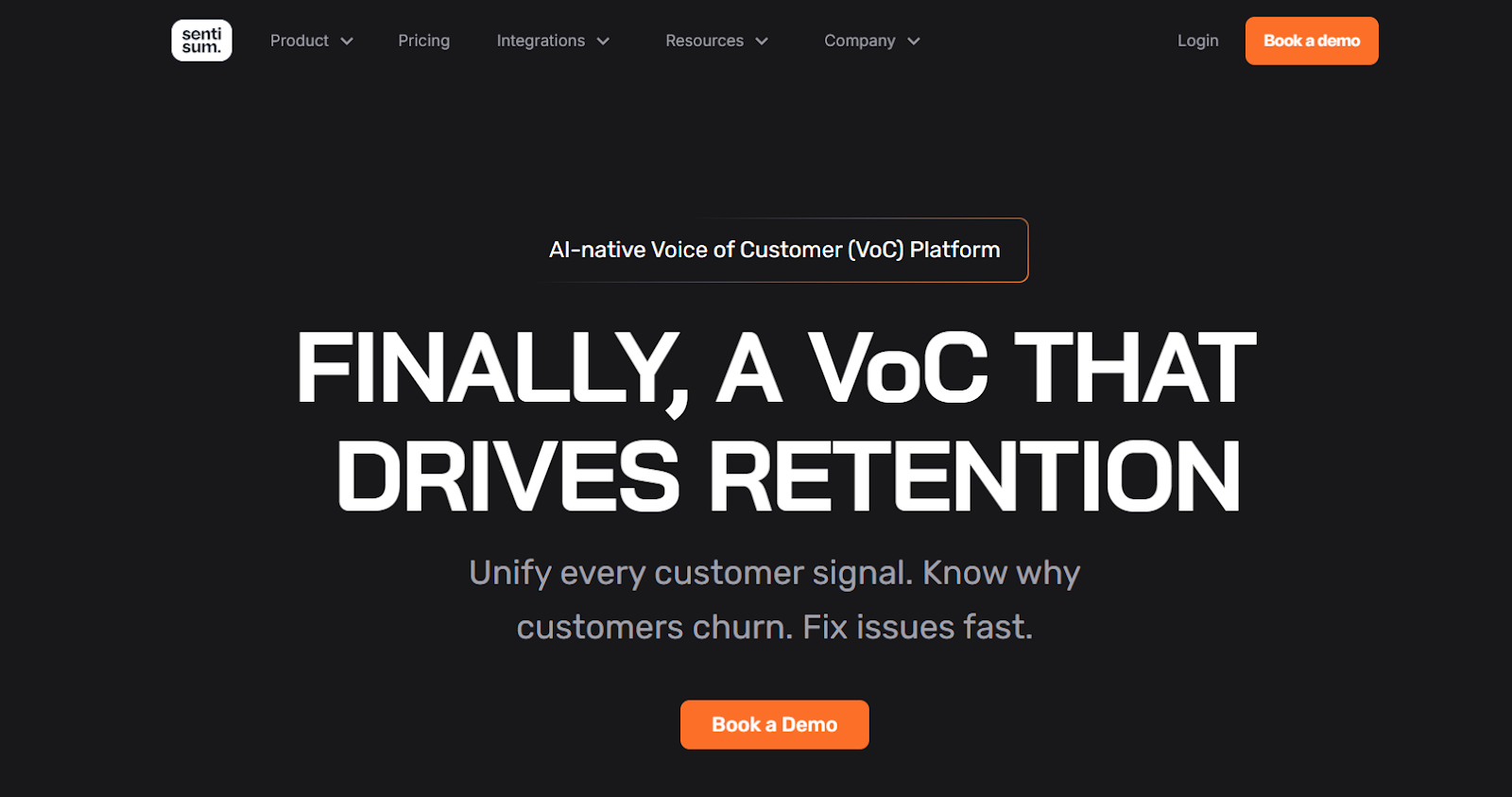
A screenshot of SentiSum’s homepage
Via SentiSum homepage

SentiSum, as one of the best SupportLogic alternatives, is an AI-native VoC platform that unifies qualitative data from every customer touchpoint, including support tickets, phone calls, surveys, and social media reviews.

It employs advanced Natural Language Processing (NLP) to perform real-time analysis, moving beyond simple topic tagging to identify the root causes behind customer sentiment, churn, and loyalty. 

The platform builds a unique, customized AI model for each client to accurately understand their specific terminology. As a SOC 2 Type II certified and GDPR compliant tool, it integrates smoothly with existing systems like Zendesk, Slack, Intercom, Gorgias, Freshdesk, Jira and more, delivering proactive, actionable insights directly into team workflows.

SentiSum: Key capabilities 

1. Kyo, SentiSum’s intelligent AI Agent

Kyo is at the heart of SentiSum, operating in real time and continuously reading and interpreting customer conversations across all connected channels. 
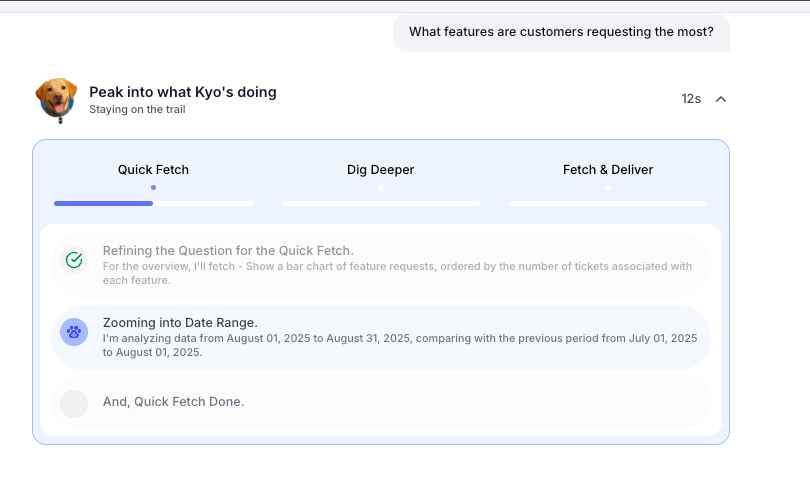
A screenshot of Kyo responding to user queries
Kyo, SentiSum’s AI agent

Instead of just presenting data, Kyo learns from patterns over time, highlights statistical anomalies, and summarizes key themes into actionable narratives. This allows the agent to do more than report; it recommends. It can surface emerging issues that are trending outside of normal bounds and suggest the next best steps for resolution. 

This frees teams from manually sifting through thousands of tickets and reviews, providing aligned, directional insights that keep CX, Product, and Leadership focused on what matters most to customers at any given moment.

2. Unifying every customer voice

The platform consolidates every customer feedback and interaction into a single source of truth. This enables powerful, cross-channel analysis. 

You can understand the precise reason a customer gave a low NPS score, even if they didn't elaborate in the survey, by correlating their feedback with their recent support interactions. 
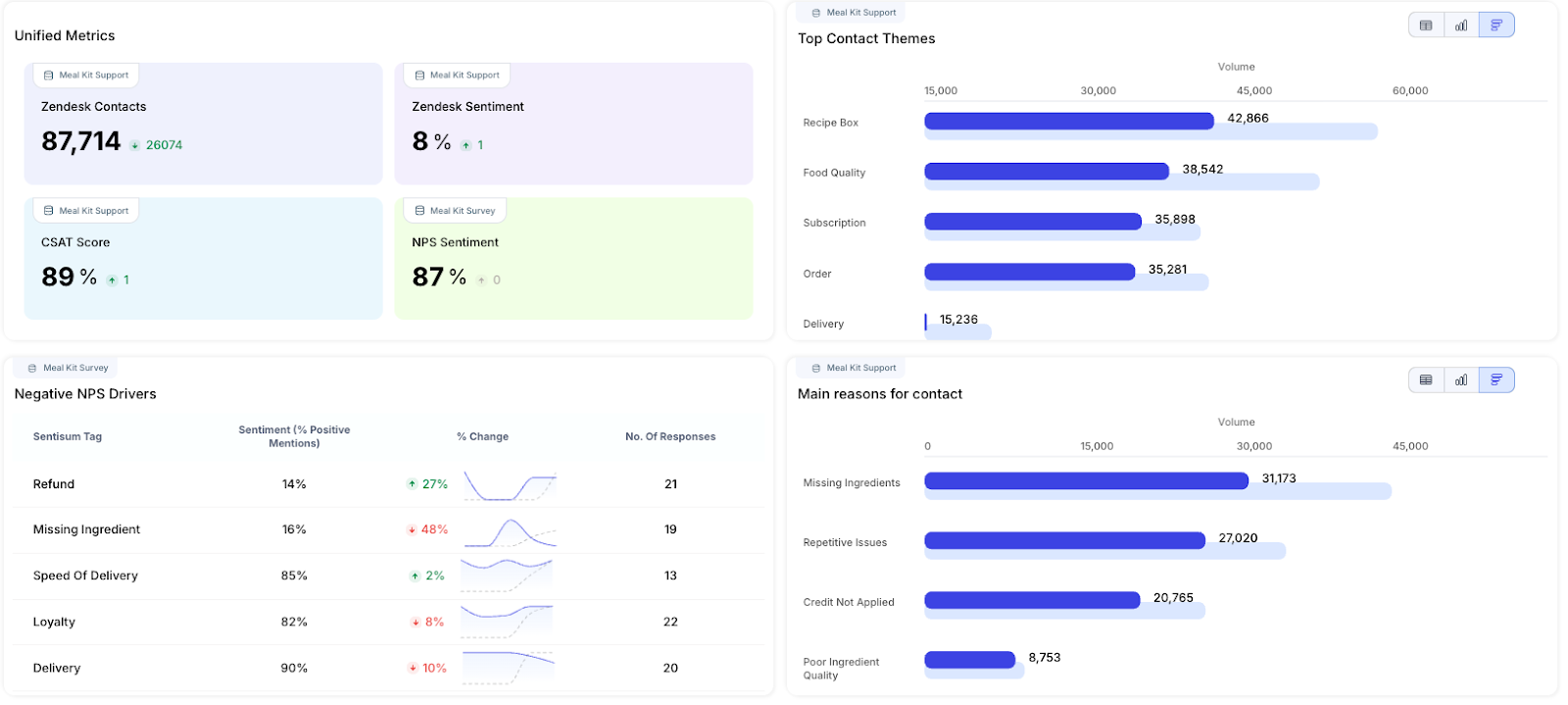
SentiSum’s interface showing unified metrics and other data
Get a complete overview of customer feedback with SentiSum

By having all channels under one roof, teams can prioritize company-wide issues that affect multiple touchpoints, rather than solving isolated problems in individual departments.

3. From data to immediate action

SentiSum is designed to trigger action. It’s AI-powered support ticket analysis automatically analyzes incoming tickets and can route specific issues like login errors or refund requests directly to the appropriate teams in Jira or Slack. 
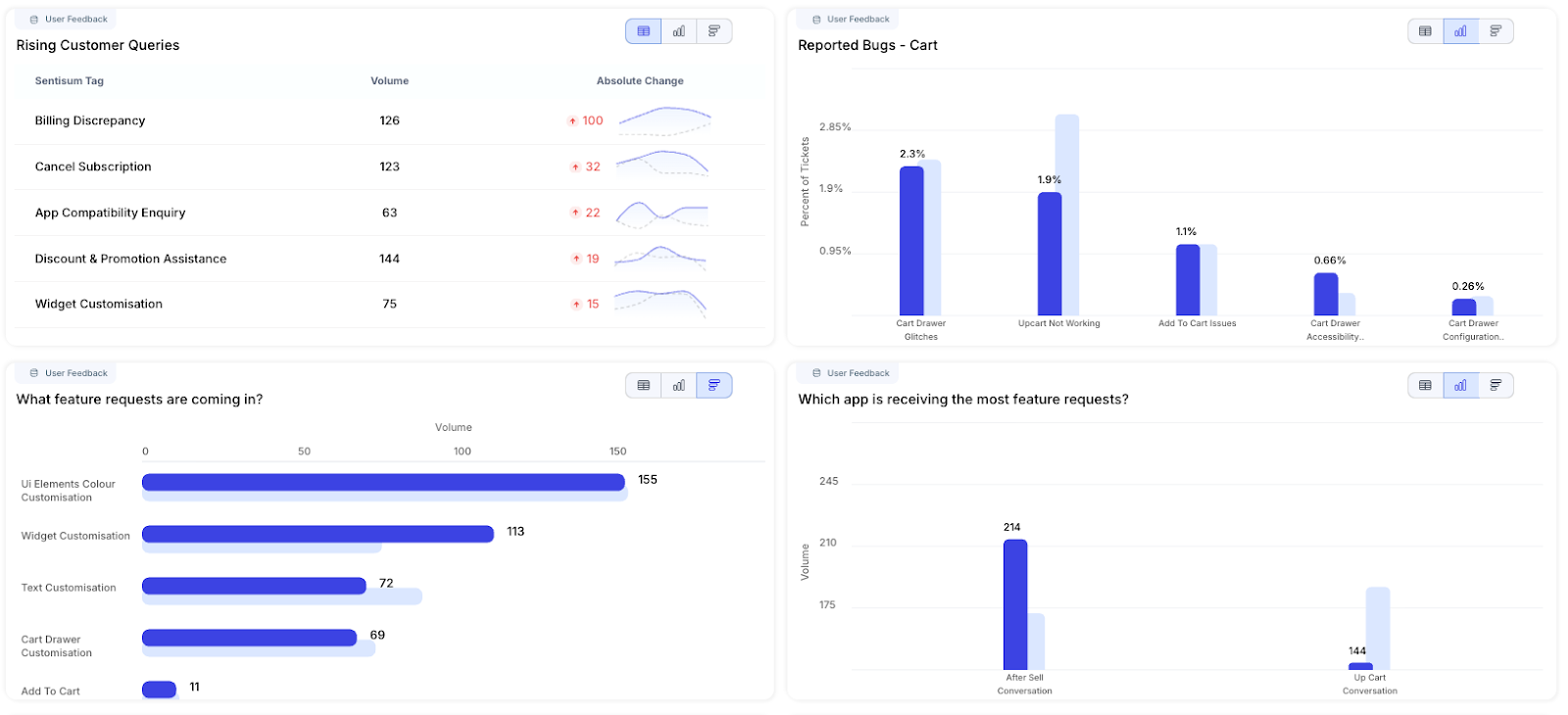
SentiSum’s dashboard showing important feedback metrics
Resolve customer queries faster with SentiSum

This auto-prioritization and triage ensure that critical problems are fast-tracked, reducing resolution time and containing potential churn risks.

4. Analyzing voice and speech

SentiSum unlocks insights typically hidden in customer phone calls. Its embedded speech-to-text analytics transcribes and analyzes voice conversations with the same depth as text-based channels. 
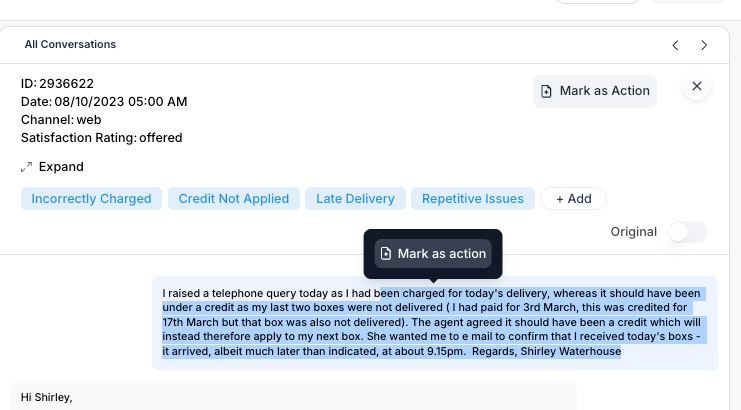
SentiSum’s interface decoding in-depth customer feedback
Derive hidden feedback from voice calls with SentiSum

This means the nuance, emotion, and specific language used in calls are converted into quantifiable data, tagged for topic and sentiment, and included in your unified customer view.

This capability finally allows you to understand the drivers behind call volume and the true performance of phone-based support agents. You can identify if a recent product update is causing a spike in confused callers or pinpoint which scripted responses are leading to negative customer sentiment. 

SentiSum’s Best features:

  • Replaces error-prone, human-dependent tagging: Machine-learning model applies accurate, consistent tags to 100% of tickets
  • Advantage of Kyo: The AI agent automates ticket prioritization and routing based on nuanced topics and sentiment
  • Root-cause analysis: Identifies the exact reasons behind changes in key metrics, such as a drop in CSAT, through detailed, data-backed insights
  • Sentiment and issue detection: Detects emerging issues and subtle sentiment shifts that keyword-based systems often miss, creating a dynamic view of the customer experience

SentiSum’s G2 Rating: 

4.8 out of 5 stars

SentiSum’s Pricing:

SentiSum pricing starts at $3,000 per month, offering customization for enterprises. 
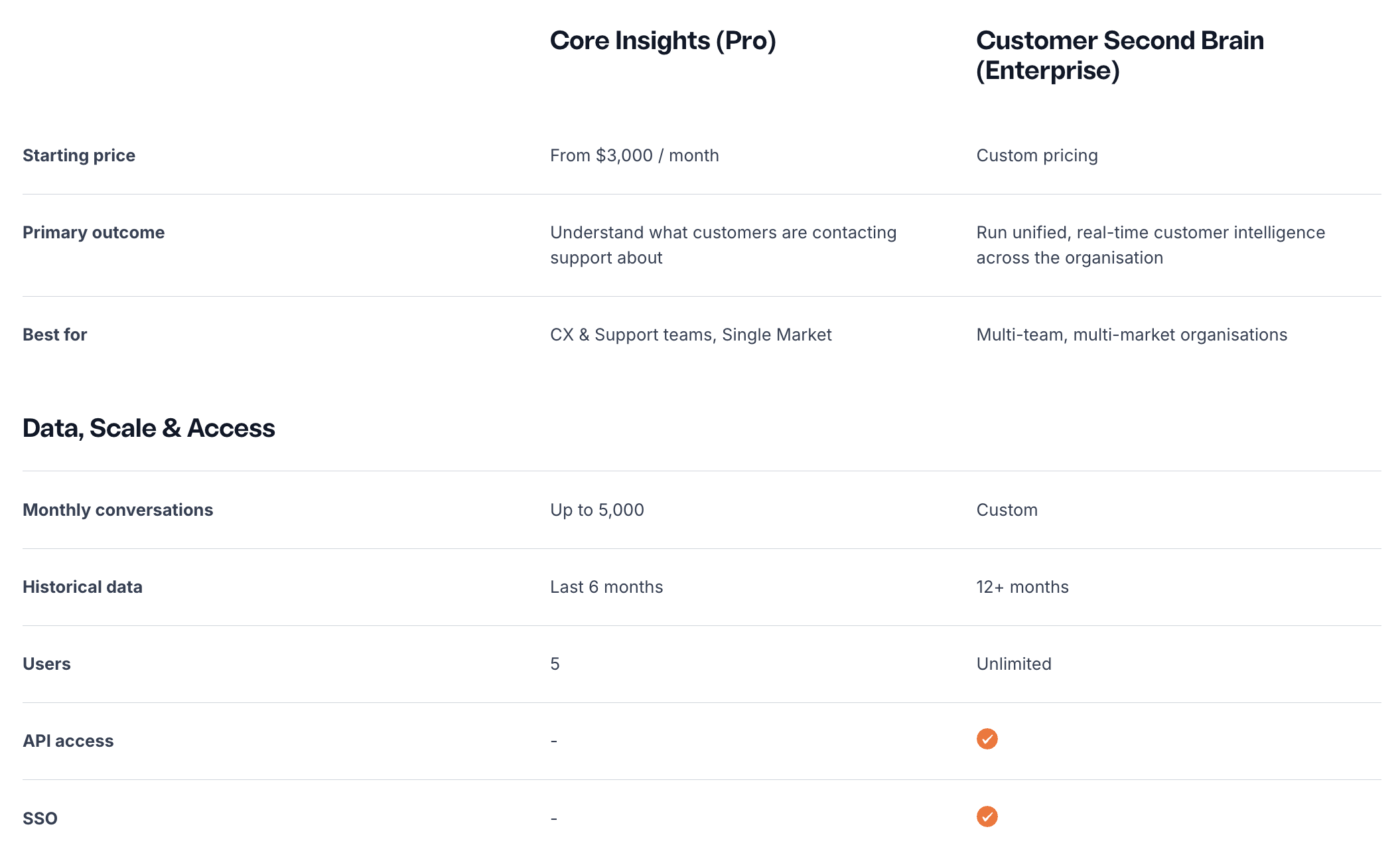
A screenshot of SentiSum’s pricing page
via SentiSum pricing page

Here is a breakdown of the pricing plan:

  • The Pro plan starts at $3,000 per month for mid-market companies
  • The Enterprise plan uses custom pricing for larger organizations
  • Pro supports 5000+ monthly conversations; Enterprise scales to custom volumes
  • Pro includes Support + Surveys, while Enterprise offers custom channels
  • Pro provides 6 months of historical data analysis; Enterprise provides 12 months
  • Both plans offer custom AI updates
  • Realtime tagging is an add-on for Pro but included in Enterprise

2. Qualtrics Customer Experience
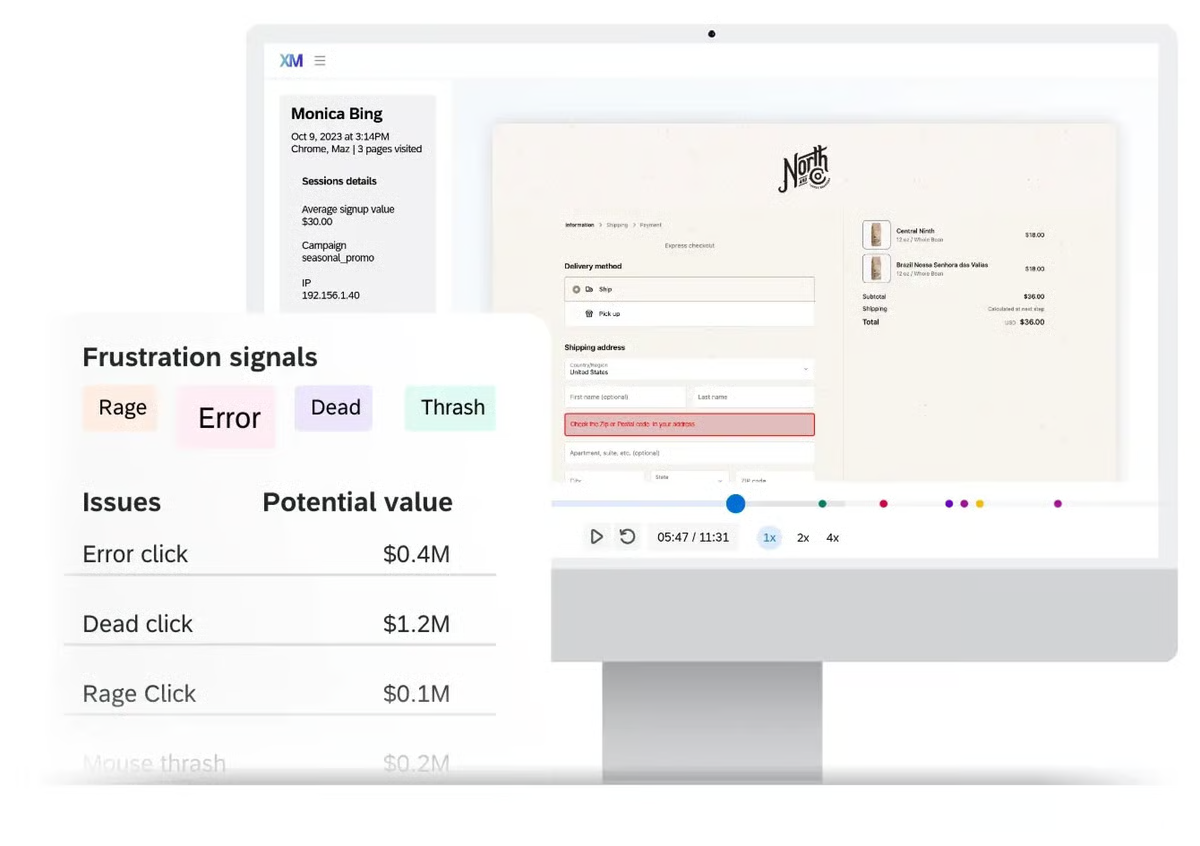
A screenshot of Qualtrics’ homepage
via Qualtrics homepage

Recognized as one of the top customer experience tools for enterprise, Qualtrics is an experience management platform that uses specialized AI to process large volumes of data from customer and employee interactions. 

The platform can automatically detect user behavior, like friction in a digital checkout, and can launch a survey or create a support ticket in real time. A core component is its Experience ID (xiD), which builds a unified, multi-channel profile for each customer by combining their complete history of interactions, feedback, and behavioral data.

Qualtrics’ Best Features:

  • Automatic friction detection: Detects signs of user frustration, such as rage clicks or failed checkouts, and triggers real-time digital surveys or auto-creates support tickets
  • Unified customer identity (xiD): Combines each user’s interaction history, behavioral signals, and feedback data into one centralized profile for a complete, multi-channel understanding of the customer experience
  • No-code customization: Enables teams to adjust survey triggers, dashboard layouts, and feedback flows through an intuitive no-code interface, allowing quick changes without IT dependency

Qualtrics’ G2 Rating: 

4.3 out of 5 stars

Qualtrics’ Pricing:

Qualtrics offers custom pricing.
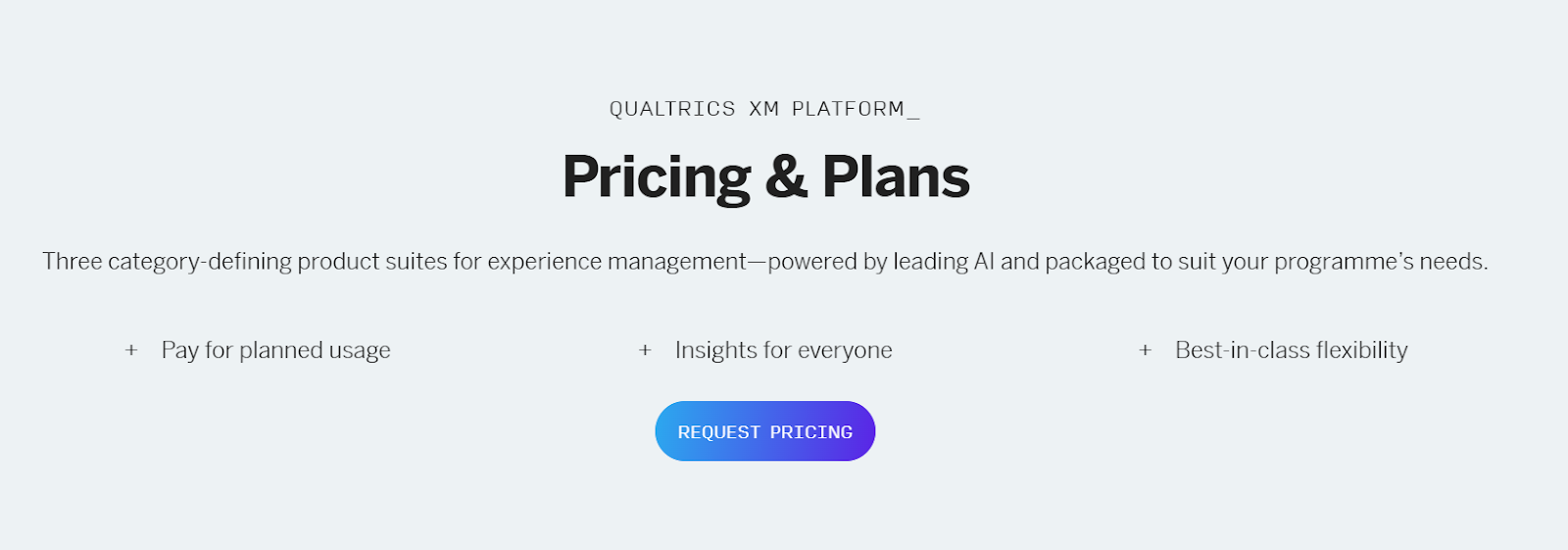
A screenshot of Qualtrics’s pricing page
via Qualtrics pricing page

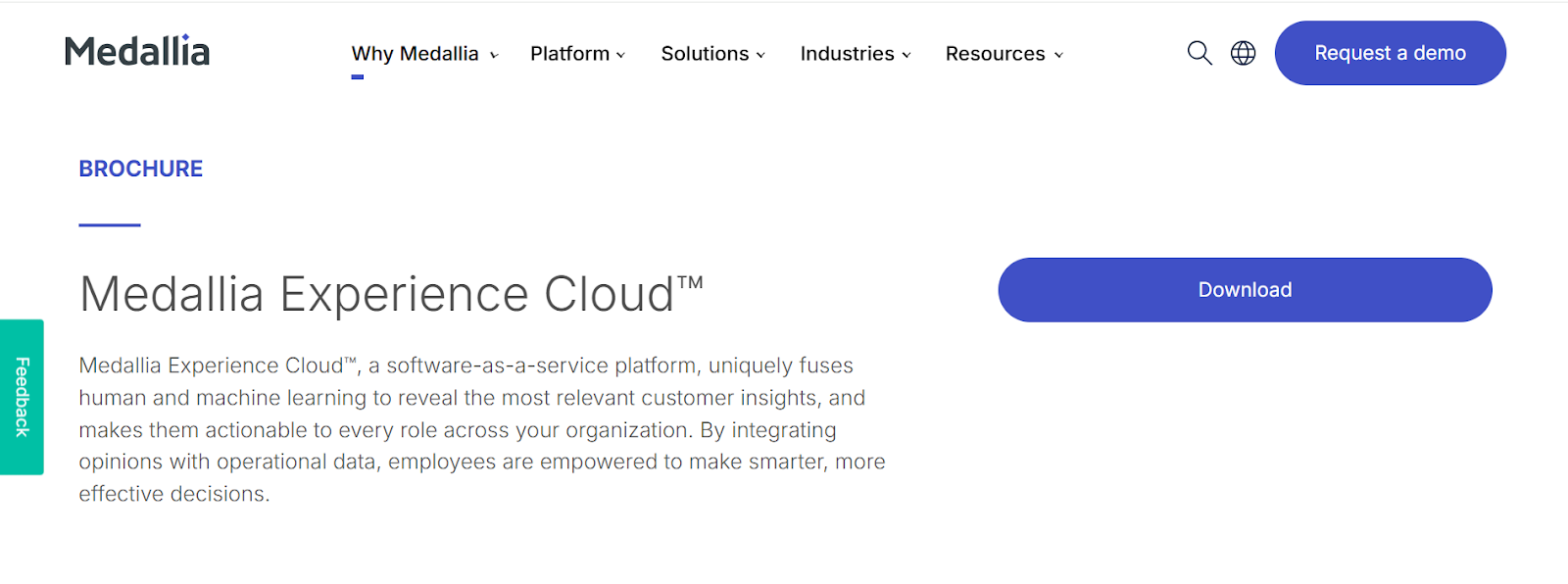
3. Medallia

A screenshot of Medallia Experience Cloud’s homepage
via Medallia Experience Cloud homepage

Medallia is another enterprise-grade platform that ingests and processes a vast array of structured and unstructured customer and employee signals.

It moves beyond standard surveys to incorporate sources like speech-to-text from call centers, digital behavior analytics from websites and apps, social media reviews, operational data from CRMs, and even IoT device outputs. 

The platform uses proprietary AI and machine learning models to perform real-time theme extraction, root cause analysis, and predictive analytics for customer retention.

Medallia’s Best Features:

  • AI-driven conversation analysis: Analyzes all customer interactions across calls and chats, transcribes speech in 30+ languages, and identifies emotions and pain points automatically
  • Seamless data integration: Connects to any data source, including legacy systems, using APIs, ETL support, and pre-built connectors for platforms like Workday and Adobe
  • Journey-level insights: Maps customer journeys to uncover broken touchpoints and ties them to key metrics such as First Contact Resolution (FCR)
  • Intelligent callback solution: The ‘Mindful’ feature replaces hold times with scheduled callbacks, balancing agent workload and improving customer satisfaction

Medallia’s G2 Rating: 

4.5 out of 5 stars

Medallia’s Pricing:

Medallia offers custom pricing.
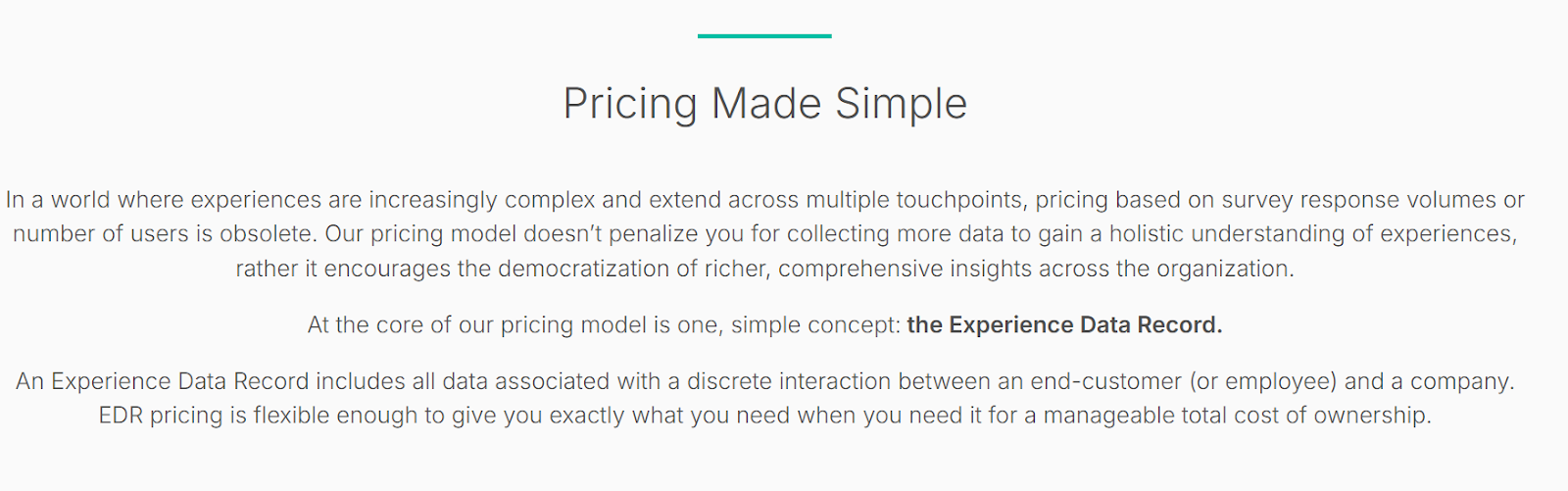
A screenshot of Medallia Experience Cloud’s pricing page
via Medallia Experience Cloud pricing page

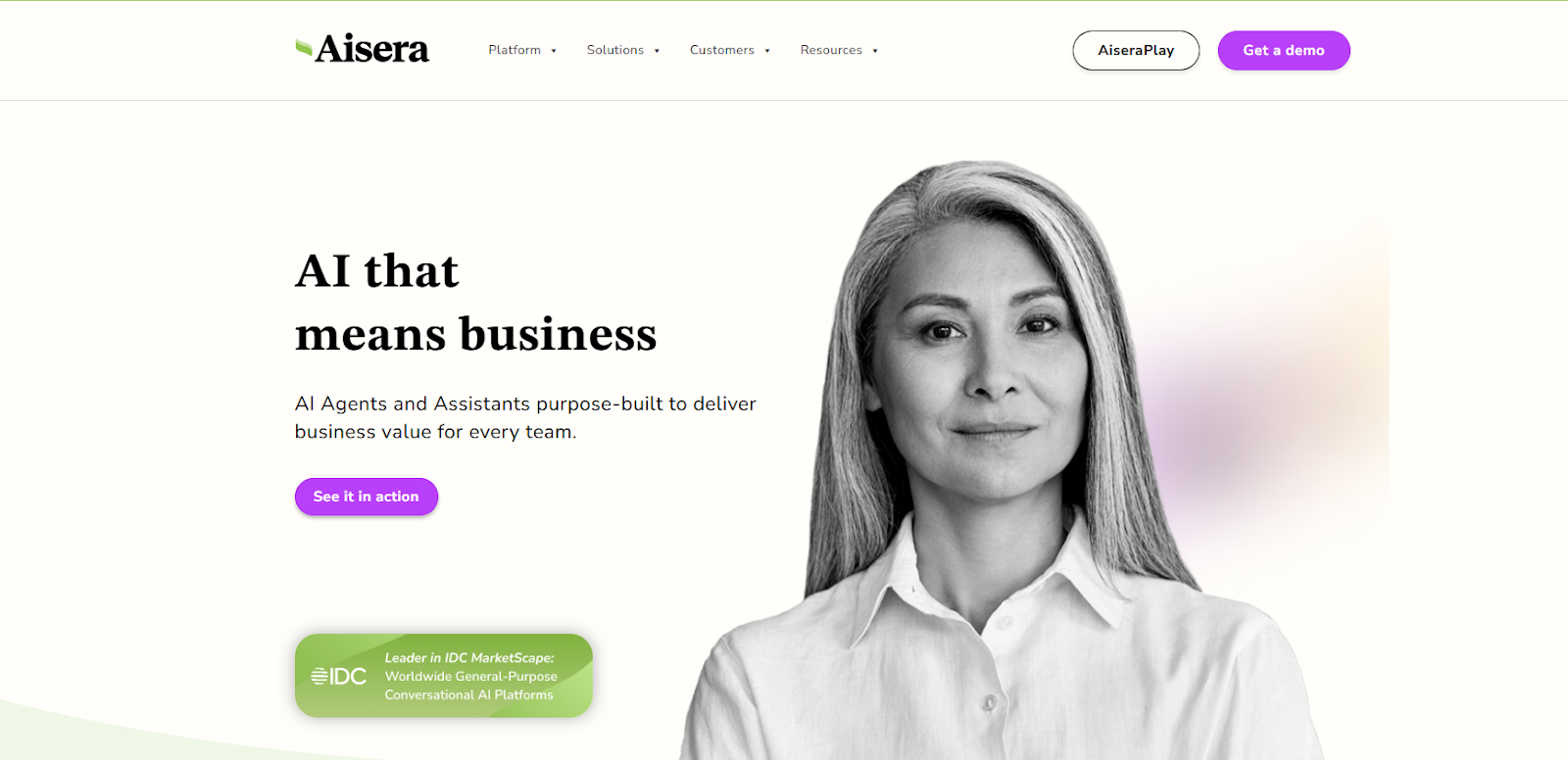
4. Aisera

A screenshot of Aisera’s homepage
via Aisera homepage

Aisera provides an AI agent platform that uses generative AI and large language models for the autonomous execution of complex tasks. 

This AI agent for enterprise support goes beyond simple chatbots by integrating with enterprise systems like ServiceNow and Slack to automate workflows in IT, HR, and customer service. 

Its architecture features open standards like MCP and A2A for tool integration and uses OpenTelemetry for performance observability. The platform also includes specialized studios for building AI applications with a low-code interface.

Aisera’s Best Features:

  • Automated cross-domain actions: Executes complex workflows like incident management and change requests directly within communication tools such as Microsoft Teams
  • AI-powered support ticket analysis ing system: Predicts and resolves issues in advance by analyzing user behavior and historical interaction data
  • Continuous learning engine: Learns from past resolutions and expert insights to create automation playbooks that enhance future performance

Aisera’s G2 Rating: 

4.4 out of 5 stars

Aisera’s Pricing: 

Public pricing is unavailable. 

5. Chattermill 
A screenshot of Chattermill’s homepage
via Chattermill homepage

Chattermill, a top customer experience tool for enterprise, consolidates data from sources like Zendesk, Intercom, and app stores into a single dashboard. 

It uses proprietary AI models, including an engine that leverages multiple LLMs like GPT-4, to analyze unstructured feedback across 100+ languages without manual translation. 

The platform automatically categorizes comments, tracks sentiment trends, and performs impact analysis to reveal the drivers behind metric changes like NPS. This enables CX and product teams to move from raw data to insights.

Chattermill’s Best Features:

  • AI-powered feedback analysis: Automates the review of unstructured feedback from tickets and reviews using custom themes, removing the need for manual tagging
  • Smart feedback segmentation: Filters insights by customer type, product, or date, allowing deeper analysis of specific user groups
  • Real-time alerts and workflows: Integrates with tools like Slack to alert teams about emerging issues or trends instantly

Chattermill’s G2 Rating: 

4.5 out of 5 stars

Chattermill’s Pricing:

Chattermill’s Pro, Team, and Enterprise plans all require requesting a custom quote, with each tier offering more data credits and integrations.
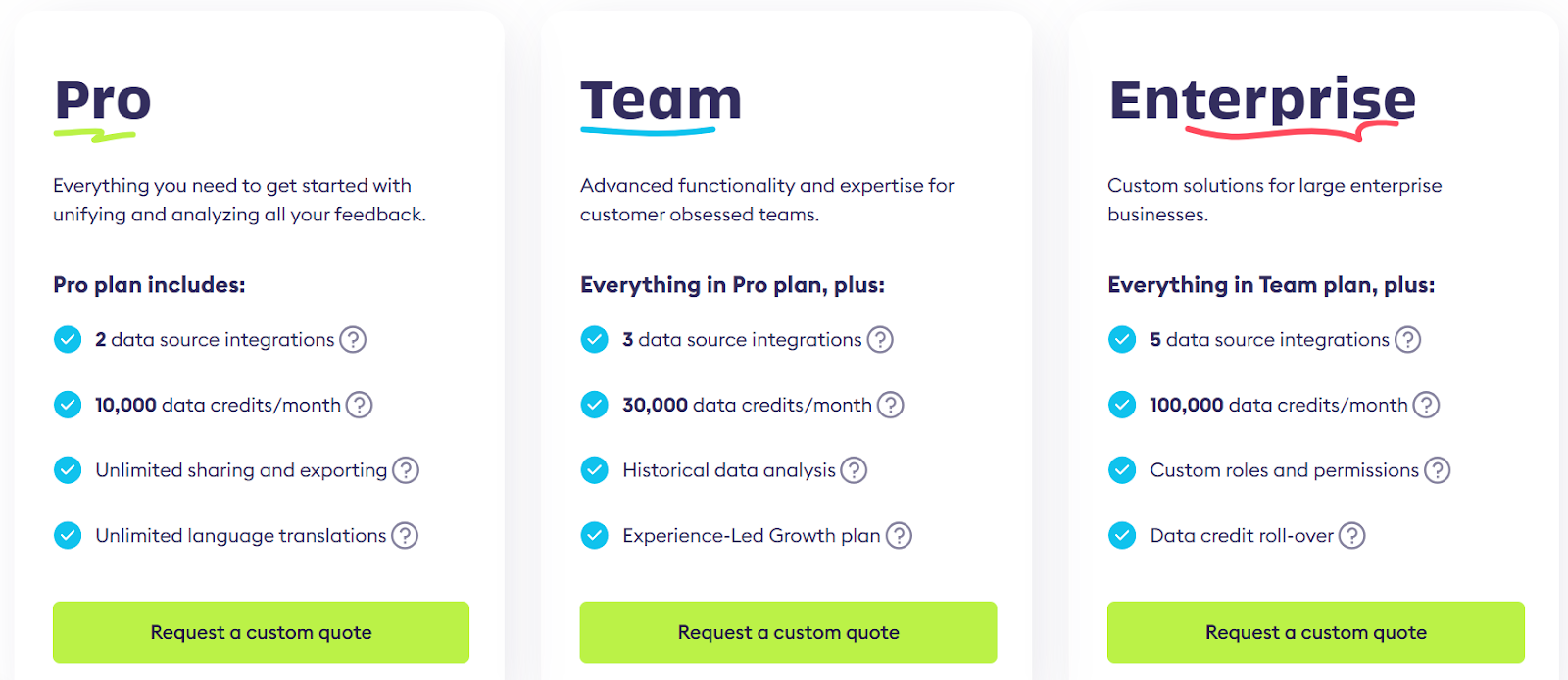
A screenshot of Chattermill’s pricing page
via Chattermill pricing page

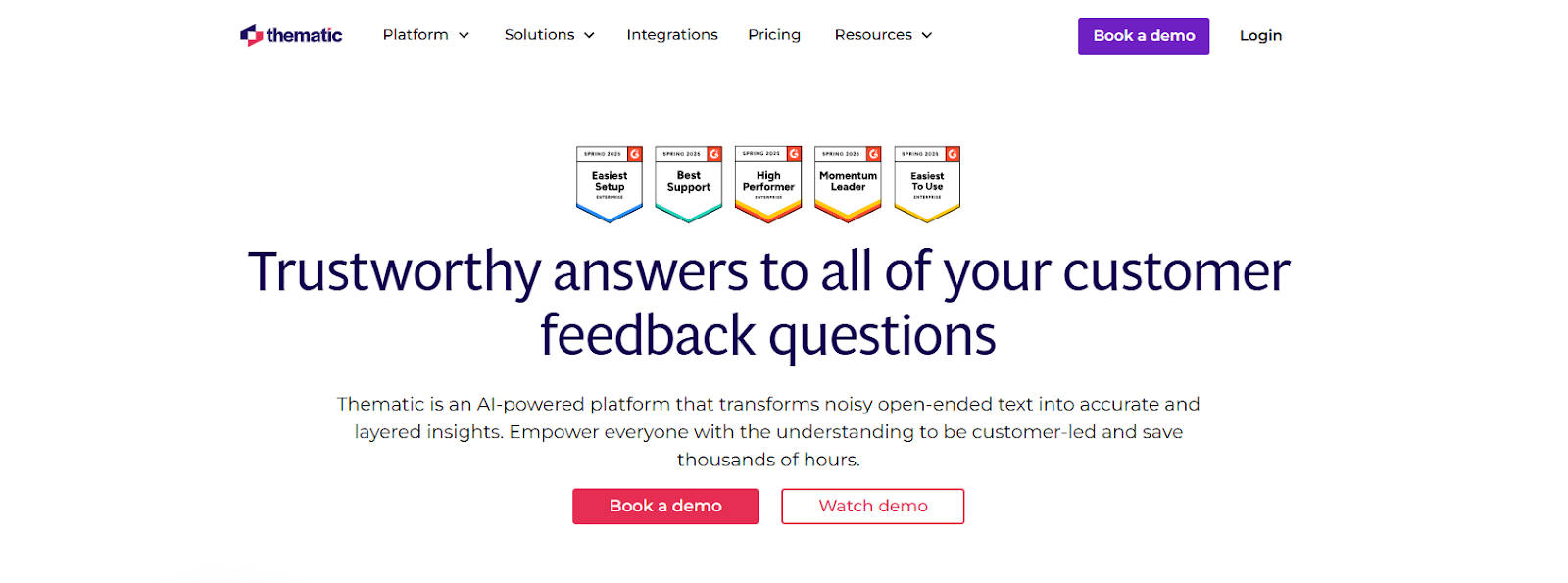
6. Thematic

A screenshot of Thematic’s homepage
via Thematic homepage

Thematic is a feedback analytics platform that uses a proprietary blend of Natural Language Processing and Generative AI. It automatically processes thousands of qualitative comments from sources like surveys, support tickets, and app reviews. 

The system transforms this raw text into specific themes, sentiment, and synthetic scores. 

A key feature is its interactive Theme Editor, which allows experts to review, refine, and verify the AI's output, bringing human expertise into the loop to curate accurate and actionable insights at scale.

Thematic’s Best Features:

  • Automated verbatim analysis: Transforms thousands of open-ended customer responses into clear themes and sentiment insights in near real time
  • Emergent theme discovery: Surfaces unexpected customer concerns by allowing themes to form naturally from the data
  • Transparent AI insights: Offers traceable analysis where users can drill down to sentence-level details to see how each theme was identified
  • Targeted issue prioritization: Filters themes by customer metadata, such as tenure or location, to uncover and address the most impactful problems

Thematic’s G2 Rating:

 4.8 out of 5 stars

Thematic’s Pricing:

The platform offers a Foundation plan at $25,000 per year with full access and support, while the Enterprise plan provides customized pricing with added onboarding, security, and volume-based benefits.
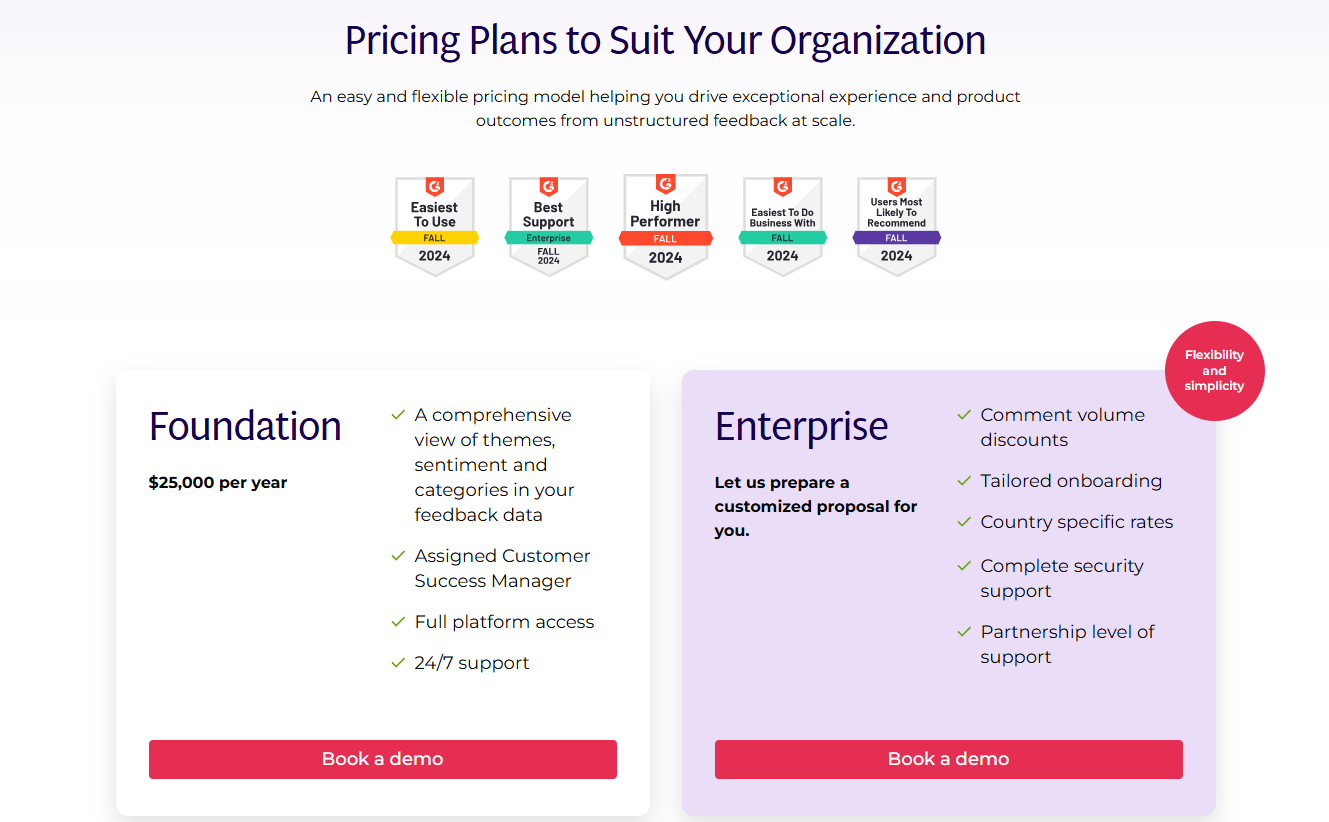
A screenshot of Thematic’s pricing page
via Thematic pricing page

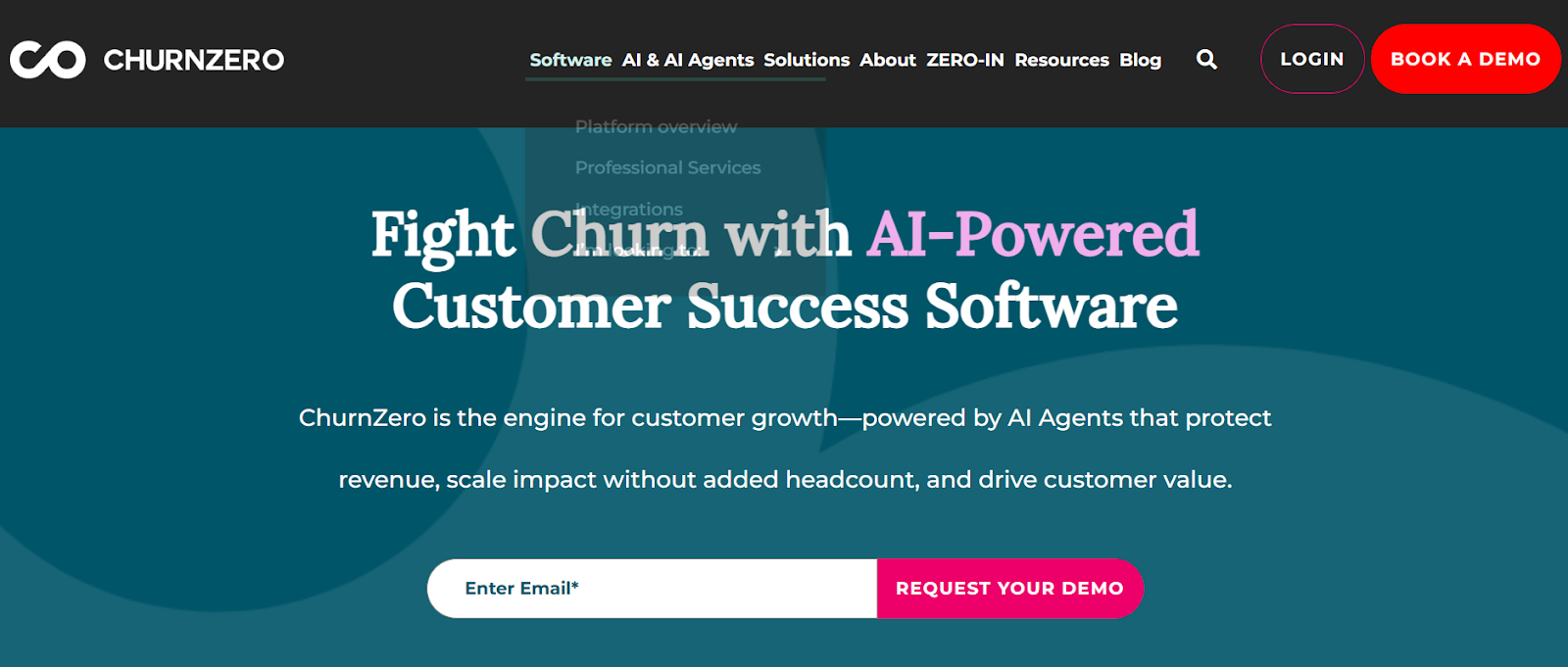
7. ChurnZero

A screenshot of ChurnZero’s homepage
via ChurnZero homepage

ChurnZero is an AI-powered customer growth platform designed specifically for customer success and revenue teams. Its core engine uses embedded, purpose-built AI Agents that autonomously execute tasks like identifying churn risks and spotting expansion opportunities. 

This top customer experience tool for enterprise centralizes customer data from the entire lifecycle, providing features for health scoring, renewal forecasting, and in-app communication. 

ChurnZero’s Best Features:

  • Agents for proactive insights: AI Agents, like Harbinger and Beacon, automatically detect specific relationship risks and buying signals, moving beyond simple analysis to direct action
  • Unified data ecosystem: Consolidates information from CRMs like Salesforce, support tools like Zendesk, and product platforms like Pendo into one reliable source of truth
  • Workflow automation assistants: Tools like Scribe and Recap handle routine tasks by drafting contextual emails and turning meeting summaries into clear action items
  • Customer health and renewal tracking: Delivers dynamic health scores and renewal forecasts, offering a data-backed view of account performance without manual reporting

ChurnZero’s G2 Rating:

4.7 out of 5 stars

ChurnZero’s Pricing:

ChurnZero's paid version starts at $12,000 annually.

How SentiSum Outperforms SupportLogic

So far, we have covered the best SupportLogic alternatives in depth. Now, we explain why SentiSum is the top choice when it comes to retention and customer experience:

1. Uncovers the specific problem, not just a general theme

Other platforms might plainly tag a ticket as 'login trouble.' SentiSum’s AI-native support ticket analysis goes into the ‘why’ of the issues, and identifies the precise reason, such as 'password reset link not arriving for Gmail users.'
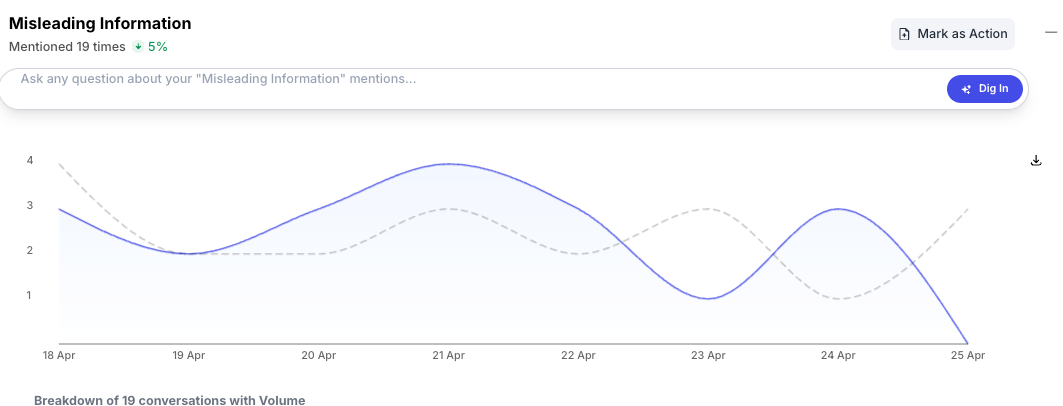
SentiSum highlighting detailed customer problem through mentions and numbers
Find out specific customer issues with SentiSum

This granular insight allows you to deploy a targeted fix for the exact issue, reducing ticket volume and improving the customer's experience directly.

2. Connects seamlessly with the tools your team already uses

SentiSum integrates directly into your existing workflow. Insights flow automatically into platforms like Zendesk, Gorgias, Dixa, Slack, and Jira. 
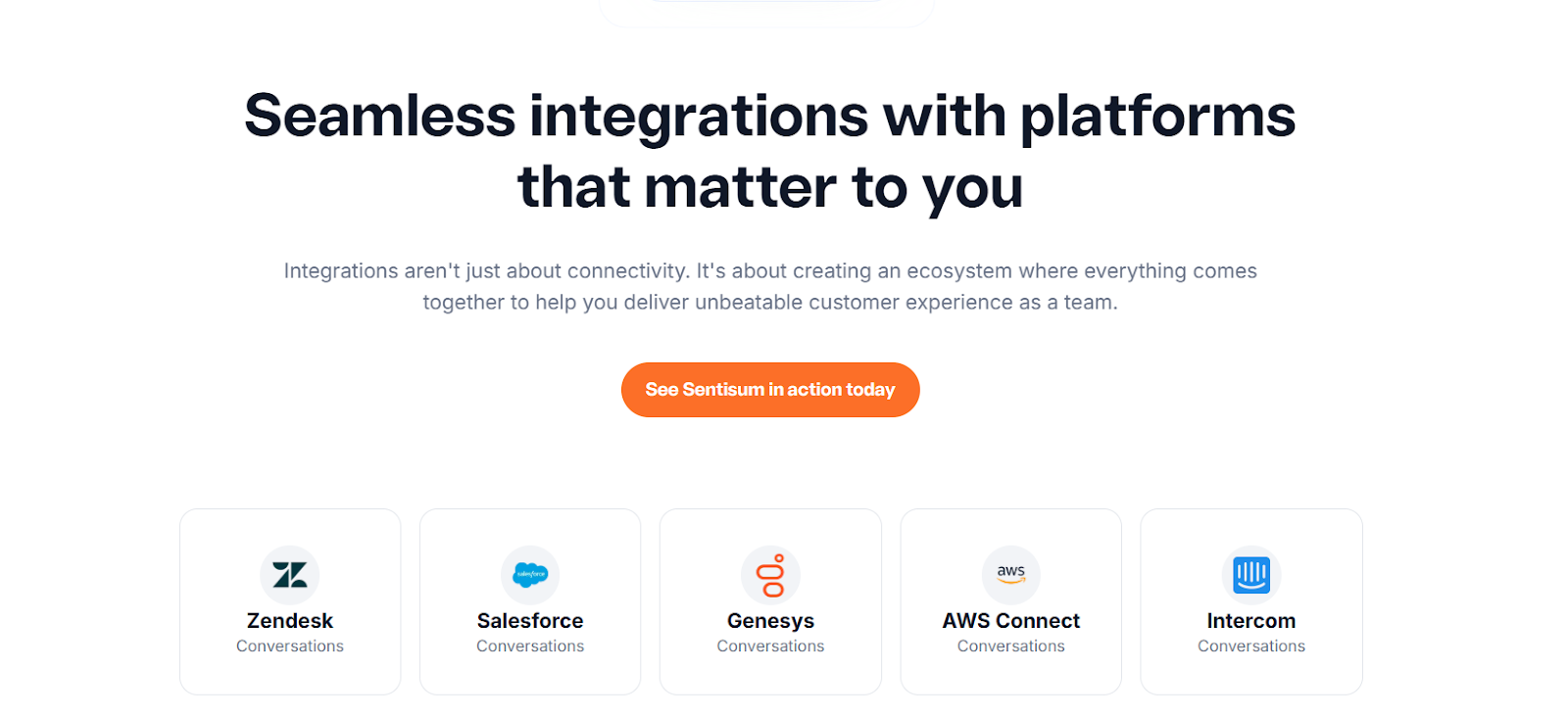
SentiSum showing a unified list of connected apps and tools.
Have all integration in one place with SentiSum

This means your teams can act on critical customer intelligence without switching screens or learning new systems.

3. Acts as a proactive partner, not a passive dashboard

SentiSum is more than a reporting tool; it's an active intelligence layer. It automatically spots rising issues, suggests actions, and can even create support tickets from negative social media reviews. 

SentiSum interface depicting unified customer feedback through graphs
Connect feedback across channels with SentiSum

This means you can address potential crises before they escalate, and use real, unfiltered customer feedback for immediate improvements.

4. Designed for everyone, not just data experts

The platform is built for simplicity. You can ask questions in plain English and get clear answers based on all your customer data. 

Kyo answering questions by displaying intuitive insights.
Support non-tech teams with SentiSum

This empowers everyone in the organization, from product to leadership, to access powerful insights without needing a technical background or waiting for reports.

Case Study

JustPark teamed up with SentiSum to bring all its scattered feedback into one place and catch customer issues in real time.

The platform helped them quickly spot a major barrier glitch caused by missing license plate updates, saving thousands in lost revenue. By fixing the issue fast, they improved driver satisfaction and partner trust.

What began as a feedback fix turned into a business advantage, with JustPark now using customer insights to prevent churn, guide new launches, and show partners how serious they are about great driver experiences.

Read the full story

➡️ Also, learn how SentiSum revitalized the broken legacy VoC: 

Legacy Voice of the Customer (VoC) is Broken. SentiSum fixed it.

Move from solving isolated problems in individual departments by booking a demo with SentiSum today!

Join a community of 2139+ customer-focused professionals and receive bi-weekly articles, podcasts, webinars, and more!

Trending articles

Competitor Alternatives

Best SupportLogic Alternatives for 2026: AI-Agent for Enterprise Support

December 11, 2025
Stephen Christou
Marketing Director at SentiSum
In this article
Understand your customer’s problems and get actionable insights
Learn more

Is your AI accurate, or am I getting sold snake oil?

The accuracy of every NLP software depends on the context. Some industries and organisations have very complex issues, some are easier to understand.

Our technology surfaces more granular insights and is very accurate compared to (1) customer service agents, (2) built-in keyword tagging tools, (3) other providers who use more generic AI models or ask you to build a taxonomy yourself.

We build you a customised taxonomy and maintain it continuously with the help of our dedicated data scientists. That means the accuracy of your tags are not dependent on the work you put in.

Either way, we recommend you start a free trial. Included in the trial is historical analysis of your data—more than enough for you to prove it works.

SupportLogic helps teams detect customer sentiment, but its interface can be difficult to master. New users report a steep learning curve and a design that is not immediately intuitive. With time, this creates internal friction, slowing down the team onboarding and daily operations. 

Moreover, the platform’s own complexity can become a distraction from providing actual customer support. Some integrations function less effectively, forcing companies to accept a subpar experience. The platform can also feel restrictive for data analysis.

The growing need for simpler tools, more transparent pricing, and stronger data visibility has led many companies to look beyond SupportLogic. This guide explores the best SupportLogic alternatives available in 2026; especially the platforms that offer seamless integration, better analytics, and an intuitive experience built for scale.

What Is SupportLogic?

SupportLogic is a support experience (SX) platform that leverages AI to scan customer communications for emotional cues and potential risks. Many users like its intelligent escalation management, which identifies customer issues before they are formally escalated, enabling teams to intervene early.

Why Should You Look for SupportLogic Alternatives?

For all its features, SupportLogic has several significant drawbacks that could impact your support team's efficiency and your company's budget.

  • Interface usability: Users frequently describe the interface as not intuitive and difficult to navigate. This poor design complicates training and slows down new hires, extending the time to full productivity.
  • Pricing complexity: Further, the platform's pricing structure is often cited as complex. Bundling with other services can lead to confusing contracts and unexpected costs.
A screenshot of a G2 review of SupportLogic
A G2 review of SupportLogic’s limitations
  • Integration gaps: Key integrations, particularly with Microsoft Teams, are less streamlined than their Slack counterparts. This creates friction and workflow disruptions for companies invested in the Microsoft ecosystem.
  • CRM limitation: And importantly, you cannot seamlessly push rich SupportLogic insights directly into your primary CRM, forcing agents to constantly switch between applications and hindering a unified workflow.

So, if you’re seeking customer experience tools for an enterprise that combine flexibility, integration, and actionable insights, it’s worth considering SupportLogic alternatives to choose the best system for your business needs. 

👀 Did you know?

Nearly 8 in 10 companies have already started using AI agents. And among them, about two-thirds say these tools are boosting productivity and delivering real business value.

Top SupportLogic Alternatives for 2026

Let’s go over the top SupportLogic alternatives you can consider in 2026:

Platform Quick Summary USP
SentiSum AI-native VoC platform that detects churn risks in real time and diagnoses root causes across all customer feedback to prevent revenue loss Real-time churn detection with AI-driven root cause analysis; purpose-built for subscription businesses that need to act before customers leave
Qualtrics Customer Experience Uses adaptive AI to transform basic customer feedback into actionable insights for experience improvement Turns fragmented customer data into personalized, automated actions across all channels
Medallia Turns omnichannel feedback and operational data into prioritized, actionable insights Unifies dozens of customer and operational signals to prescribe specific, actionable improvements
Aisera Automates service management with generative AI agents that execute tasks Executes complex workflows while guaranteeing data privacy and reducing AI hallucinations
Chattermill Unifies all customer feedback channels for AI-powered, granular sentiment and trend analysis Analyzes feedback in its original language, delivering granular insights without manual translation
Thematic Its AI generates a thematic analysis that expert users can directly refine and verify for accuracy Turns qualitative feedback into curated themes using transparent AI
ChurnZero An AI customer growth platform that automates risk detection and revenue expansion Uses native AI Agents that autonomously act on insights to protect revenue

Here’s a deep dive into the alternatives: 

1. SentiSum

A screenshot of SentiSum’s homepage
Via SentiSum homepage

SentiSum, as one of the best SupportLogic alternatives, is an AI-native VoC platform that unifies qualitative data from every customer touchpoint, including support tickets, phone calls, surveys, and social media reviews.

It employs advanced Natural Language Processing (NLP) to perform real-time analysis, moving beyond simple topic tagging to identify the root causes behind customer sentiment, churn, and loyalty. 

The platform builds a unique, customized AI model for each client to accurately understand their specific terminology. As a SOC 2 Type II certified and GDPR compliant tool, it integrates smoothly with existing systems like Zendesk, Slack, Intercom, Gorgias, Freshdesk, Jira and more, delivering proactive, actionable insights directly into team workflows.

SentiSum: Key capabilities 

1. Kyo, SentiSum’s intelligent AI Agent

Kyo is at the heart of SentiSum, operating in real time and continuously reading and interpreting customer conversations across all connected channels. 

A screenshot of Kyo responding to user queries
Kyo, SentiSum’s AI agent

Instead of just presenting data, Kyo learns from patterns over time, highlights statistical anomalies, and summarizes key themes into actionable narratives. This allows the agent to do more than report; it recommends. It can surface emerging issues that are trending outside of normal bounds and suggest the next best steps for resolution. 

This frees teams from manually sifting through thousands of tickets and reviews, providing aligned, directional insights that keep CX, Product, and Leadership focused on what matters most to customers at any given moment.

2. Unifying every customer voice

The platform consolidates every customer feedback and interaction into a single source of truth. This enables powerful, cross-channel analysis. 

You can understand the precise reason a customer gave a low NPS score, even if they didn't elaborate in the survey, by correlating their feedback with their recent support interactions. 

SentiSum’s interface showing unified metrics and other data
Get a complete overview of customer feedback with SentiSum

By having all channels under one roof, teams can prioritize company-wide issues that affect multiple touchpoints, rather than solving isolated problems in individual departments.

3. From data to immediate action

SentiSum is designed to trigger action. It’s AI-powered support ticket analysis automatically analyzes incoming tickets and can route specific issues like login errors or refund requests directly to the appropriate teams in Jira or Slack. 

SentiSum’s dashboard showing important feedback metrics
Resolve customer queries faster with SentiSum

This auto-prioritization and triage ensure that critical problems are fast-tracked, reducing resolution time and containing potential churn risks.

4. Analyzing voice and speech

SentiSum unlocks insights typically hidden in customer phone calls. Its embedded speech-to-text analytics transcribes and analyzes voice conversations with the same depth as text-based channels. 

SentiSum’s interface decoding in-depth customer feedback
Derive hidden feedback from voice calls with SentiSum

This means the nuance, emotion, and specific language used in calls are converted into quantifiable data, tagged for topic and sentiment, and included in your unified customer view.

This capability finally allows you to understand the drivers behind call volume and the true performance of phone-based support agents. You can identify if a recent product update is causing a spike in confused callers or pinpoint which scripted responses are leading to negative customer sentiment. 

SentiSum’s Best features:

  • Replaces error-prone, human-dependent tagging: Machine-learning model applies accurate, consistent tags to 100% of tickets
  • Advantage of Kyo: The AI agent automates ticket prioritization and routing based on nuanced topics and sentiment
  • Root-cause analysis: Identifies the exact reasons behind changes in key metrics, such as a drop in CSAT, through detailed, data-backed insights
  • Sentiment and issue detection: Detects emerging issues and subtle sentiment shifts that keyword-based systems often miss, creating a dynamic view of the customer experience

SentiSum’s G2 Rating: 

4.8 out of 5 stars

SentiSum’s Pricing:

SentiSum pricing starts at $3,000 per month, offering customization for enterprises. 

A screenshot of SentiSum’s pricing page
via SentiSum pricing page

Here is a breakdown of the pricing plan:

  • The Pro plan starts at $3,000 per month for mid-market companies
  • The Enterprise plan uses custom pricing for larger organizations
  • Pro supports 5000+ monthly conversations; Enterprise scales to custom volumes
  • Pro includes Support + Surveys, while Enterprise offers custom channels
  • Pro provides 6 months of historical data analysis; Enterprise provides 12 months
  • Both plans offer custom AI updates
  • Realtime tagging is an add-on for Pro but included in Enterprise

2. Qualtrics Customer Experience

A screenshot of Qualtrics’ homepage
via Qualtrics homepage

Recognized as one of the top customer experience tools for enterprise, Qualtrics is an experience management platform that uses specialized AI to process large volumes of data from customer and employee interactions. 

The platform can automatically detect user behavior, like friction in a digital checkout, and can launch a survey or create a support ticket in real time. A core component is its Experience ID (xiD), which builds a unified, multi-channel profile for each customer by combining their complete history of interactions, feedback, and behavioral data.

Qualtrics’ Best Features:

  • Automatic friction detection: Detects signs of user frustration, such as rage clicks or failed checkouts, and triggers real-time digital surveys or auto-creates support tickets
  • Unified customer identity (xiD): Combines each user’s interaction history, behavioral signals, and feedback data into one centralized profile for a complete, multi-channel understanding of the customer experience
  • No-code customization: Enables teams to adjust survey triggers, dashboard layouts, and feedback flows through an intuitive no-code interface, allowing quick changes without IT dependency

Qualtrics’ G2 Rating: 

4.3 out of 5 stars

Qualtrics’ Pricing:

Qualtrics offers custom pricing.

A screenshot of Qualtrics’s pricing page
via Qualtrics pricing page

3. Medallia

A screenshot of Medallia Experience Cloud’s homepage
via Medallia Experience Cloud homepage

Medallia is another enterprise-grade platform that ingests and processes a vast array of structured and unstructured customer and employee signals.

It moves beyond standard surveys to incorporate sources like speech-to-text from call centers, digital behavior analytics from websites and apps, social media reviews, operational data from CRMs, and even IoT device outputs. 

The platform uses proprietary AI and machine learning models to perform real-time theme extraction, root cause analysis, and predictive analytics for customer retention.

Medallia’s Best Features:

  • AI-driven conversation analysis: Analyzes all customer interactions across calls and chats, transcribes speech in 30+ languages, and identifies emotions and pain points automatically
  • Seamless data integration: Connects to any data source, including legacy systems, using APIs, ETL support, and pre-built connectors for platforms like Workday and Adobe
  • Journey-level insights: Maps customer journeys to uncover broken touchpoints and ties them to key metrics such as First Contact Resolution (FCR)
  • Intelligent callback solution: The ‘Mindful’ feature replaces hold times with scheduled callbacks, balancing agent workload and improving customer satisfaction

Medallia’s G2 Rating: 

4.5 out of 5 stars

Medallia’s Pricing:

Medallia offers custom pricing.

A screenshot of Medallia Experience Cloud’s pricing page
via Medallia Experience Cloud pricing page

4. Aisera

A screenshot of Aisera’s homepage
via Aisera homepage

Aisera provides an AI agent platform that uses generative AI and large language models for the autonomous execution of complex tasks. 

This AI agent for enterprise support goes beyond simple chatbots by integrating with enterprise systems like ServiceNow and Slack to automate workflows in IT, HR, and customer service. 

Its architecture features open standards like MCP and A2A for tool integration and uses OpenTelemetry for performance observability. The platform also includes specialized studios for building AI applications with a low-code interface.

Aisera’s Best Features:

  • Automated cross-domain actions: Executes complex workflows like incident management and change requests directly within communication tools such as Microsoft Teams
  • AI-powered support ticket analysis ing system: Predicts and resolves issues in advance by analyzing user behavior and historical interaction data
  • Continuous learning engine: Learns from past resolutions and expert insights to create automation playbooks that enhance future performance

Aisera’s G2 Rating: 

4.4 out of 5 stars

Aisera’s Pricing: 

Public pricing is unavailable. 

5. Chattermill 

A screenshot of Chattermill’s homepage
via Chattermill homepage

Chattermill, a top customer experience tool for enterprise, consolidates data from sources like Zendesk, Intercom, and app stores into a single dashboard. 

It uses proprietary AI models, including an engine that leverages multiple LLMs like GPT-4, to analyze unstructured feedback across 100+ languages without manual translation. 

The platform automatically categorizes comments, tracks sentiment trends, and performs impact analysis to reveal the drivers behind metric changes like NPS. This enables CX and product teams to move from raw data to insights.

Chattermill’s Best Features:

  • AI-powered feedback analysis: Automates the review of unstructured feedback from tickets and reviews using custom themes, removing the need for manual tagging
  • Smart feedback segmentation: Filters insights by customer type, product, or date, allowing deeper analysis of specific user groups
  • Real-time alerts and workflows: Integrates with tools like Slack to alert teams about emerging issues or trends instantly

Chattermill’s G2 Rating: 

4.5 out of 5 stars

Chattermill’s Pricing:

Chattermill’s Pro, Team, and Enterprise plans all require requesting a custom quote, with each tier offering more data credits and integrations.

A screenshot of Chattermill’s pricing page
via Chattermill pricing page

6. Thematic

A screenshot of Thematic’s homepage
via Thematic homepage

Thematic is a feedback analytics platform that uses a proprietary blend of Natural Language Processing and Generative AI. It automatically processes thousands of qualitative comments from sources like surveys, support tickets, and app reviews. 

The system transforms this raw text into specific themes, sentiment, and synthetic scores. 

A key feature is its interactive Theme Editor, which allows experts to review, refine, and verify the AI's output, bringing human expertise into the loop to curate accurate and actionable insights at scale.

Thematic’s Best Features:

  • Automated verbatim analysis: Transforms thousands of open-ended customer responses into clear themes and sentiment insights in near real time
  • Emergent theme discovery: Surfaces unexpected customer concerns by allowing themes to form naturally from the data
  • Transparent AI insights: Offers traceable analysis where users can drill down to sentence-level details to see how each theme was identified
  • Targeted issue prioritization: Filters themes by customer metadata, such as tenure or location, to uncover and address the most impactful problems

Thematic’s G2 Rating:

 4.8 out of 5 stars

Thematic’s Pricing:

The platform offers a Foundation plan at $25,000 per year with full access and support, while the Enterprise plan provides customized pricing with added onboarding, security, and volume-based benefits.

A screenshot of Thematic’s pricing page
via Thematic pricing page

7. ChurnZero

A screenshot of ChurnZero’s homepage
via ChurnZero homepage

ChurnZero is an AI-powered customer growth platform designed specifically for customer success and revenue teams. Its core engine uses embedded, purpose-built AI Agents that autonomously execute tasks like identifying churn risks and spotting expansion opportunities. 

This top customer experience tool for enterprise centralizes customer data from the entire lifecycle, providing features for health scoring, renewal forecasting, and in-app communication. 

ChurnZero’s Best Features:

  • Agents for proactive insights: AI Agents, like Harbinger and Beacon, automatically detect specific relationship risks and buying signals, moving beyond simple analysis to direct action
  • Unified data ecosystem: Consolidates information from CRMs like Salesforce, support tools like Zendesk, and product platforms like Pendo into one reliable source of truth
  • Workflow automation assistants: Tools like Scribe and Recap handle routine tasks by drafting contextual emails and turning meeting summaries into clear action items
  • Customer health and renewal tracking: Delivers dynamic health scores and renewal forecasts, offering a data-backed view of account performance without manual reporting

ChurnZero’s G2 Rating:

4.7 out of 5 stars

ChurnZero’s Pricing:

ChurnZero's paid version starts at $12,000 annually.

How SentiSum Outperforms SupportLogic

So far, we have covered the best SupportLogic alternatives in depth. Now, we explain why SentiSum is the top choice when it comes to retention and customer experience:

1. Uncovers the specific problem, not just a general theme

Other platforms might plainly tag a ticket as 'login trouble.' SentiSum’s AI-native support ticket analysis goes into the ‘why’ of the issues, and identifies the precise reason, such as 'password reset link not arriving for Gmail users.'

SentiSum highlighting detailed customer problem through mentions and numbers
Find out specific customer issues with SentiSum

This granular insight allows you to deploy a targeted fix for the exact issue, reducing ticket volume and improving the customer's experience directly.

2. Connects seamlessly with the tools your team already uses

SentiSum integrates directly into your existing workflow. Insights flow automatically into platforms like Zendesk, Gorgias, Dixa, Slack, and Jira. 

SentiSum showing a unified list of connected apps and tools.
Have all integration in one place with SentiSum

This means your teams can act on critical customer intelligence without switching screens or learning new systems.

3. Acts as a proactive partner, not a passive dashboard

SentiSum is more than a reporting tool; it's an active intelligence layer. It automatically spots rising issues, suggests actions, and can even create support tickets from negative social media reviews. 

SentiSum interface depicting unified customer feedback through graphs
Connect feedback across channels with SentiSum

This means you can address potential crises before they escalate, and use real, unfiltered customer feedback for immediate improvements.

4. Designed for everyone, not just data experts

The platform is built for simplicity. You can ask questions in plain English and get clear answers based on all your customer data. 

Kyo answering questions by displaying intuitive insights.
Support non-tech teams with SentiSum

This empowers everyone in the organization, from product to leadership, to access powerful insights without needing a technical background or waiting for reports.

Case Study

JustPark teamed up with SentiSum to bring all its scattered feedback into one place and catch customer issues in real time.

The platform helped them quickly spot a major barrier glitch caused by missing license plate updates, saving thousands in lost revenue. By fixing the issue fast, they improved driver satisfaction and partner trust.

What began as a feedback fix turned into a business advantage, with JustPark now using customer insights to prevent churn, guide new launches, and show partners how serious they are about great driver experiences.

Read the full story

➡️ Also, learn how SentiSum revitalized the broken legacy VoC: 

Legacy Voice of the Customer (VoC) is Broken. SentiSum fixed it.

Move from solving isolated problems in individual departments by booking a demo with SentiSum today!

Heading 1

Heading 2

Heading 3

Heading 4

Heading 5
Heading 6

Lorem ipsum dolor sit amet, consectetur adipiscing elit, sed do eiusmod tempor incididunt ut labore et dolore magna aliqua. Ut enim ad minim veniam, quis nostrud exercitation ullamco laboris nisi ut aliquip ex ea commodo consequat. Duis aute irure dolor in reprehenderit in voluptate velit esse cillum dolore eu fugiat nulla pariatur.

Block quote

Ordered list

  1. Item 1
  2. Item 2
  3. Item 3

Unordered list

  • Item A
  • Item B
  • Item C

Text link

Bold text

Emphasis

Superscript

Subscript

Frequently asked questions

Is your AI accurate, or am I getting sold snake oil?

The accuracy of every NLP software depends on the context. Some industries and organisations have very complex issues, some are easier to understand.

Our technology surfaces more granular insights and is very accurate compared to (1) customer service agents, (2) built-in keyword tagging tools, (3) other providers who use more generic AI models or ask you to build a taxonomy yourself.

We build you a customised taxonomy and maintain it continuously with the help of our dedicated data scientists. That means the accuracy of your tags are not dependent on the work you put in.

Either way, we recommend you start a free trial. Included in the trial is historical analysis of your data—more than enough for you to prove it works.

Do you integrate with my systems? How long is that going to take?

Lorem ipsum dolor sit amet, consectetur adipiscing elit. Suspendisse varius enim in eros elementum tristique. Duis cursus, mi quis viverra ornare, eros dolor interdum nulla, ut commodo diam libero vitae erat. Aenean faucibus nibh et justo cursus id rutrum lorem imperdiet. Nunc ut sem vitae risus tristique posuere.

What size company do you usually work with? Is this valuable for me?

Lorem ipsum dolor sit amet, consectetur adipiscing elit. Suspendisse varius enim in eros elementum tristique. Duis cursus, mi quis viverra ornare, eros dolor interdum nulla, ut commodo diam libero vitae erat. Aenean faucibus nibh et justo cursus id rutrum lorem imperdiet. Nunc ut sem vitae risus tristique posuere.

What is your term of the contract?

Lorem ipsum dolor sit amet, consectetur adipiscing elit. Suspendisse varius enim in eros elementum tristique. Duis cursus, mi quis viverra ornare, eros dolor interdum nulla, ut commodo diam libero vitae erat. Aenean faucibus nibh et justo cursus id rutrum lorem imperdiet. Nunc ut sem vitae risus tristique posuere.

How do you keep my data private?

Lorem ipsum dolor sit amet, consectetur adipiscing elit. Suspendisse varius enim in eros elementum tristique. Duis cursus, mi quis viverra ornare, eros dolor interdum nulla, ut commodo diam libero vitae erat. Aenean faucibus nibh et justo cursus id rutrum lorem imperdiet. Nunc ut sem vitae risus tristique posuere.

Support Insights Community
Join a community of 2200+ customer-focused professionals and receive bi-weekly articles, podcasts, webinars, and more!

Lorem ipsum dolor sit amet, consectetur adipiscing elit. Suspendisse varius enim in eros elementum tristique. Duis cursus, mi quis viverra ornare, eros dolor interdum nulla, ut commodo diam libero vitae erat. Aenean faucibus nibh et justo cursus id rutrum lorem imperdiet. Nunc ut sem vitae risus tristique posuere.

Lorem ipsum dolor sit amet, consectetur adipiscing elit. Suspendisse varius enim in eros elementum tristique. Duis cursus, mi quis viverra ornare, eros dolor interdum nulla, ut commodo diam libero vitae erat. Aenean faucibus nibh et justo cursus id rutrum lorem imperdiet. Nunc ut sem vitae risus tristique posuere.

Lorem ipsum dolor sit amet, consectetur adipiscing elit. Suspendisse varius enim in eros elementum tristique. Duis cursus, mi quis viverra ornare, eros dolor interdum nulla, ut commodo diam libero vitae erat. Aenean faucibus nibh et justo cursus id rutrum lorem imperdiet. Nunc ut sem vitae risus tristique posuere.

Thank you! Your submission has been received!
Oops! Something went wrong while submitting the form.

Frequently Asked Questions

What are the SupportLogic alternatives for enterprise support?

For enterprise support, SentiSum offers a strong alternative. It learns your specific business language, providing more granular root-cause analysis than generic platforms. 

Additionally, it unifies feedback from support tickets, phone calls, and surveys into a single view, delivering proactive insights to help teams act faster on customer issues.

How can AI help with support ticket analysis and customer retention?

One of the top customer retention AI tools, SentiSum analyzes 100% of support tickets to pinpoint the exact reasons for customer frustration, helping you fix recurring problems before they cause churn. It also identifies root causes and sentiment in real-time, enabling proactive interventions.

What is the best AI-drivencustomer feedback platform?

SentiSum stands out for its deeply customized approach to feedback analysis. Instead of using a one-size-fits-all model, it builds a unique AI for each client that understands their product names and specific jargon. 

This allows it to uncover precise root causes from all feedback channels, turning unstructured opinions into a clear action plan for product and support teams.

How do AI-driven VoC platforms improve enterprise support?

Best AI-driven customer feedback platforms like SentiSum move enterprises from reactive support to proactive problem-solving. They unify all customer conversations and feedback to truly identify trending issues and their root causes. 

This gives support leaders the evidence needed to prioritize fixes, reduce ticket volume, and demonstrate tangible improvements in customer experience metrics.

What customer retention AI tools help with churn prediction in customer support?

Churn prediction tools analyze support interactions for early warning signs. SentiSum, for example, scans tickets, calls, and reviews to detect rising frustration and specific at-risk behaviors. Its AI doesn't just flag sentiment; it explains the underlying issues causing it, allowing teams to intervene with targeted solutions before customers decide to leave.

Is your AI accurate, or am I getting sold snake oil?

The accuracy of every NLP software depends on the context. Some industries and organisations have very complex issues, some are easier to understand.

Our technology surfaces more granular insights and is very accurate compared to (1) customer service agents, (2) built-in keyword tagging tools, (3) other providers who use more generic AI models or ask you to build a taxonomy yourself.

We build you a customised taxonomy and maintain it continuously with the help of our dedicated data scientists. That means the accuracy of your tags are not dependent on the work you put in.

Either way, we recommend you start a free trial. Included in the trial is historical analysis of your data—more than enough for you to prove it works.

Competitor Alternatives
December 11, 2025
8
min read.

Best SupportLogic Alternatives for 2026: AI-Agent for Enterprise Support

Stephen Christou
Marketing Director at SentiSum
Table of contents
Understand your customer’s problems and get actionable insight
Share

TL;DR

  • SupportLogic spotlights sentiment and escalations, but reviewers cite a steep learning curve, unclear pricing, and uneven integrations.
  • Teams are seeking simpler UX, transparent pricing, and cleaner data visibility that fits current workflows without extra overhead.
  • The blog breaks down when to consider switching, the specific pain points to evaluate, and how to score options on usability, integrations, analytics depth, and time to value.
  • As an AI-native VoC tool, SentiSum stands out in the roundup. It unifies tickets, calls, surveys, and reviews, then uses AI to surface real root causes, detect churn risks in real time, and recommend next steps. This aligns closely with teams exploring best VoC platforms for enterprise support.
  • Outcome to aim for includes: faster resolution, fewer zero-insight dashboards, and a single source of truth that drives proactive fixes instead of reactive reporting.

SupportLogic helps teams detect customer sentiment, but its interface can be difficult to master. New users report a steep learning curve and a design that is not immediately intuitive. With time, this creates internal friction, slowing down the team onboarding and daily operations. 

Moreover, the platform’s own complexity can become a distraction from providing actual customer support. Some integrations function less effectively, forcing companies to accept a subpar experience. The platform can also feel restrictive for data analysis.

The growing need for simpler tools, more transparent pricing, and stronger data visibility has led many companies to look beyond SupportLogic. This guide explores the best SupportLogic alternatives available in 2026; especially the platforms that offer seamless integration, better analytics, and an intuitive experience built for scale.

What Is SupportLogic?

SupportLogic is a support experience (SX) platform that leverages AI to scan customer communications for emotional cues and potential risks. Many users like its intelligent escalation management, which identifies customer issues before they are formally escalated, enabling teams to intervene early.

Why Should You Look for SupportLogic Alternatives?

For all its features, SupportLogic has several significant drawbacks that could impact your support team's efficiency and your company's budget.

  • Interface usability: Users frequently describe the interface as not intuitive and difficult to navigate. This poor design complicates training and slows down new hires, extending the time to full productivity.
  • Pricing complexity: Further, the platform's pricing structure is often cited as complex. Bundling with other services can lead to confusing contracts and unexpected costs.
A screenshot of a G2 review of SupportLogic
A G2 review of SupportLogic’s limitations
  • Integration gaps: Key integrations, particularly with Microsoft Teams, are less streamlined than their Slack counterparts. This creates friction and workflow disruptions for companies invested in the Microsoft ecosystem.
  • CRM limitation: And importantly, you cannot seamlessly push rich SupportLogic insights directly into your primary CRM, forcing agents to constantly switch between applications and hindering a unified workflow.

So, if you’re seeking customer experience tools for an enterprise that combine flexibility, integration, and actionable insights, it’s worth considering SupportLogic alternatives to choose the best system for your business needs. 

👀 Did you know?

Nearly 8 in 10 companies have already started using AI agents. And among them, about two-thirds say these tools are boosting productivity and delivering real business value.

Top SupportLogic Alternatives for 2026

Let’s go over the top SupportLogic alternatives you can consider in 2026:

Platform Quick Summary USP
SentiSum AI-native VoC platform that detects churn risks in real time and diagnoses root causes across all customer feedback to prevent revenue loss Real-time churn detection with AI-driven root cause analysis; purpose-built for subscription businesses that need to act before customers leave
Qualtrics Customer Experience Uses adaptive AI to transform basic customer feedback into actionable insights for experience improvement Turns fragmented customer data into personalized, automated actions across all channels
Medallia Turns omnichannel feedback and operational data into prioritized, actionable insights Unifies dozens of customer and operational signals to prescribe specific, actionable improvements
Aisera Automates service management with generative AI agents that execute tasks Executes complex workflows while guaranteeing data privacy and reducing AI hallucinations
Chattermill Unifies all customer feedback channels for AI-powered, granular sentiment and trend analysis Analyzes feedback in its original language, delivering granular insights without manual translation
Thematic Its AI generates a thematic analysis that expert users can directly refine and verify for accuracy Turns qualitative feedback into curated themes using transparent AI
ChurnZero An AI customer growth platform that automates risk detection and revenue expansion Uses native AI Agents that autonomously act on insights to protect revenue

Here’s a deep dive into the alternatives: 

1. SentiSum

A screenshot of SentiSum’s homepage
Via SentiSum homepage

SentiSum, as one of the best SupportLogic alternatives, is an AI-native VoC platform that unifies qualitative data from every customer touchpoint, including support tickets, phone calls, surveys, and social media reviews.

It employs advanced Natural Language Processing (NLP) to perform real-time analysis, moving beyond simple topic tagging to identify the root causes behind customer sentiment, churn, and loyalty. 

The platform builds a unique, customized AI model for each client to accurately understand their specific terminology. As a SOC 2 Type II certified and GDPR compliant tool, it integrates smoothly with existing systems like Zendesk, Slack, Intercom, Gorgias, Freshdesk, Jira and more, delivering proactive, actionable insights directly into team workflows.

SentiSum: Key capabilities 

1. Kyo, SentiSum’s intelligent AI Agent

Kyo is at the heart of SentiSum, operating in real time and continuously reading and interpreting customer conversations across all connected channels. 

A screenshot of Kyo responding to user queries
Kyo, SentiSum’s AI agent

Instead of just presenting data, Kyo learns from patterns over time, highlights statistical anomalies, and summarizes key themes into actionable narratives. This allows the agent to do more than report; it recommends. It can surface emerging issues that are trending outside of normal bounds and suggest the next best steps for resolution. 

This frees teams from manually sifting through thousands of tickets and reviews, providing aligned, directional insights that keep CX, Product, and Leadership focused on what matters most to customers at any given moment.

2. Unifying every customer voice

The platform consolidates every customer feedback and interaction into a single source of truth. This enables powerful, cross-channel analysis. 

You can understand the precise reason a customer gave a low NPS score, even if they didn't elaborate in the survey, by correlating their feedback with their recent support interactions. 

SentiSum’s interface showing unified metrics and other data
Get a complete overview of customer feedback with SentiSum

By having all channels under one roof, teams can prioritize company-wide issues that affect multiple touchpoints, rather than solving isolated problems in individual departments.

3. From data to immediate action

SentiSum is designed to trigger action. It’s AI-powered support ticket analysis automatically analyzes incoming tickets and can route specific issues like login errors or refund requests directly to the appropriate teams in Jira or Slack. 

SentiSum’s dashboard showing important feedback metrics
Resolve customer queries faster with SentiSum

This auto-prioritization and triage ensure that critical problems are fast-tracked, reducing resolution time and containing potential churn risks.

4. Analyzing voice and speech

SentiSum unlocks insights typically hidden in customer phone calls. Its embedded speech-to-text analytics transcribes and analyzes voice conversations with the same depth as text-based channels. 

SentiSum’s interface decoding in-depth customer feedback
Derive hidden feedback from voice calls with SentiSum

This means the nuance, emotion, and specific language used in calls are converted into quantifiable data, tagged for topic and sentiment, and included in your unified customer view.

This capability finally allows you to understand the drivers behind call volume and the true performance of phone-based support agents. You can identify if a recent product update is causing a spike in confused callers or pinpoint which scripted responses are leading to negative customer sentiment. 

SentiSum’s Best features:

  • Replaces error-prone, human-dependent tagging: Machine-learning model applies accurate, consistent tags to 100% of tickets
  • Advantage of Kyo: The AI agent automates ticket prioritization and routing based on nuanced topics and sentiment
  • Root-cause analysis: Identifies the exact reasons behind changes in key metrics, such as a drop in CSAT, through detailed, data-backed insights
  • Sentiment and issue detection: Detects emerging issues and subtle sentiment shifts that keyword-based systems often miss, creating a dynamic view of the customer experience

SentiSum’s G2 Rating: 

4.8 out of 5 stars

SentiSum’s Pricing:

SentiSum pricing starts at $3,000 per month, offering customization for enterprises. 

A screenshot of SentiSum’s pricing page
via SentiSum pricing page

Here is a breakdown of the pricing plan:

  • The Pro plan starts at $3,000 per month for mid-market companies
  • The Enterprise plan uses custom pricing for larger organizations
  • Pro supports 5000+ monthly conversations; Enterprise scales to custom volumes
  • Pro includes Support + Surveys, while Enterprise offers custom channels
  • Pro provides 6 months of historical data analysis; Enterprise provides 12 months
  • Both plans offer custom AI updates
  • Realtime tagging is an add-on for Pro but included in Enterprise

2. Qualtrics Customer Experience

A screenshot of Qualtrics’ homepage
via Qualtrics homepage

Recognized as one of the top customer experience tools for enterprise, Qualtrics is an experience management platform that uses specialized AI to process large volumes of data from customer and employee interactions. 

The platform can automatically detect user behavior, like friction in a digital checkout, and can launch a survey or create a support ticket in real time. A core component is its Experience ID (xiD), which builds a unified, multi-channel profile for each customer by combining their complete history of interactions, feedback, and behavioral data.

Qualtrics’ Best Features:

  • Automatic friction detection: Detects signs of user frustration, such as rage clicks or failed checkouts, and triggers real-time digital surveys or auto-creates support tickets
  • Unified customer identity (xiD): Combines each user’s interaction history, behavioral signals, and feedback data into one centralized profile for a complete, multi-channel understanding of the customer experience
  • No-code customization: Enables teams to adjust survey triggers, dashboard layouts, and feedback flows through an intuitive no-code interface, allowing quick changes without IT dependency

Qualtrics’ G2 Rating: 

4.3 out of 5 stars

Qualtrics’ Pricing:

Qualtrics offers custom pricing.

A screenshot of Qualtrics’s pricing page
via Qualtrics pricing page

3. Medallia

A screenshot of Medallia Experience Cloud’s homepage
via Medallia Experience Cloud homepage

Medallia is another enterprise-grade platform that ingests and processes a vast array of structured and unstructured customer and employee signals.

It moves beyond standard surveys to incorporate sources like speech-to-text from call centers, digital behavior analytics from websites and apps, social media reviews, operational data from CRMs, and even IoT device outputs. 

The platform uses proprietary AI and machine learning models to perform real-time theme extraction, root cause analysis, and predictive analytics for customer retention.

Medallia’s Best Features:

  • AI-driven conversation analysis: Analyzes all customer interactions across calls and chats, transcribes speech in 30+ languages, and identifies emotions and pain points automatically
  • Seamless data integration: Connects to any data source, including legacy systems, using APIs, ETL support, and pre-built connectors for platforms like Workday and Adobe
  • Journey-level insights: Maps customer journeys to uncover broken touchpoints and ties them to key metrics such as First Contact Resolution (FCR)
  • Intelligent callback solution: The ‘Mindful’ feature replaces hold times with scheduled callbacks, balancing agent workload and improving customer satisfaction

Medallia’s G2 Rating: 

4.5 out of 5 stars

Medallia’s Pricing:

Medallia offers custom pricing.

A screenshot of Medallia Experience Cloud’s pricing page
via Medallia Experience Cloud pricing page

4. Aisera

A screenshot of Aisera’s homepage
via Aisera homepage

Aisera provides an AI agent platform that uses generative AI and large language models for the autonomous execution of complex tasks. 

This AI agent for enterprise support goes beyond simple chatbots by integrating with enterprise systems like ServiceNow and Slack to automate workflows in IT, HR, and customer service. 

Its architecture features open standards like MCP and A2A for tool integration and uses OpenTelemetry for performance observability. The platform also includes specialized studios for building AI applications with a low-code interface.

Aisera’s Best Features:

  • Automated cross-domain actions: Executes complex workflows like incident management and change requests directly within communication tools such as Microsoft Teams
  • AI-powered support ticket analysis ing system: Predicts and resolves issues in advance by analyzing user behavior and historical interaction data
  • Continuous learning engine: Learns from past resolutions and expert insights to create automation playbooks that enhance future performance

Aisera’s G2 Rating: 

4.4 out of 5 stars

Aisera’s Pricing: 

Public pricing is unavailable. 

5. Chattermill 

A screenshot of Chattermill’s homepage
via Chattermill homepage

Chattermill, a top customer experience tool for enterprise, consolidates data from sources like Zendesk, Intercom, and app stores into a single dashboard. 

It uses proprietary AI models, including an engine that leverages multiple LLMs like GPT-4, to analyze unstructured feedback across 100+ languages without manual translation. 

The platform automatically categorizes comments, tracks sentiment trends, and performs impact analysis to reveal the drivers behind metric changes like NPS. This enables CX and product teams to move from raw data to insights.

Chattermill’s Best Features:

  • AI-powered feedback analysis: Automates the review of unstructured feedback from tickets and reviews using custom themes, removing the need for manual tagging
  • Smart feedback segmentation: Filters insights by customer type, product, or date, allowing deeper analysis of specific user groups
  • Real-time alerts and workflows: Integrates with tools like Slack to alert teams about emerging issues or trends instantly

Chattermill’s G2 Rating: 

4.5 out of 5 stars

Chattermill’s Pricing:

Chattermill’s Pro, Team, and Enterprise plans all require requesting a custom quote, with each tier offering more data credits and integrations.

A screenshot of Chattermill’s pricing page
via Chattermill pricing page

6. Thematic

A screenshot of Thematic’s homepage
via Thematic homepage

Thematic is a feedback analytics platform that uses a proprietary blend of Natural Language Processing and Generative AI. It automatically processes thousands of qualitative comments from sources like surveys, support tickets, and app reviews. 

The system transforms this raw text into specific themes, sentiment, and synthetic scores. 

A key feature is its interactive Theme Editor, which allows experts to review, refine, and verify the AI's output, bringing human expertise into the loop to curate accurate and actionable insights at scale.

Thematic’s Best Features:

  • Automated verbatim analysis: Transforms thousands of open-ended customer responses into clear themes and sentiment insights in near real time
  • Emergent theme discovery: Surfaces unexpected customer concerns by allowing themes to form naturally from the data
  • Transparent AI insights: Offers traceable analysis where users can drill down to sentence-level details to see how each theme was identified
  • Targeted issue prioritization: Filters themes by customer metadata, such as tenure or location, to uncover and address the most impactful problems

Thematic’s G2 Rating:

 4.8 out of 5 stars

Thematic’s Pricing:

The platform offers a Foundation plan at $25,000 per year with full access and support, while the Enterprise plan provides customized pricing with added onboarding, security, and volume-based benefits.

A screenshot of Thematic’s pricing page
via Thematic pricing page

7. ChurnZero

A screenshot of ChurnZero’s homepage
via ChurnZero homepage

ChurnZero is an AI-powered customer growth platform designed specifically for customer success and revenue teams. Its core engine uses embedded, purpose-built AI Agents that autonomously execute tasks like identifying churn risks and spotting expansion opportunities. 

This top customer experience tool for enterprise centralizes customer data from the entire lifecycle, providing features for health scoring, renewal forecasting, and in-app communication. 

ChurnZero’s Best Features:

  • Agents for proactive insights: AI Agents, like Harbinger and Beacon, automatically detect specific relationship risks and buying signals, moving beyond simple analysis to direct action
  • Unified data ecosystem: Consolidates information from CRMs like Salesforce, support tools like Zendesk, and product platforms like Pendo into one reliable source of truth
  • Workflow automation assistants: Tools like Scribe and Recap handle routine tasks by drafting contextual emails and turning meeting summaries into clear action items
  • Customer health and renewal tracking: Delivers dynamic health scores and renewal forecasts, offering a data-backed view of account performance without manual reporting

ChurnZero’s G2 Rating:

4.7 out of 5 stars

ChurnZero’s Pricing:

ChurnZero's paid version starts at $12,000 annually.

How SentiSum Outperforms SupportLogic

So far, we have covered the best SupportLogic alternatives in depth. Now, we explain why SentiSum is the top choice when it comes to retention and customer experience:

1. Uncovers the specific problem, not just a general theme

Other platforms might plainly tag a ticket as 'login trouble.' SentiSum’s AI-native support ticket analysis goes into the ‘why’ of the issues, and identifies the precise reason, such as 'password reset link not arriving for Gmail users.'

SentiSum highlighting detailed customer problem through mentions and numbers
Find out specific customer issues with SentiSum

This granular insight allows you to deploy a targeted fix for the exact issue, reducing ticket volume and improving the customer's experience directly.

2. Connects seamlessly with the tools your team already uses

SentiSum integrates directly into your existing workflow. Insights flow automatically into platforms like Zendesk, Gorgias, Dixa, Slack, and Jira. 

SentiSum showing a unified list of connected apps and tools.
Have all integration in one place with SentiSum

This means your teams can act on critical customer intelligence without switching screens or learning new systems.

3. Acts as a proactive partner, not a passive dashboard

SentiSum is more than a reporting tool; it's an active intelligence layer. It automatically spots rising issues, suggests actions, and can even create support tickets from negative social media reviews. 

SentiSum interface depicting unified customer feedback through graphs
Connect feedback across channels with SentiSum

This means you can address potential crises before they escalate, and use real, unfiltered customer feedback for immediate improvements.

4. Designed for everyone, not just data experts

The platform is built for simplicity. You can ask questions in plain English and get clear answers based on all your customer data. 

Kyo answering questions by displaying intuitive insights.
Support non-tech teams with SentiSum

This empowers everyone in the organization, from product to leadership, to access powerful insights without needing a technical background or waiting for reports.

Case Study

JustPark teamed up with SentiSum to bring all its scattered feedback into one place and catch customer issues in real time.

The platform helped them quickly spot a major barrier glitch caused by missing license plate updates, saving thousands in lost revenue. By fixing the issue fast, they improved driver satisfaction and partner trust.

What began as a feedback fix turned into a business advantage, with JustPark now using customer insights to prevent churn, guide new launches, and show partners how serious they are about great driver experiences.

Read the full story

➡️ Also, learn how SentiSum revitalized the broken legacy VoC: 

Legacy Voice of the Customer (VoC) is Broken. SentiSum fixed it.

Move from solving isolated problems in individual departments by booking a demo with SentiSum today!

Frequently Asked Questions

What are the SupportLogic alternatives for enterprise support?

For enterprise support, SentiSum offers a strong alternative. It learns your specific business language, providing more granular root-cause analysis than generic platforms. 

Additionally, it unifies feedback from support tickets, phone calls, and surveys into a single view, delivering proactive insights to help teams act faster on customer issues.

How can AI help with support ticket analysis and customer retention?

One of the top customer retention AI tools, SentiSum analyzes 100% of support tickets to pinpoint the exact reasons for customer frustration, helping you fix recurring problems before they cause churn. It also identifies root causes and sentiment in real-time, enabling proactive interventions.

What is the best AI-drivencustomer feedback platform?

SentiSum stands out for its deeply customized approach to feedback analysis. Instead of using a one-size-fits-all model, it builds a unique AI for each client that understands their product names and specific jargon. 

This allows it to uncover precise root causes from all feedback channels, turning unstructured opinions into a clear action plan for product and support teams.

How do AI-driven VoC platforms improve enterprise support?

Best AI-driven customer feedback platforms like SentiSum move enterprises from reactive support to proactive problem-solving. They unify all customer conversations and feedback to truly identify trending issues and their root causes. 

This gives support leaders the evidence needed to prioritize fixes, reduce ticket volume, and demonstrate tangible improvements in customer experience metrics.

What customer retention AI tools help with churn prediction in customer support?

Churn prediction tools analyze support interactions for early warning signs. SentiSum, for example, scans tickets, calls, and reviews to detect rising frustration and specific at-risk behaviors. Its AI doesn't just flag sentiment; it explains the underlying issues causing it, allowing teams to intervene with targeted solutions before customers decide to leave.

Explore Real Success Stories

Explore Success Stories

Curious how leading consumer brands like Ticketmaster, Gousto, JustPark are turning Voice of Customer data into faster fixes and lower churn?

Talk to a Data Expert

30-min free product walkthrough to see how CX and retention teams are using SentiSum to lower churn
Written By
Stephen Christou
I lead marketing at SentiSum, drawing on more than 15 years’ experience at Cohesity, TIBCO, and HPE. My focus has always been on aligning sales and marketing to unlock growth. I am especially interested in how AI is changing customer experience and creating new ways for businesses to scale.