.webp)



.webp)
.svg)


TL;DR
- Prevent repeat contacts and lost customers: AI identifies problems that cause churn, allowing support teams to intervene before customers escalate complaints or abandon purchases.
- Reduce refunds and operational inefficiencies: It also pinpoints root causes like delivery delays or payment errors, enabling operations teams to act quickly to prevent churn.
- Improve team alignment and decision-making: Real-time insights keep support, operations, product, and CX teams focused on the same problems, ensuring faster resolution across channels.
- Enable proactive retention strategies: AI delivers early warnings about emerging issues like spikes in negative reviews or delivery frustrations.
- Deliver AI-native actionable intelligence: AI agents monitor, explain, and recommend actions in real time, turning raw data into insights.
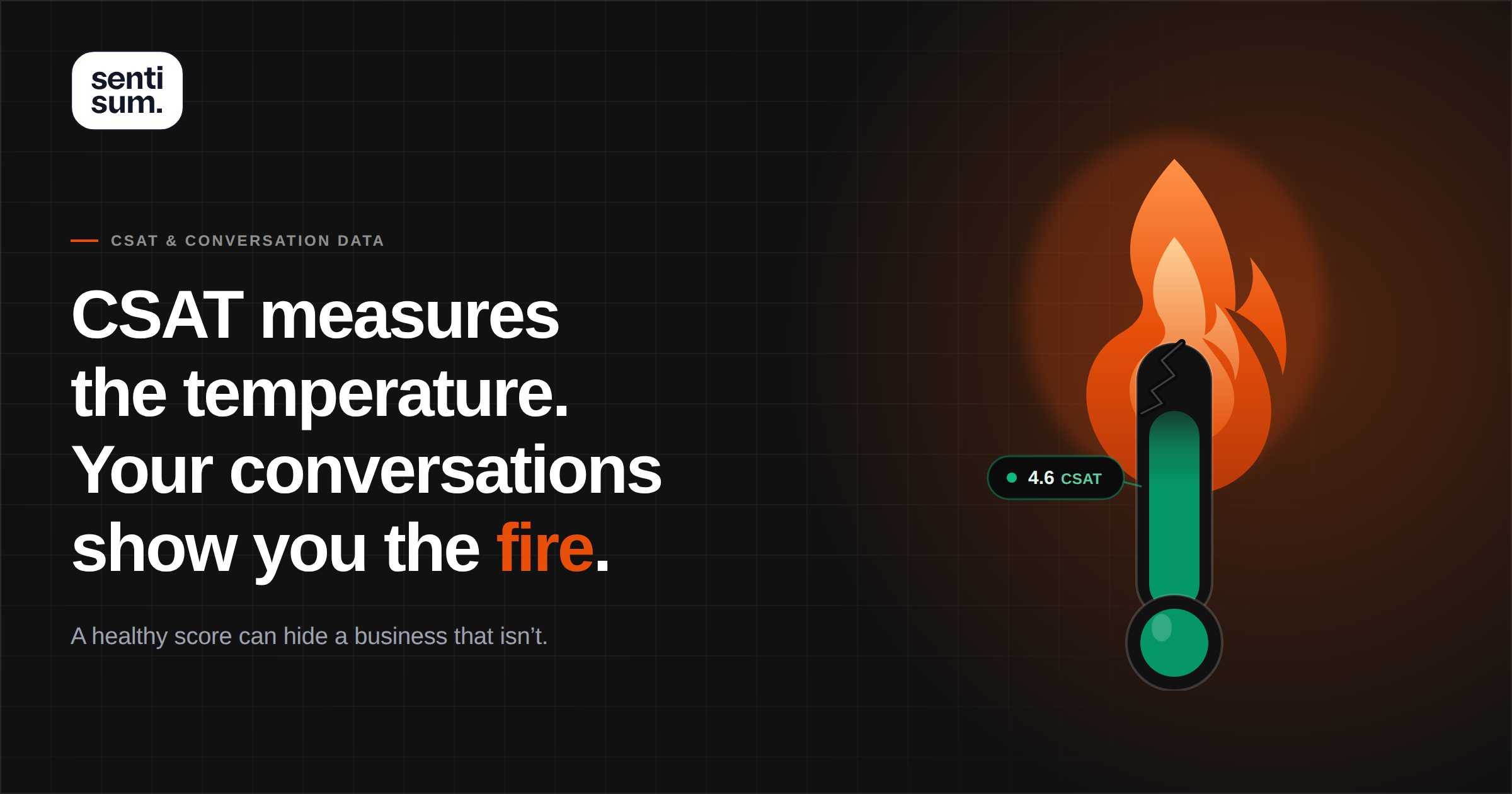
In retail, high Customer Satisfaction (CSAT) scores or stable Net Promoter Score (NPS) can be misleading. For instance, a business might achieve a 90% satisfaction rate, while refunds rise by 25%, and 30% of customers contact support more than once for the same issue.
Negative reviews tend to multiply, with 50 low-star posts appearing in a week, despite dashboards showing perfectly “healthy” results.
So, the problem is not the feedback data; it’s the scale and level of fragmentation.
Feedback typically comes through thousands of support tickets, hundreds of social mentions, and countless product reviews. As a result, making clear deductions or tracking patterns becomes nearly impossible.
In this guide, we explore how AI retail customer experience tools, such as Sentisum, can analyze these scattered signals in real time, identifying the issues that drive churn.
What Retail Customer Experience Insights Actually Mean Today
Omnichannel retail customer insights are no longer retrospective. They capture what customers are experiencing in real time, across every touchpoint: support tickets, product reviews, social media, chat, and surveys.
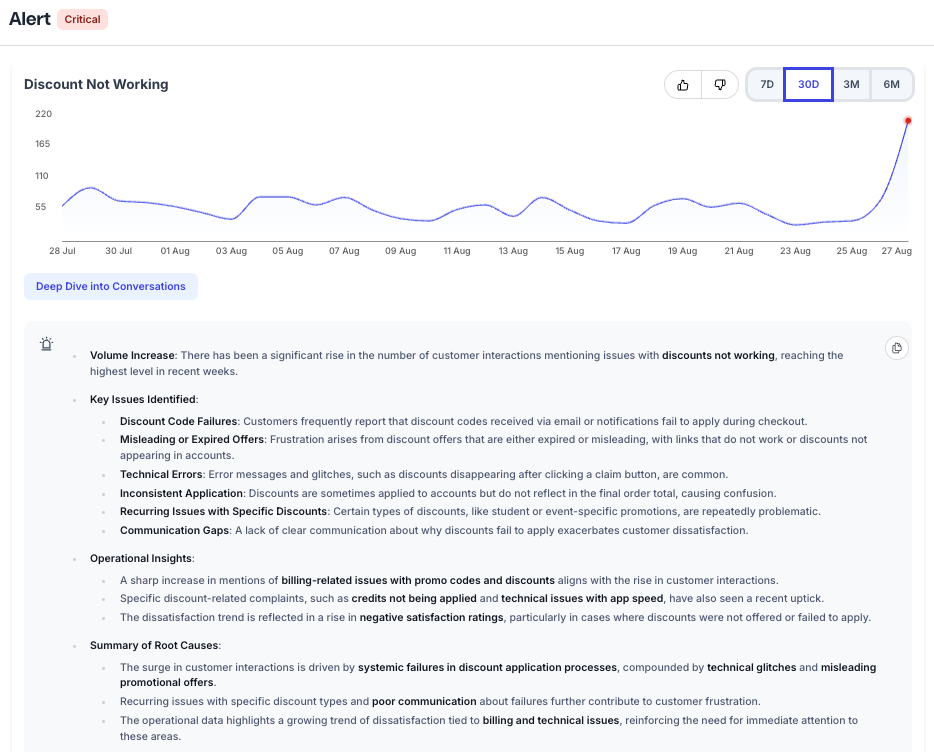
These signals reveal operational gaps and friction points, often before customers take their business elsewhere.
The key distinction is between knowing what happened and understanding why it’s happening right now. Traditional methods deliver lagging indicators, quarterly trends showing an 8% rise in delivery complaints, but they rarely reveal the root cause: which carrier, which region, or whether operational changes are at fault.
As a result, top retail teams now rely on monitoring systems that detect emerging issues, explain their causes, and enable rapid resolution.
Insights are no longer static reports; they are active, actionable intelligence that drives timely decisions and prevents churn. But achieving it requires solving a fundamental problem: why retail CX fails in the first place.
Why Retail CX Breaks Down Across Channels
Retail customer experience breaks down across channels because each team only sees a fragment of the customer’s journey, and there’s no unified view connecting those fragments. In essence, data is siloed across support, ecommerce, finance, and social media.
Manual processes and spreadsheets can’t keep up with the volume or complexity of customer interactions. So, patterns and systemic issues go unnoticed until they escalate. It leads to repeated contacts, unresolved problems, and frustrated customers who feel ignored.
This isn't a rare scenario; it's every week for most retail operations.
Even with good categories, tagging is inconsistent, slow, and always behind. By the time you've tagged enough tickets to spot a pattern, you're already handling repeat contacts, rising refunds, and customers who think you don't care.
- Spreadsheets and basic dashboards often fail when dealing with a large number of customer comments. You can't manually read through that much feedback looking for themes.
- You can't spot sentiment changes across multiple channels without a system specifically designed to do so.
- You also can't keep support, operations, product, and CX teams on the same page when everyone's looking at different pieces of incomplete data.
By the end of the day, you’ll get repeat contacts increase because concerns aren’t resolved the first time. Refunds spike as customers give up on getting help. Agents escalate issues without understanding whether they’re isolated problems or part of a larger systemic failure.
Retail customers don't usually leave because they're unhappy; they leave because their troubles remain unsolved, which makes them feel like the company doesn't care. It is precisely why AI has become essential: detecting patterns at scale that no human team can spot manually.
How AI Changes Retail Customer Insights
AI identifies patterns across vast volumes of conversations that humans simply cannot detect, not because people aren’t capable, but because the scale makes it impossible.
Let’s take an example.
AI doesn’t just label feedback as good or bad
Retail sentiment analysis tracks emotional shifts and urgency levels, revealing when routine issues escalate into deal-breakers. Slight annoyance over a delayed order is different from a customer saying they will never order again, and AI identifies that distinction at scale.
Theme clustering uncovers problems no human team could catch. Customers describe the same issue in multiple ways: “checkout wouldn’t apply my discount,” “promo code didn’t work,” “sale price didn’t show up,” or “charged full price even though it was on sale.”
AI recognizes these as the same underlying situation, even when the exact words differ.
Adding customer behavior creates an even clearer picture. By combining what customers say with their actions, this approach to customer data insights for retail identifies not only the problem but also who is at risk and why.
AI retail analytics reduces manual work without removing human judgment. It tells you what’s happening and why it matters. Your team then determines the best course of action. That’s the balance that delivers both insight and action.
Introducing AI Agent-Led Retail Customer Insights
As you know, there's an important difference between AI tools and AI agents:
- AI tools give you dashboards. They help you tag tickets more efficiently, display sentiment graphs, and identify trends. However, someone still needs to regularly review reports and determine what's important.
- AI agents watch, explain, and suggest actions. They go beyond automation, as they are autonomous. They monitor issues for you, understand what they're seeing, and tell you what you need to know when you need to know it.
It is exactly the shift retail teams need: from "what happened?" to "what should we do next?"
Powered by AI-native platforms, an AI agent grasps the entire context:
- Knows that a 40% increase in delivery complaints might be normal holiday volume in December, but signals a problem in March
- Recognizes a spike in "where is my order" contacts around a specific product launch, which probably means a fulfillment issue with that SKU
- Connects feedback across channels, so when the same issue appears in tickets, reviews, and social comments, it flags the most pressing concern
Furthermore, AI agents explain, not just alert. When it detects an unusual pattern, you don't just get a notification that the volume is up. You get a summary:
"58 tickets in the past 24 hours mention delayed orders with Carrier X in the Northeast region, up 180% from normal. Customers are frustrated and urgent. 12 customers are saying they'll cancel future orders."
That explanation tells you what's happening, where it's concentrated, how customers feel, and what's at risk. Your team acts immediately because now they fully understand the problem.
How Kyo, SentiSum's AI Agent, Works in Retail
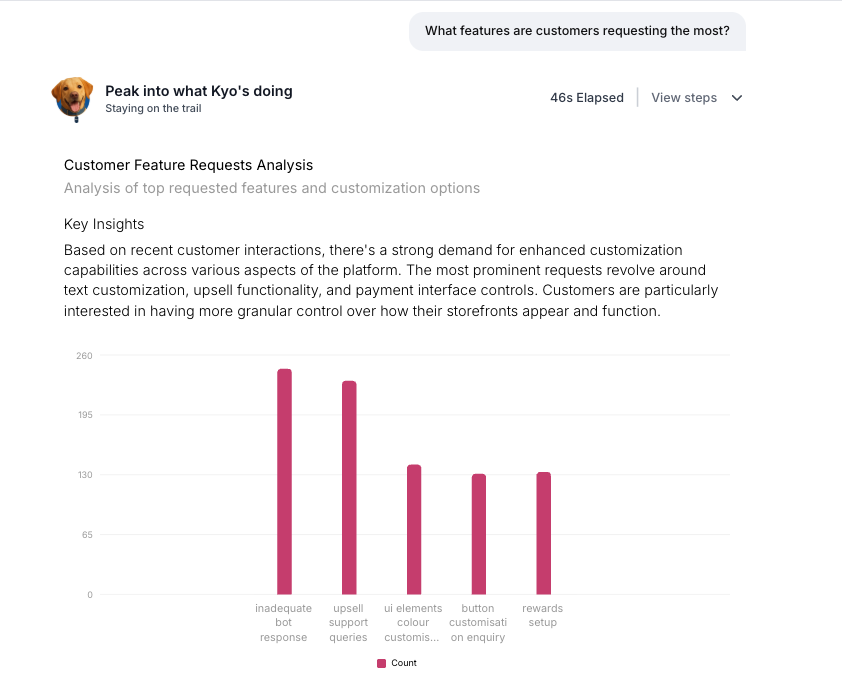
Kyo, SentiSum's AI agent, highlights anomalies, detects churn risks, and suggests next-best actions in real time. It analyzes every piece of customer feedback across your business: support tickets, product reviews, post-purchase surveys, social media mentions, and chat transcripts.
Kyo powers two specialized agents that work together:
- Early Warning Agent: Spots delivery delays, payment problems, and product quality concerns as they happen.
- Insights Agent: Explains the "why" behind customer frustration and churn signals.
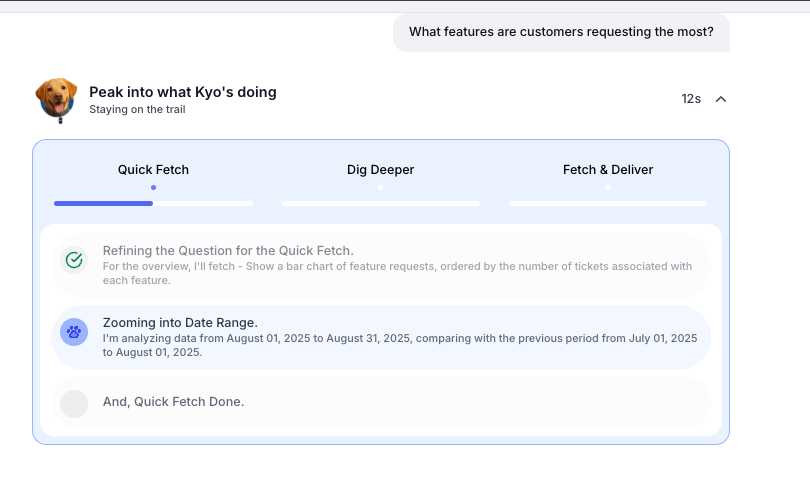
When customers mention delivery problems in tickets, review products negatively due to packaging issues, or post frustrations on social media about payment troubles, Kyo sees it all simultaneously and connects the dots.
Here’s how:
1. Detecting anomalies across retail operations
Kyo monitors the critical areas where retail CX typically breaks down, like delivery delays and carrier problems, returns friction and refund confusion, payment and checkout difficulties, and product quality concerns.
But instead of just tracking volume, Kyo looks for unusual patterns that signal something's genuinely wrong.
This is what it looks like in action:
2. Emerging root causes
Here's where Kyo becomes truly valuable for retail teams.
Say there's a sudden increase in "refund delay" complaints. Kyo doesn't just tell you volume is up. It investigates: the spike is concentrated around orders processed through a specific payment gateway. The issue started 48 hours ago. 70% of affected customers are repeat buyers.
Kyo identifies the root cause in a clear summary:
"Recent payment processing change is causing refunds to take 7-10 days instead of 3-5 days. Customers are contacting support because they expected processing based on your stated policy. Impact: 84 tickets, 70% repeat customers, high frustration sentiment."
No jargon. No confusing graphs. A clear explanation that your team can find most useful.
3. Delivering insights where your team works
Kyo delivers insights directly into Slack, Zendesk or email, wherever your team actually operates. You don't need to remember to check another platform or log into a separate dashboard.
The summary arrives with context: what's happening, where it's concentrated, how customers feel, and what's at risk. The suggested action is specific:
"Update knowledge base article about refund timelines, proactively notify affected customers, and escalate to the payments team for resolution."
A Real Example: From Detection to Resolution
Here's how it works in practice:
- Tuesday 9 AM: Kyo detects a pattern through retail VoC analytics. "Delivery delays with Carrier X in the Pacific Northwest region, affecting 89 orders over the past 3 days. High customer frustration. Issue appears to be facility-level problem at Seattle hub."
- Tuesday 9:30 AM: Your operations team contacts the carrier and confirms a temporary staffing issue at the Seattle facility.
- Tuesday 11 PM: Orders are rerouted to an alternative carrier. Support updates the knowledge base with realistic delivery expectations.
- Tuesday 2 PM: Affected customers receive proactive messages with updated delivery timelines and a goodwill gesture.
- Wednesday: Your CX team monitors sentiment to confirm that the matter has been resolved. Customer frustration drops. No social media escalation. No CSAT damage.
This is the difference between reactive CX management and proactive, AI-native problem-solving.
Kyo surfaces pain points while they're still fixable, explains the root cause so teams act decisively, and keeps everyone aligned on what actually matters right now.
Conclusion: Turning Insights Into Retention and Revenue
Retail customer insights help you keep customers and protect revenue by spotting problems early. When you identify and resolve friction points like a delivery delay promptly, you prevent complaints, negative reviews, and lost business.
Using AI to track feedback reduces repeat contacts, lowers support costs, and enables agents to resolve issues faster with greater confidence. When all teams see the same real-time insights, everyone focuses on fixing the right concerns.
Acting proactively enhances customer trust, prevents brand damage, and translates insights into tangible results: fewer churned customers, lower costs, and improved experiences.
Book a demo with SentiSum and discover how Kyo assists retail teams in fixing CX issues before customers leave.
Frequently Asked Questions
Retail customer insights are the real-time understanding of customer feedback across all touchpoints: support tickets, product reviews, surveys, social media, and chat.
Unlike traditional metrics that report historical trends, modern retail customer experience insights identify emerging friction points, explain root causes, and surface what needs fixing before customers leave.
Leading retailers use customer data insights as an early warning system rather than a reporting tool. They monitor feedback to detect anomalies like delivery delays, return friction, or pricing confusion.
When problems emerge, they investigate root causes, align teams around priorities, and fix pain points before they scale. This approach prevents churn, reduces repeat contacts, and protects revenue.
The best tools for retail AI customer insights go beyond basic dashboards and surveys. They unify feedback from support tickets, reviews, social media, and chat in real time, detect anomalies automatically, and explain root causes in plain language. AI-native platforms like SentiSum deliver insights directly into team workflows rather than requiring manual dashboard reviews.
AI retail customer analytics interprets customer feedback at scale, identifying patterns across hundreds of conversations that human analysis would miss. It detects sentiment shifts, clusters themes across varied languages, and connects signals across channels to reveal root causes.
AI agents like Kyo monitor feedback, explain anomalies in plain language, and recommend specific actions, moving teams from reactive reporting to proactive resolution.
Most retail churn starts with unresolved problems, not explicit dissatisfaction. Customers experience delivery delays, return confusion, or pricing issues, and when these aren't fixed quickly, they simply shop elsewhere. Retail churn prevention analytics reveal these friction points while they're still fixable. Early detection allows teams to resolve issues, prevent repeat contacts, and protect customer relationships before frustration turns into lost customers.
Explore Real Success Stories

Explore Success Stories


Talk to a Data Expert