.webp)



.webp)
.svg)


TL;DR
- For CX leaders: Detect churn signals earlier by analyzing real support conversations rather than relying on delayed survey feedback.
- AI-native differentiation: Analyze real-time operational intelligence across tickets, calls, reviews, and social channels to remove data silos that hide churn drivers.
- Cross-functional value: Bring together Support’s root causes, Product’s feature gaps, and Customer Success at-risk accounts into a single source of customer truth.
- Subscription business focus: Reduce churn in subscription businesses where small improvements in retention can have an outsized impact on profitability.
- Speed to implementation: Get high-quality tagging and insights quickly, with minimal setup and no manual taxonomy required.
- Strategic advantage: Surface anomalies and recommended actions early, before KPIs decline and revenue is at risk.
If you lead customer support, product, operations, or marketing in a fast-growing company, customer feedback is overwhelming. Worse still, it is scattered across tickets, NPS comments, reviews, chats, surveys, and social media.
As a customer support leader, you need clear answers, but your teams are often forced into reactive mode. Customer data sits in messy spreadsheets and disconnected dashboards, making it hard to see why customers churn and where to focus to improve retention.
That’s where customer insights analytics can benefit.
Instead of guessing why churn is rising or why Customer Satisfaction (CSAT) has dropped, AI-native VoC tools like SentiSum consolidate all that unstructured feedback in one place. You get quick, actionable insights your team can use to improve satisfaction.
What Is Customer Insights Analytics?
Customer insights analytics gives CX, product, and operations leaders a clear, real-time view of what’s helping or hurting the customer experience, and what to fix first to protect retention.
Static reports and disconnected dashboards fall short of showing what’s really happening. Teams get live signals that reveal where customers struggle, why frustration is rising, and which issues will drive churn if left unresolved.
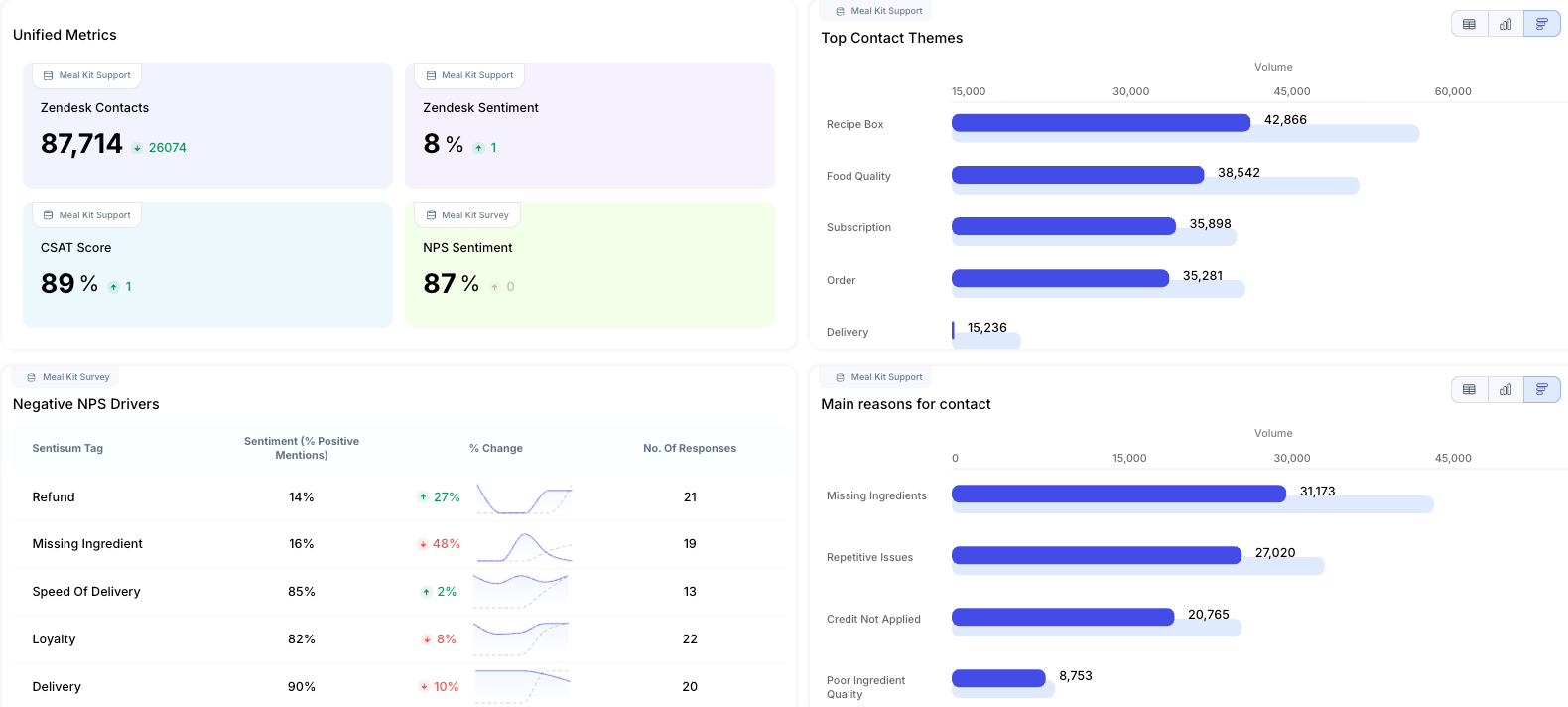
It shows how customers actually move through critical journeys, such as onboarding, checkout, and support, highlighting drop-offs and friction points that don’t appear in survey scores alone.
AI-driven sentiment analysis surfaces emotions and intent hidden inside tickets, chats, reviews, and open-text feedback, so teams understand not just what happened, but how customers felt.
Predictive insights flag churn risk and dissatisfaction early, giving teams time to act before customers leave. Real-time alerts expose emerging problems, such as a sudden spike in delivery complaints or product bugs.
By unifying voice-of-the-customer data from support, product usage, surveys, and social channels, teams get a single, reliable view of what customers are experiencing.
This shared perspective helps leadership prioritize the right actions and align across functions.
It also turns customer feedback into measurable gains in satisfaction, loyalty, and revenue.
AI-native customer analytics tools like SentiSum solve these problems by automating the heavy lifting, consolidating all your feedback in one place, and providing clear, trustworthy insights.
Why Customer Insights Analytics Has Become Core to CX and Retention Strategies
Customer insights analytics enables businesses to understand what customers are saying across all channels in one place. It shows early signs of problems that could make customers leave. And it gives teams quick alerts so they can fix issues and keep customers satisfied.
Here’s how that helps:
1. Customers share feedback across every channel
Customer feedback shows up everywhere: support tickets, reviews, surveys, chats, and social channels. When this information stays fragmented across tools and teams, it becomes harder to see patterns, understand root causes, and act quickly on what customers need most.
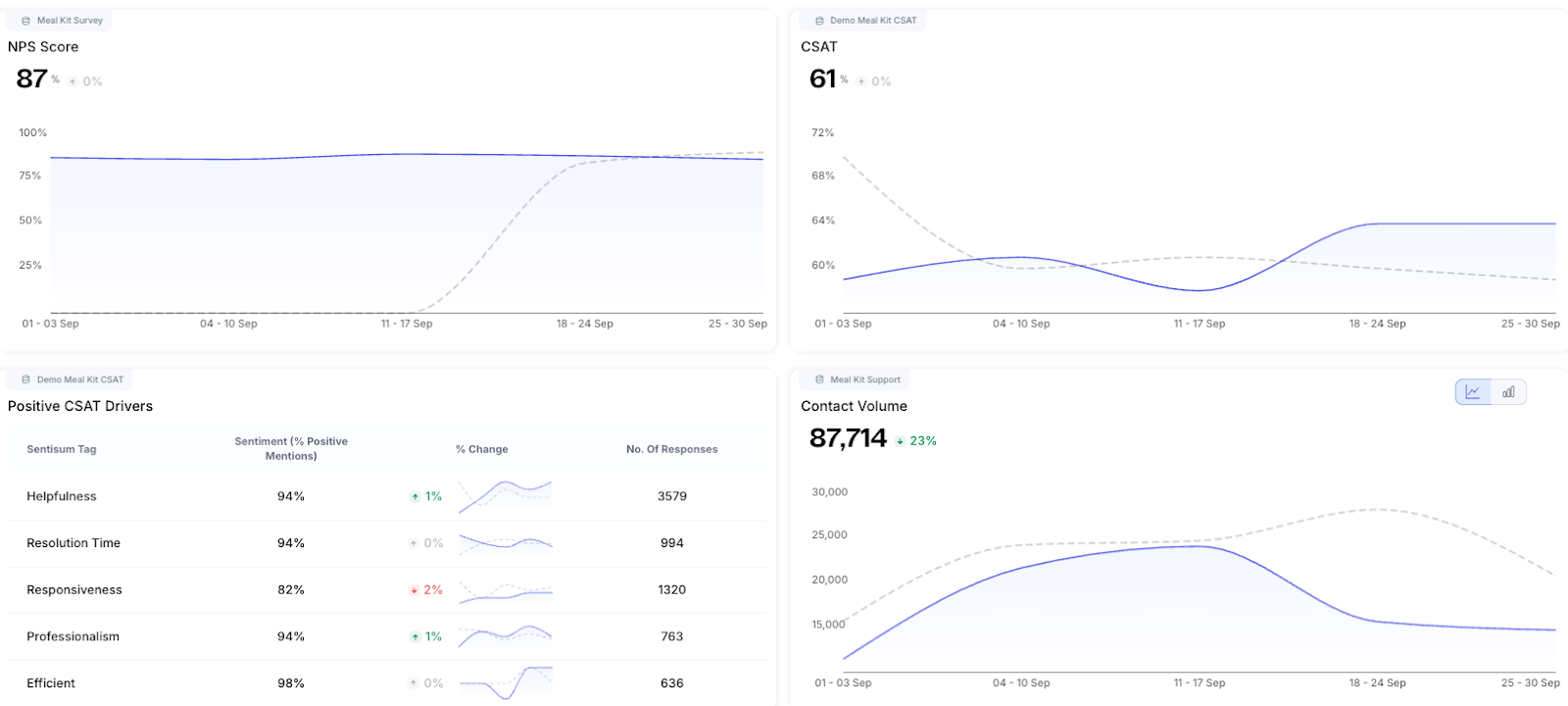
Customers don’t separate their feedback by channel. They leave a one-star app review, vent on X, answer an NPS survey bluntly, open a support ticket, and raise the same issue with their account manager.
Inside the business, that feedback is split across tools and teams.
- CX sees tickets
- Marketing sees social
- Product sees reviews and feature requests
Without strong customer feedback analytics to connect these signals, critical issues get missed, ownership stays unclear, and churn risks go unnoticed.
Each team is doing its best, but each is looking through a keyhole. No one sees the whole room.
This is where customer insights, analytics, and Voice of the Customer analytics have started playing a larger role, unifying all customer input into a coherent story.
Let’s take an example:
2. Predictive analytics makes churn prevention proactive
Churn doesn’t start on the renewal date. It starts months earlier:
- Customers feel they’re not being heard
- The same issue happens for the third time
- A billing, onboarding, or product experience creates friction again and again
If your only signal is a cancelled contract or a closed account, you’re already too late.
Without churn prevention analytics, most teams are stuck in a reactive pattern:
- Churn happens
- You dig into a handful of lost accounts
- You realize there were clear warning signs of support frustration, delayed orders, and poor onboarding, all of which were reflected in your feedback
However, with predictive analytics for customer insights, here’s how you can turn that story around:
- Spot accounts where negative sentiment is rising over time
- Identify repeated complaints that strongly correlate with churn
- Prioritise proactive outreach to at-risk segments before renewal dates
3. Real-time insights speed up issue resolution
When something goes wrong at scale, every minute counts. A bad release, a payment outage, a shipping delay, none of these wait for the end-of-month report.
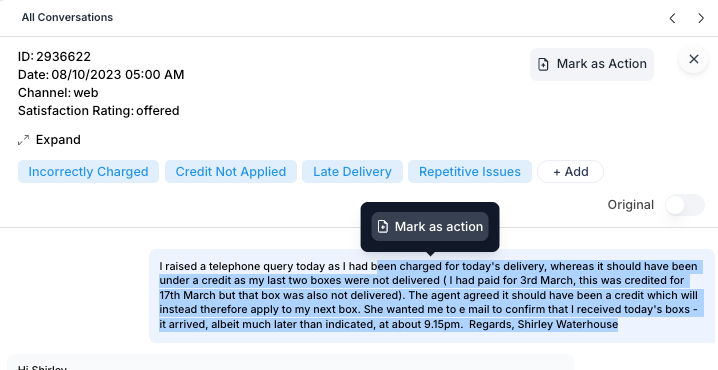
Real-time customer satisfaction analytics and insights provide support and operations teams with early visibility into problems that would otherwise surface too late.
Rather than waiting for customers to complain publicly or escalate through leadership, teams can:
- Spot sudden increases in tickets after a release
- Friction in onboarding
- Recurring issues with refunds, shipping, or logins as they begin to emerge
With real-time alerts and anomaly detection, leaders can see issues unfold in the moment, understand what customers are actually saying, and quickly bring the right teams together. It allows organizations to contain impact, protect key accounts, and fix problems before they turn into churn drivers or PR risks.
The Role of Artificial Intelligence in Customer Insights Analytics
Support tickets, chats, reviews, surveys, and social posts create a constant stream of unstructured data that’s impossible to process in real time without automation. AI makes it manageable by analyzing incoming feedback, identifying patterns and sentiment instantly, and turning raw customer input into actionable insights.
Here’s how:
Real-time anomaly detection
AI flags unusual spikes the moment they happen. If payment failures increase after a release or if refund requests double within a few hours, the support, product, and engineering teams are alerted immediately.
This prevents trial drop-offs, reduces ticket backlogs, and stops revenue-impacting issues before they reach social media or executive inboxes.
Automatic theme clustering at scale
Customers describe the same problem in different ways. AI automatically groups all related feedback, such as shipping delays or login failures, into a single issue. CX and operations leaders get a clear view of what’s breaking, how widespread it is, and where it sits in the funnel, without manual cleanup.
Consistent tagging you can rely on
Manual tagging creates inconsistent data that leaders can’t trust. AI applies a single classification model to every ticket, channel, and region.
That consistency gives product and CX leaders accurate trend analysis and confidence when prioritizing fixes that affect retention and expansion.
Predictive signals tied to churn
AI connects behavior, sentiment, and usage patterns to identify accounts at risk before renewal discussions begin.
If customers who struggle during onboarding tend to churn within 60 days, AI flags new accounts showing the same signals so customer success teams can intervene early.
Executive-ready summaries
AI turns thousands of conversations into clear weekly summaries that show top issues, what changed, and what needs action now. Leaders get answers, not dashboards, and teams spend time fixing problems rather than building reports.
This is why AI-native customer insights outperform traditional analytics. They surface risk early, connect feedback to funnel outcomes, and give teams the time and clarity needed to protect revenue and retention.
Meet Kyo: SentiSum’s AI Agent
Kyo AI Engine is built for CX leaders who need answers from customer feedback, not another dashboard to interpret. It continuously analyzes every customer conversation across tickets, reviews, surveys, and social channels, then surfaces what’s changing, what’s broken, and what needs action now.
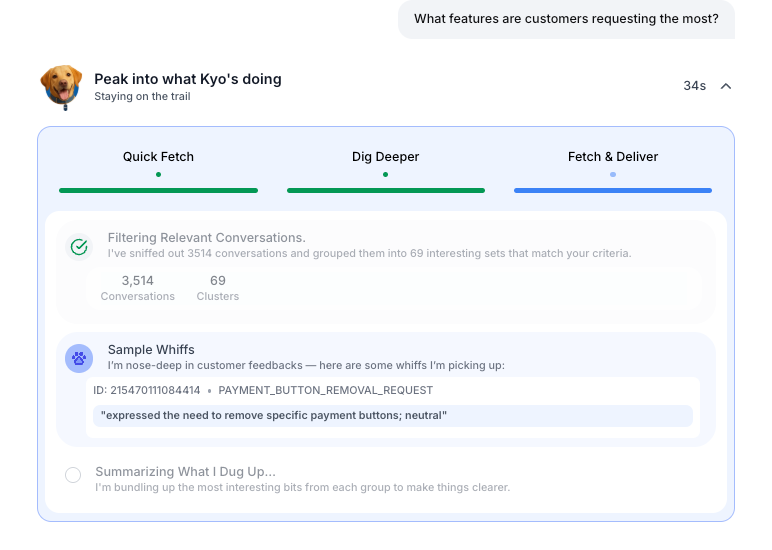
Compared to traditional analytics tools that rely on manual setup and delayed reporting, Kyo works as an always-on analyst. It reads every interaction, connects related issues across channels, and turns raw feedback into clear insights teams can act on immediately.
This gives CX, Product, Operations, and Marketing teams a shared, real-time understanding of customer risk, friction, and opportunity, without waiting on reports or analysts.
Here’s how Kyo comes into play:
1. Real-time summaries of conversations
Kyo automatically summarizes tickets, chats, reviews, and survey responses as they come in. Teams know exactly what customers are talking about without reading every message.
2. Trend detection
Kyo also identifies patterns early. For example:
- If complaints about a new feature slowly increase, Kyo highlights it.
- If sentiment drops for a specific customer segment, Kyo alerts the right team.
This helps companies address issues before they become widespread.
3. Anomaly detection
When something unusual happens, like a surge in login failures or refund requests, Kyo flags it immediately and points to the source of the issue.
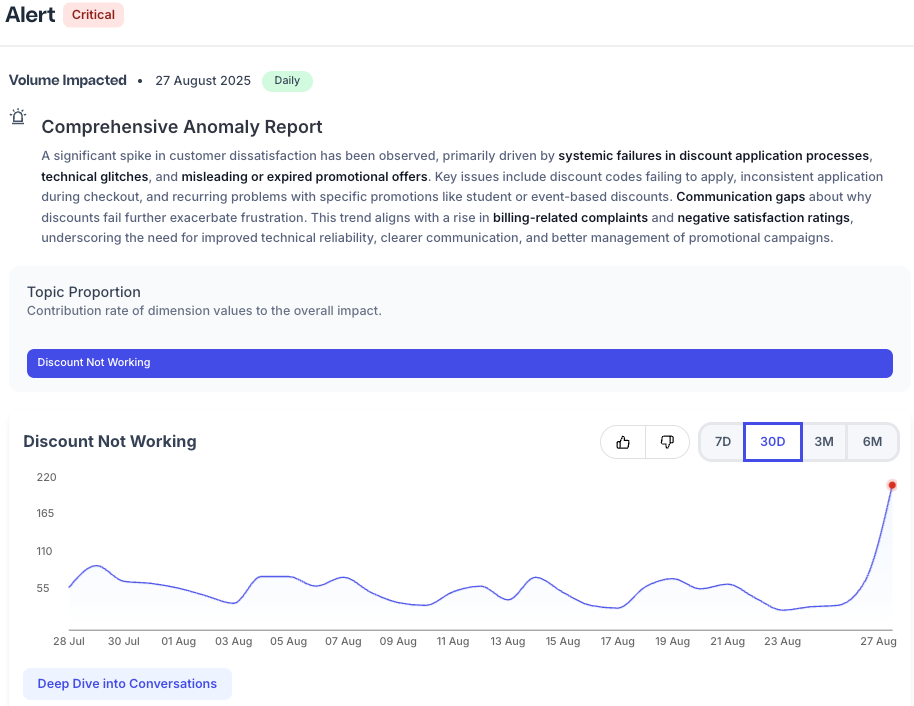
Teams don’t have to hunt through dashboards. They get the answer directly.
4. Actionable recommendations
Kyo doesn’t just say “there’s a problem.”It suggests what to do next. For example:
- If onboarding complaints rise, Kyo may recommend updating guides or assigning CSMs to affected users.
- If billing questions spike, he may suggest reviewing invoices or updating the FAQ.
This enables teams to move from awareness to action.
How SentiSum Helps Teams Act on Insights Faster
As an AI-native VoC platform, SentiSum gives CX leaders, Customer Success teams, and Product managers a way to understand customer feedback at scale. It brings tickets, reviews, and surveys into one place and turns them into clear insights your teams can act on.
With predictive signals and real-time alerts, you can spot issues earlier, prevent churn, and improve satisfaction across the entire customer journey.
1. Unified feedback analysis across channels
Most teams in growing companies don’t struggle because they lack feedback; they struggle because every team sees something different.
- CX sees support tickets.
- Product sees bug reports and app reviews.
- Marketing sees social media comments.
- CS sees renewal risks and customer frustrations.
- Ops sees delivery, billing, and process issues.
Siloed data leads to slow reactions, repeated issues, and misaligned priorities.
To combat it, SentiSum gives your organization one shared source of truth by pulling all feedback into a single dashboard, including:
- Tickets and chat transcripts (Support / CX)
- Email and phone logs (Support / Ops)
- NPS, CSAT, CES, onboarding, and renewal surveys (CX / CS)
- Social, app store, and product reviews (Marketing / Product)
This unified view helps teams align, identify root causes more quickly, and avoid building separate reports that never match.
2. Predictive analytics for churn and satisfaction
CX and CS teams often know a customer is slipping only when usage drops or renewal time arrives.
- Product teams only hear about issues after they escalate
- Ops teams only learn about failures when volumes spike
SentiSum gives these teams early warning signals before customers churn or escalate issues. Its predictive analytics lets teams:
- See which accounts show rising negative sentiment
- Identify customers who are sending repeated complaints
- Understand how bugs, outages, billing issues, or policy changes affect churn
- Prioritize high-risk accounts for proactive outreach
3. Intelligent ticket tagging and sentiment clustering
For Support, CX, and Ops teams, manual tagging is a huge pain:
- Agents use different tags
- Categories become inconsistent
- Reports don’t match across teams
- The product receives unclear, messy data
SentiSum removes this problem entirely by automating tagging and sentiment analysis. You get:
- Accurate, standardized tags across all teams
- Reliable sentiment scores
- Hundreds of hours saved in manual work
- Clean data for quarterly business reviews, VOC meetings, and roadmap planning
It is especially useful for high-volume environments like e-commerce, fintech, and SaaS support.
4. Anomaly detection and real-time alerts
In fast-moving businesses such as SaaS deployments or financial transactions, issues arise suddenly and spread quickly.
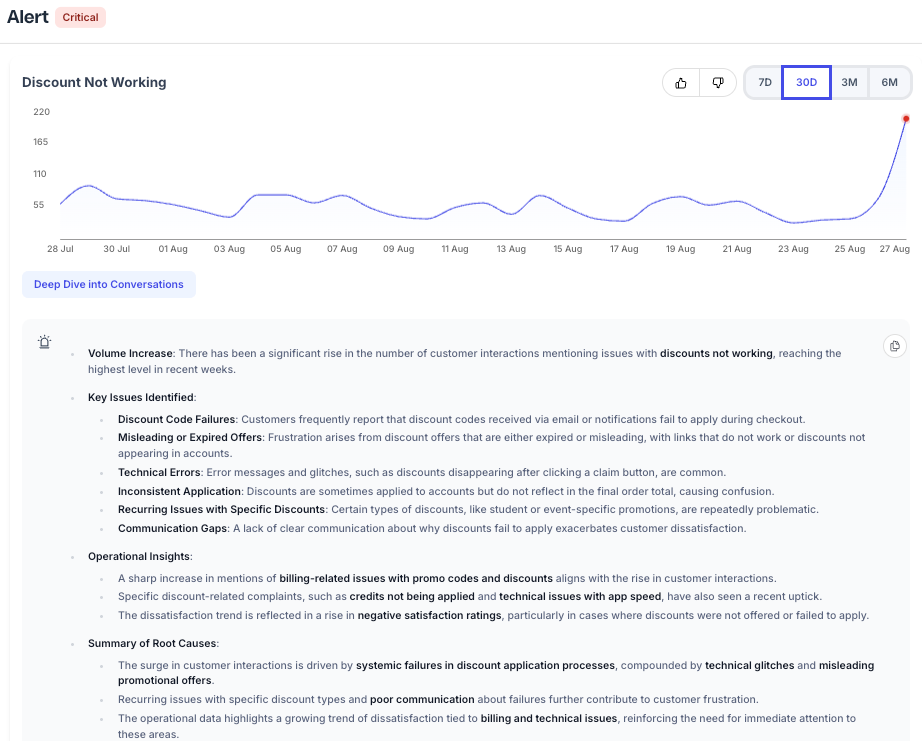
A spike in complaints about a broken checkout flow or a buggy feature release can cascade within hours, triggering ticket floods, social media backlash, escalations to leadership, and ultimately churn.
By the time traditional dashboards surface the pattern, the damage is already done.
SentiSum's Early Warning Agent continuously monitors feedback across all channels, detecting anomalies as they happen and alerting the right teams before small problems become business-critical incidents.
When complaint volume spikes around a specific issue, when new problems emerge that weren't present yesterday, or when satisfaction suddenly drops after a product update, Kyo flags it immediately with root cause context.
This real-time detection means your team can investigate a delivery delay within hours instead of discovering it weeks later in a quarterly review. You catch the faulty promo code on Black Friday before it costs you significant revenue. Also, you spot the UX friction in your new onboarding flow before it drives away trial users.
Why AI-Powered Customer Insights Is the Future of CX
Companies can no longer rely on manual analysis to understand customers. This shift improves retention, raises satisfaction, reduces operational workload, and aligns decision-making across teams. With SentiSum and Kyo, organizations gain a smarter way to understand customers and fix issues before they grow.
Book a demo for SentiSum to drive retention with unstructured feedback.
Frequently Asked Questions
Customer insights analytics is the process of collecting and analysing feedback from tickets, surveys, chats, reviews, and social channels to understand customer needs, behaviours, and sentiment. It turns scattered data into clear insights that teams can use to improve products, services, and customer experience.
Customer insights analytics lets teams identify friction points, track sentiment changes, understand root causes, and prioritise the issues that most impact customers. By turning raw feedback into clear patterns, companies fix problems, reduce complaints, and deliver a smoother, more consistent customer experience.
The best tools unify feedback, analyze sentiment, automate tagging, highlight trends, and offer predictive insights. AI-native VoC platforms like SentiSum give teams real-time understanding across tickets, surveys, reviews, and social data, making it easier to find issues, align teams, and act quickly on customer needs.
AI reads and summarizes customer conversations, groups related feedback, detects sentiment shifts, flags anomalies, and predicts churn risks. It gives teams accurate insights without manual review, helping CX, Product, and Support teams act earlier and improve customer satisfaction at scale.
Predictive analytics identifies early signs of churn by analysing behaviour patterns and negative sentiment. It highlights at-risk accounts, reveals what’s causing dissatisfaction, and allows teams to act proactively to reduce churn, strengthen relationships, and improve long-term customer lifetime value.
Explore Real Success Stories

Explore Success Stories


Talk to a Data Expert