Customer Sentiment

5 Best AI Sentiment Analysis Tools 2026

5 Best AI Sentiment Analysis Tools 2026
Marketing Director at SentiSum
LinkedIn icon
5 Best AI Sentiment Analysis Tools 2026

This one main flaw in traditional sentiment tracking might resonate with Heads of Support and CX leaders.

Dashboards might flag tickets as “negative,” but they rarely explain:

  • What’s actually frustrating customers
  • Which issues matter most
  • Where your team should focus to fix right now

Most tools only explain the reasons for negative sentiments retrospectively. What modern CX teams really need is immediate visibility, something that catches problems as they start, explains what’s causing them, and shows which actions to take that can prevent churn.

Modern AI sentiment analysis tools go beyond basic positive or negative labels. They track sentiment in real time, uncover the root causes of frustration, highlight patterns that signal churn risk, and much more. 

In this guide, let’s explore how the top 5 sentiment analysis tools in 2026 square up.

What Is AI Sentiment Analysis?

AI customer sentiment analysis relies on natural language processing (NLP) and machine learning to understand customer sentiment from unstructured feedback. This includes support tickets, live chats, surveys, reviews, call transcripts, and social media posts.

Manual sentiment analysis, in contrast, requires humans to read messages one by one, making the process subjective. This is exactly where AI removes the limitation, as it can analyze thousands or millions of interactions at scale and apply consistent logic to every data point. As we noted before, it looks beyond the words customers use and focuses on the emotion and intent behind them, giving teams a more accurate view.

Example: How AI Sentiment Analysis Works

Traditional sentiment tools were built on simple keyword rules. Words like "bad" or "hate" were marked as negative, while "great" or "love" were marked as positive.

However, this method collapses in real conversations. Sarcasm, idioms, and mixed emotions get misclassified.

  • The Negation Trap: A phrase like "It's not bad" confuses keyword tools. They see "bad" and tag it negative, missing the actual neutral sentiment.
  • The Sarcasm Trap: A phrase like "Oh great, another bug" is flagged as positive because of the word "great," hiding a critical product failure.

To tackle this, modern AI-native tools take a different approach. 

They use Large Language Models (LLMs) trained on billions of conversations to understand context, tone, and intent. They recognize that "killing it" is a compliment for a sales team, but a complaint for a battery. 

This foundational shift from keyword matching to contextual understanding provides actionable insights rather than just surface-level scores.

Now that we’ve established what separates legacy software from modern AI, the question becomes: which platform actually delivers on that promise?

Best AI Sentiment Analysis Tools in 2026

Understanding customer sentiment at scale has become essential for businesses looking to improve retention, prevent churn, and respond to feedback in real time. 

Let’s go over the list of the top 5 best AI tools for sentiment analysis in 2026 that can transform raw customer interactions into actionable insights to drive business outcomes:

1. SentiSum: AI-Native Sentiment Analysis for Retention
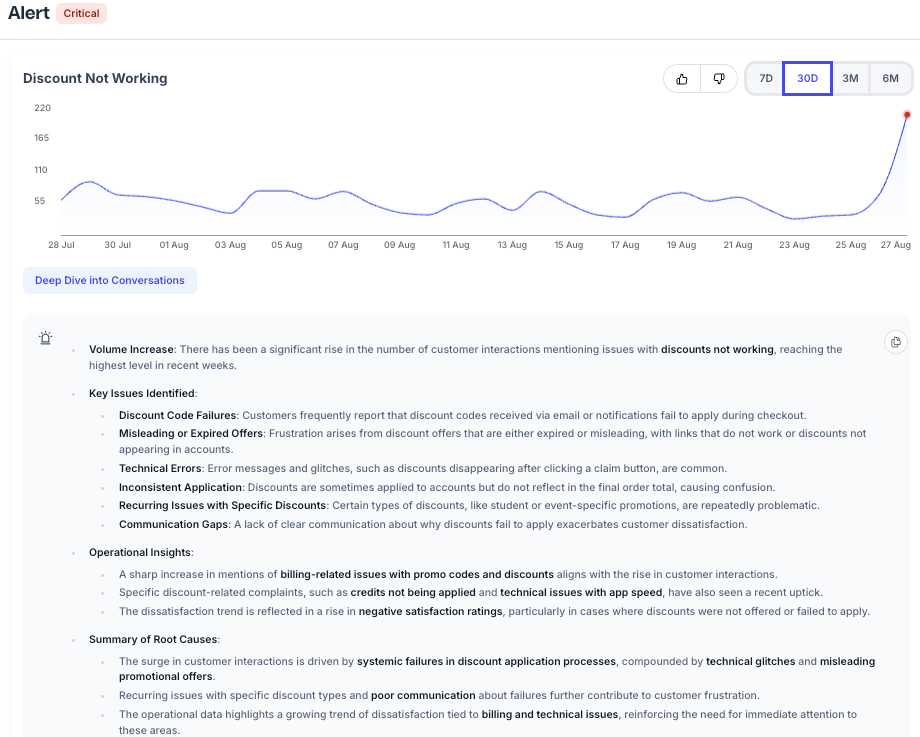
Spike in discount not working issues
SentiSum showing discount issues driving customer complaints

SentiSum is an AI-native sentiment analysis platform purpose-built for mid-market and enterprise teams, as well as subscription-based businesses regularly handling large volumes of customer interactions. 

With native NLP support and Kyo, the domain-trained AI engine built over 10+ years of CX research, it parses through complex data. Diverse sources such as support tickets, calls, chats, surveys, and CRM notes are thoroughly analyzed so that users can generate actionable, to-the-point insights. 

Anyone from the team can put in a simple query, get the actual issues, and have the best steps to nip the chances of churn in the bud. 

So, where legacy sentiment scoring tools provide static sentiment scores, SentiSum identifies customer emotions as early signals of churn, expansion opportunities, and lifetime value. 

Its AI-native design also means sentiment analysis is deeply integrated into how the platform interprets customer behavior, rather than simply layered on top of dashboards.

Additionally, SentiSum goes beyond labeling interactions as positive, neutral, or negative. It explains what changed, why it changed, and recommends next steps to help teams intervene proactively. 

By continuously monitoring every meaningful interaction, the platform links emotional signals directly to business risk, providing a unified and real-time view of customer health and its potential impact on retention.

SentiSum’s Key Features

1. AI-Powered Insight through Kyo

Kyo has a proactive approach to tackling churn. It actively monitors conversations as they happen, detects unusual sentiment patterns, and explains the underlying drivers behind them.

Caption: AI agent analyzing feature requests from feedback

Alt text: Customer feedback analysis showing requested product features

As customer feedback flows in, Kyo clusters related conversations, summarizes emerging themes, and learns from historical patterns to recommend concrete next steps. 

Teams no longer spend time investigating after metrics fall. Kyo surfaces issues early, often before CSAT, NPS, or escalation rates show any change.

And if you ask, how does it differentiate from generic LLM engines like ChatGPT

It’s this: generic LLMs are designed for broad creativity and predictive text generation, whereas the Kyo AI Engine is purpose-built specifically for Voice of the Customer (VoC) analysis. 

Instead of filling knowledge gaps with assumptions (a common risk with open-web models), Kyo operates on an evidence-first framework, learning solely from verified customer feedback to flag uncertainty rather than guessing. 

This specialization ensures enterprise-grade compliance, providing PII safety, data lineage, and audit trails that general-purpose models typically lack.

2. Predictive Churn and Early Warning Signals

Through predictive sentiment analysis, SentiSum learns from historical sentiment patterns and identifies signals that consistently precede churn, often 30 to 60 days before customers leave. 

These insights power the platform’s Early Warning Agent, which flags emerging risks before traditional metrics decline. Teams can intervene early with targeted outreach, product fixes, or operational changes before churn happens and while retention is still recoverable.

As a case in point, UK-based parking technology giant JustPark proved this by stopping a hidden revenue leak. 

With SentiSum, they found drivers getting stuck at barriers due to a missing feature for updating license plates. They shipped a fix immediately, preventing thousands in lost revenue and churn.

Suggested Read: From Siloed Feedback to Instant Action: How JustPark Fixed Problems Before They Cost Thousands

3. Real-Time Sentiment Monitoring

SentiSum’s real-time sentiment detection operates on live data rather than periodic analysis. Sentiment is tracked continuously across all customer touchpoints, allowing teams to spot shifts the moment they occur. 

When it moves in an unexpected direction, the platform triggers alerts so leaders can investigate immediately instead of discovering problems weeks later in retrospective reports. This real-time approach is especially valuable for fast-growing SaaS, retail, and enterprise organizations where sentiment can change rapidly.

4. Automatic Root-Cause Discovery

Rather than forcing teams to manually tag or categorize feedback, SentiSum automatically groups conversations by their real underlying issues. 

Negative sentiment is mapped to specific root causes such as billing friction, onboarding confusion, delivery failures, or missing features, making it clear what is actually driving dissatisfaction.

 Then, each cluster links directly back to the original conversations, so teams can validate insights, understand nuance, and move from diagnosis to action with more confidence. 

5. Unified Customer Sentiment Timelines

One of SentiSum’s most powerful capabilities is its ability to unify sentiment across channels into a single timeline per customer. Tickets, calls, surveys, and CRM notes are analyzed together, revealing how sentiment evolves rather than appearing as disconnected data points.

This holistic view allows teams to understand how repeated “minor” frustrations compound into churn risk and which interactions matter most in changing the customer’s trajectory.

6. Insights Delivered Where Teams Work

SentiSum doesn’t trap insights inside dashboards. Its AI agent sentiment analysis via the Insights Agent pushes recommendations directly into the tools teams already use, including Slack, Microsoft Teams, Zendesk, and email. 

Each alert includes clear context and suggested next steps, making it easy for teams to act immediately rather than translate data into decisions.

7. Seamless Multi-Channel Integrations

The platform connects natively with major CX and support systems such as Zendesk, Intercom, Freshdesk, Dixa, Georgias, and other enterprise tools. This ensures sentiment analysis fits naturally into existing workflows without requiring teams to change how they work.

SentiSum’s Pricing 
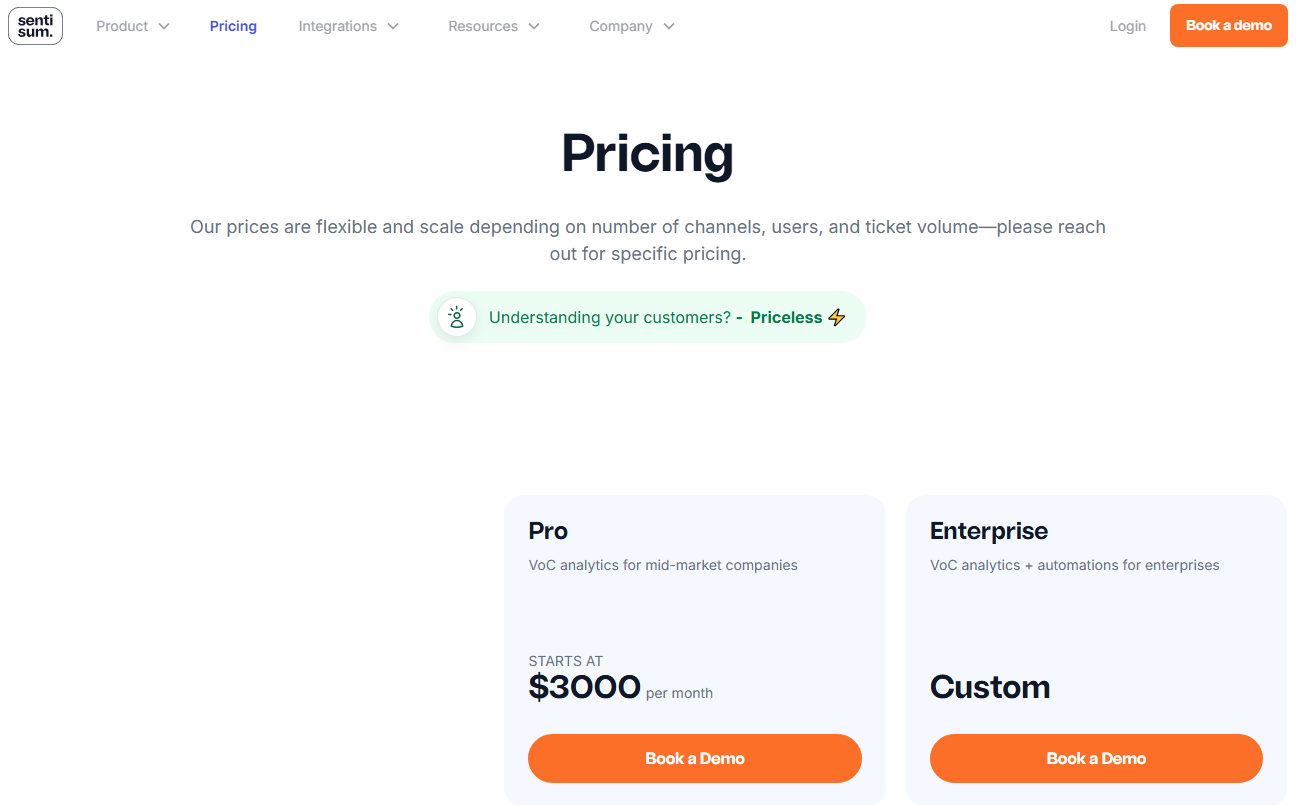
SentiSum pricing page 
SentiSum pricing plans for Pro and Enterprise

SentiSum offers flexible plans tailored to larger teams and complex environments. The Pro tier is aimed at mid-market companies and starts at $3,000 per month for a defined conversation volume and recent historical data. 

Enterprise pricing is fully customizable based on scale, users, and language requirements.

2. MonkeyLearn – No-Code Text Analysis Platform
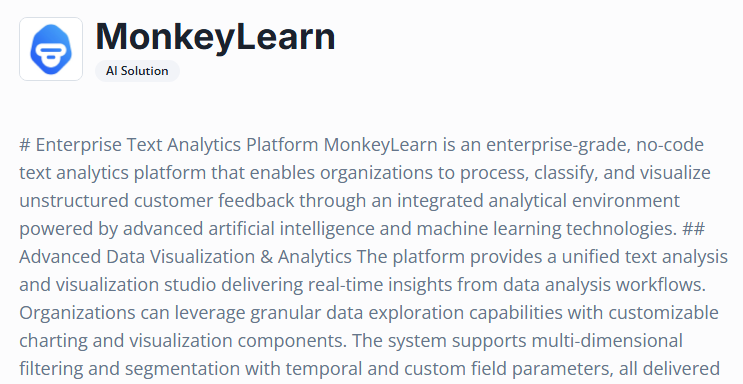
MonkeyLearn page describing AI-powered text analysis and visualization
MonkeyLearn AI platform for no-code enterprise text analytics

MonkeyLearn is a user-friendly text analysis platform that enables businesses to perform sentiment analysis without programming knowledge. It allows users to build custom machine learning models tailored to specific use cases, making it accessible for teams who need sentiment analysis but lack data science resources.

The platform specializes in processing customer feedback from emails, support tickets, surveys, and reviews, with particular strength in recognizing industry-specific language and emotions.

MonkeyLearn Key Features

  • Custom Model Creation. The software builds tailored sentiment models through a simple graphical interface without writing code.
  • Pre-Built Models. You can access publicly available sentiment classifiers for common use cases, including topic detection, keyword extraction, and entity recognition.
  • Text Classification. It categorizes feedback into custom categories or tags for sentiment analysis, topic detection, and aspect identification.
  • Sentiment and Entity Extraction. It also allows you to identify specific data points like keywords, names, companies, and sentiment indicators within text.

MonkeyLearn Pricing

MonkeyLearn costs $299 a month for 10,000 queries. Contact them for more custom pricing.

3. Brandwatch – Social Listening At Scale
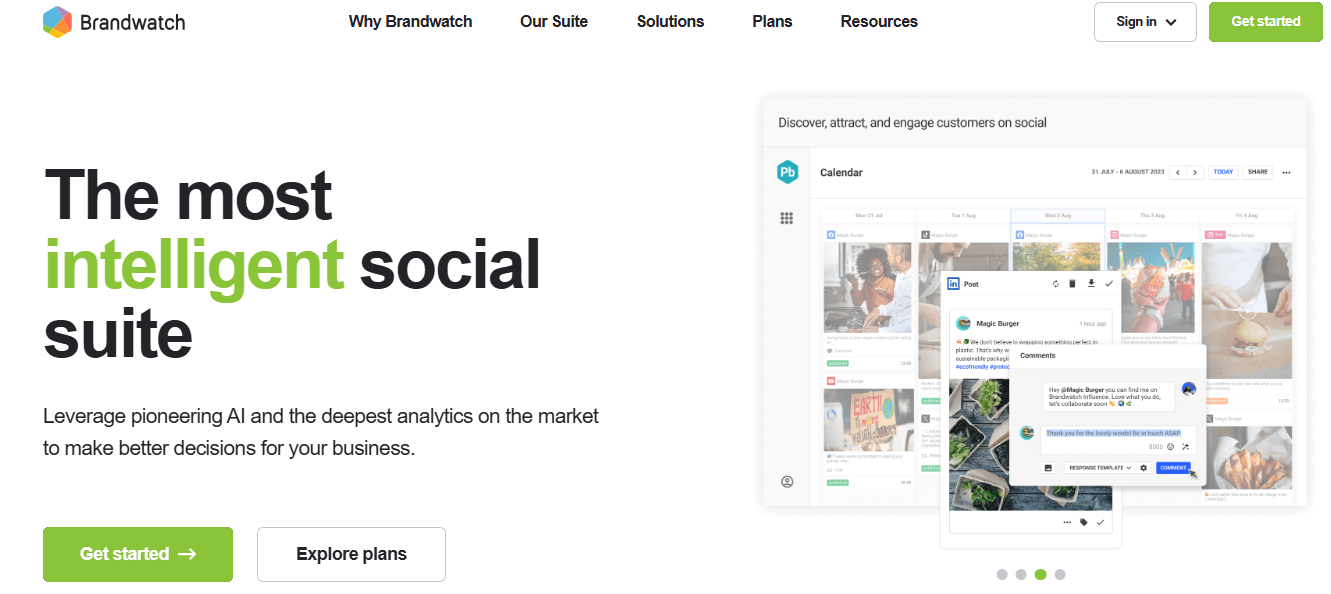
Homepage displaying an intelligent social media suite
Brandwatch social media intelligence and analytics platform

Brandwatch Consumer Intelligence is a social media monitoring and analytics platform that provides sentiment analysis across online sources and posts.

The platform tracks brand perception, competitive intelligence, and consumer trends through advanced sentiment analysis that handles complex language, slang, dialects, etc.

Brandwatch Key Features

  • Advanced Sentiment Model. It has a learning model with accuracy, benchmarked against leading AI companies.
  • Emotion Distribution Analysis. The tool captures specific emotions (anger, disgust, fear, joy, sadness, surprise) beyond basic positive/negative sentiment.
  • Language Support. It supports 44 languages with sentiment analysis for emoji-only posts.
  • Real-Time Monitoring. Instant alerts when sentiment shifts occur, enabling rapid crisis response.

Brandwatch Pricing

Brandwatch does not publicly share pricing information. 

4. Qualtrics XM Discover – Enterprise Experience Management
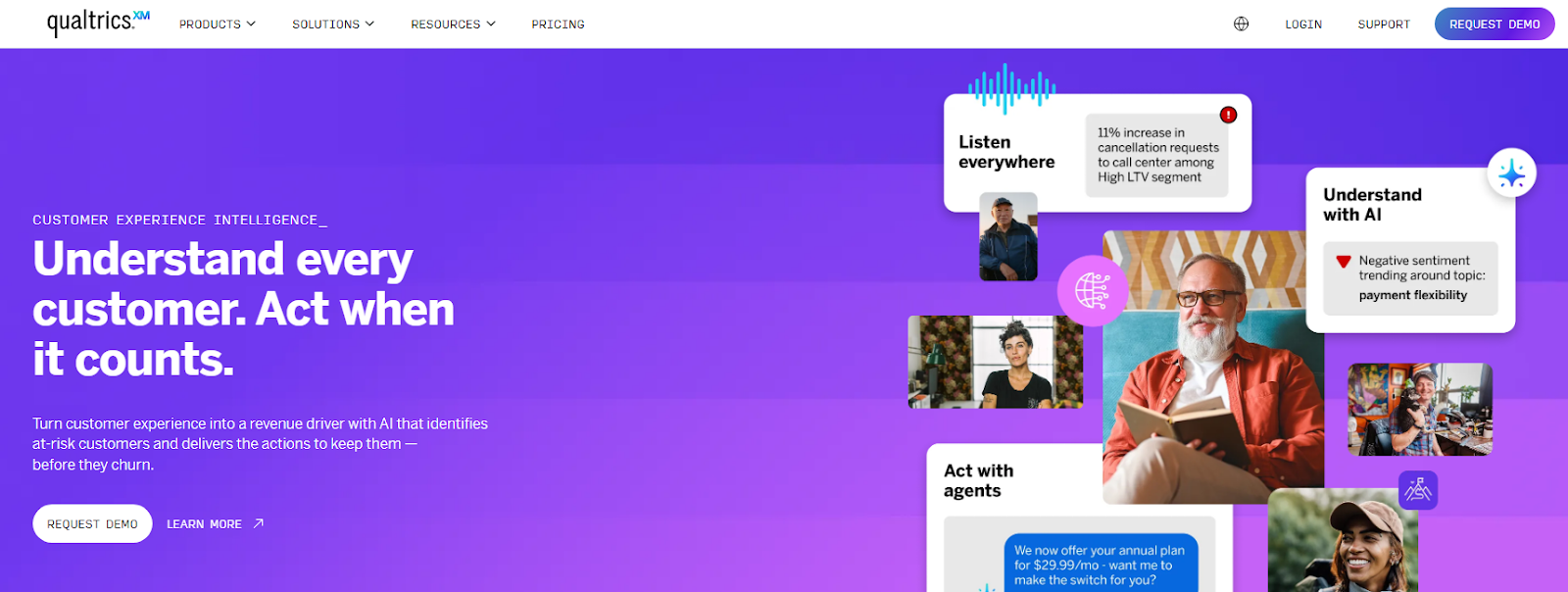
Qualtrics AI-powered customer experience insights
Qualtrics XM platform for customer experience intelligence

Qualtrics is an enterprise experience management platform that combines conversational analytics, AI, and natural language processing to analyze sentiment across every customer and employee interaction. 

The platform goes beyond traditional text analytics by automatically identifying topic, sentiment, emotion, intensity, empathy, effort, reason for contact, and intent in every conversation. XM Discover integrates seamlessly with the broader Qualtrics XM Platform.

Qualtrics Key Features

  • Sentence-Level Sentiment Scoring. It has a -5 to +5 granular scale divided into Very Negative, Negative, Neutral, Positive, and Very Positive segments.
  • AI-Assisted Topic Modeling. The platform uses generative AI to jump-start topic-hierarchy creation based on unstructured data, use case, persona, and industry context.
  • Smart Audit. It has AI-powered precision scoring that identifies sentences, reducing model accuracy to improve performance.
  • Sentiment Modifiers. You get advanced rules that recognize contextual language like "very" and "slightly" to adjust sentiment intensity.

Qualtrics’ Pricing

It offers custom pricing.

5. Medallia – Experience Management With Impact Scoring
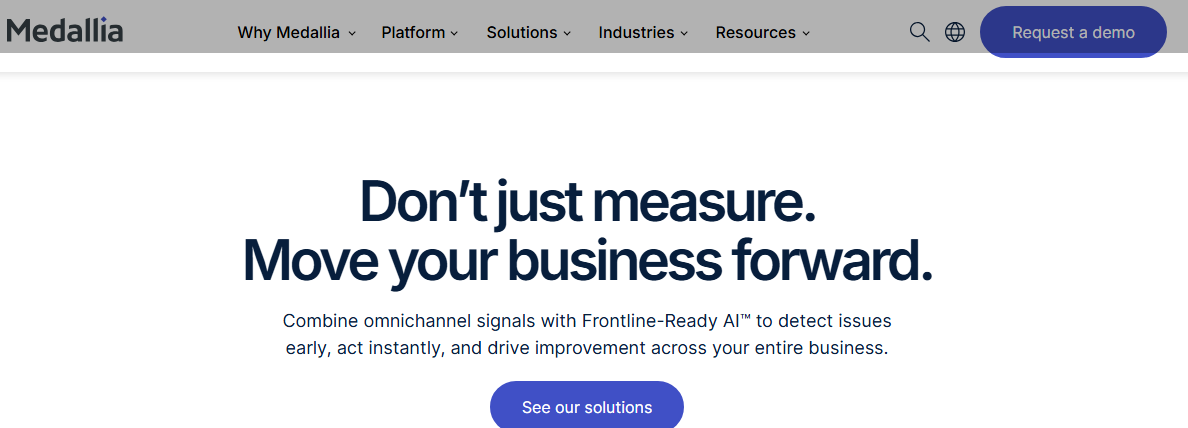
Displaying AI-driven customer experience insights
Medallia platform highlights AI-driven business improvement

Medallia is a text analysis solution integrated within the Medallia Experience Cloud platform. It specializes in transforming unstructured data from millions of surveys, social media reactions, reviews, emails, conversations, voice recordings, agent notes, and SMS messages into actionable insights. 

Medallia's unique strength lies in its Impact Score metric, which quantifies how specific topics affect overall satisfaction scores, enabling teams to prioritize improvements.

Medallia Key Features

  • Impact Score Analysis. It quantifies how specific topics and sentiments affect NPS, CSAT, and CES scores, enabling data-driven prioritization.
  • Phrase-Level Parsing. Medallia breaks down feedback at the phrase level to identify multiple topics and sentiments within a single comment.
  • Net Sentiment Scoring. The tool applies sentiment scores to feedback without attached metrics (like social mentions).
  • Real-Time Alerts. You’ll get surfaces of emerging trends and missed opportunities with role-based notifications.
  • Emotion Detection. It identifies dozens of complex emotions, including empathy, effort, and CX risk, beyond basic sentiment.

Medallia’s Pricing

Medallia offers custom pricing.

Tool AI-Native Key Strength Best For Pricing
SentiSum Yes Predictive churn detection, real-time monitoring, root-cause analysis Mid-market & enterprise teams handling high-volume feedback Pro: $3,000/mo
Enterprise: Custom
MonkeyLearn No No-code custom models, easy setup Teams without data science resources $299/mo for 10,000 queries
Brandwatch No Social listening at scale, emoji & multilingual support Large-scale social media monitoring Custom pricing
Qualtrics XM Discover No Granular sentiment scoring, AI-assisted topic modeling Enterprise experience management Custom pricing
Medallia No Impact scoring, phrase-level analysis Enterprise feedback & CX programs Custom pricing

Now that we have discussed the top tools, let’s focus a bit on the technicalities. For customer support, especially in subscription businesses, why should you prioritize AI sentiment analysis? 

Why AI Sentiment Analysis Matters for Customer Support

AI sentiment analysis delivers three major advantages: 

1. Scale

Human teams can only review small samples of feedback. AI analyzes every ticket, review, survey comment, and message, so insights reflect the full customer experience, not a guess based on limited data.

2. Speed

Manual analysis takes days or weeks. By the time insights reach leadership, the issue has already grown. 

AI works in real time, spotting sentiment shifts as they happen. When a new bug or policy change starts frustrating customers, teams can respond the same day instead of discovering the problem weeks later.

3. Depth

Traditional tools tell you that sentiment is negative. AI tells you why. Customer sentiment analytics can show that frustration rose because of shipping delays in a specific region, or that sentiment improved after a checkout update. 

This turns sentiment from a reporting metric into a diagnostic tool that drives real action.

Customer Support teams using sentiment analysis software often find that problems are far more specific than expected. Rather than vague concerns about “poor experience,” they uncover precise issues like confusing renewal emails or mobile crashes on certain devices. 

That level of clarity makes it possible to fix the right problems quickly, reduce churn, and improve retention with confidence.

Now, let us focus on the features you must scope for when evaluating an AI sentiment analysis tool.

Key Features to Look for in AI Sentiment Analysis Tools in 2026

Not all sentiment analysis tools can deliver measurable value. Basic platforms label feedback as positive or negative, but stronger solutions go further with more in-depth suggestions.

When evaluating AI sentiment analysis tools, focus on features that turn feedback into insight, not passive sentiment scores.

1. Real-Time Sentiment Detection

Real-time sentiment detection lets teams understand how customers feel as interactions happen. These tools track sentiment across chats, tickets, and calls as conversations unfold. When negative sentiment spikes, teams can respond immediately. 

This makes it easier to catch issues such as outages, broken features, or unclear updates before they affect a large number of customers. Early visibility often prevents small problems from becoming major incidents.

2. Root Cause Identification

Recognizing that customers are unhappy is only the first step. Strong sentiment tools also explain why. They group feedback into clear themes such as billing issues, login problems, delivery delays, or onboarding friction. 

This removes the need to review hundreds of conversations manually. Teams see direct connections between sentiment changes and specific products, features, or customer segments, which helps them prioritize fixes more effectively.

3. Predictive Sentiment Analysis

Predictive sentiment analysis focuses on what may happen next. It identifies patterns that often appear before churn, escalations, or disengagement. 

These signals may include repeated complaints, growing frustration over time, or unresolved issues across multiple interactions. 

When tools flag these risks early, teams can take proactive action through targeted support or product improvements. This reduces churn and protects long-term revenue.

4. Multi-Channel Sentiment Coverage

Customers share feedback across many channels, including support tickets, live chat, surveys, reviews, and social media. Tools that analyze only one channel miss important context. Multi-channel sentiment analysis brings all feedback together to show the full customer experience. 

This creates a clearer view of how sentiment changes across the journey and prevents fragmented insights that slow decision-making.

5. AI Assistant And Agent Capabilities

Many modern sentiment tools include AI agents that go beyond static dashboards. These assistants monitor sentiment trends, flag unusual changes, explain what is driving them, and suggest next steps. 

For example, they may summarize the cause of a sudden sentiment drop and recommend actions such as updating help content or escalating certain tickets. This reduces manual analysis and helps teams respond faster with confidence.

6. Integration With Existing Workflows

Sentiment insights are most useful when they fit naturally into existing workflows. Strong platforms integrate with support tools, CRMs, and collaboration systems. 

Agents can see sentiment context directly within tickets, while leaders receive alerts where they already work. Seamless integration ensures insights turn into action, not just reports.

Take Your AI Sentiment Analysis to the Next Level with SentiSum

After reviewing the key features of AI sentiment analysis tools, it’s clear that choosing the right platform can transform how your team understands and responds to customer feedback. 

SentiSum combines real-time detection, root cause analysis, predictive insights, and multi-channel coverage with seamless workflow integration, making it easier to act on customer sentiment and drive retention.

Do you want to see how SentiSum could work for your team? Book a demo today.

Join a community of 2139+ customer-focused professionals and receive bi-weekly articles, podcasts, webinars, and more!

Trending articles

Customer Sentiment

5 Best AI Sentiment Analysis Tools 2026

January 27, 2026
Stephen Christou
Marketing Director at SentiSum
In this article
Understand your customer’s problems and get actionable insights
Learn more

Is your AI accurate, or am I getting sold snake oil?

The accuracy of every NLP software depends on the context. Some industries and organisations have very complex issues, some are easier to understand.

Our technology surfaces more granular insights and is very accurate compared to (1) customer service agents, (2) built-in keyword tagging tools, (3) other providers who use more generic AI models or ask you to build a taxonomy yourself.

We build you a customised taxonomy and maintain it continuously with the help of our dedicated data scientists. That means the accuracy of your tags are not dependent on the work you put in.

Either way, we recommend you start a free trial. Included in the trial is historical analysis of your data—more than enough for you to prove it works.

This one main flaw in traditional sentiment tracking might resonate with Heads of Support and CX leaders.

Dashboards might flag tickets as “negative,” but they rarely explain:

  • What’s actually frustrating customers
  • Which issues matter most
  • Where your team should focus to fix right now

Most tools only explain the reasons for negative sentiments retrospectively. What modern CX teams really need is immediate visibility, something that catches problems as they start, explains what’s causing them, and shows which actions to take that can prevent churn.

Modern AI sentiment analysis tools go beyond basic positive or negative labels. They track sentiment in real time, uncover the root causes of frustration, highlight patterns that signal churn risk, and much more. 

In this guide, let’s explore how the top 5 sentiment analysis tools in 2026 square up.

What Is AI Sentiment Analysis?

AI customer sentiment analysis relies on natural language processing (NLP) and machine learning to understand customer sentiment from unstructured feedback. This includes support tickets, live chats, surveys, reviews, call transcripts, and social media posts.

Manual sentiment analysis, in contrast, requires humans to read messages one by one, making the process subjective. This is exactly where AI removes the limitation, as it can analyze thousands or millions of interactions at scale and apply consistent logic to every data point. As we noted before, it looks beyond the words customers use and focuses on the emotion and intent behind them, giving teams a more accurate view.

Example: How AI Sentiment Analysis Works

Traditional sentiment tools were built on simple keyword rules. Words like "bad" or "hate" were marked as negative, while "great" or "love" were marked as positive.

However, this method collapses in real conversations. Sarcasm, idioms, and mixed emotions get misclassified.

  • The Negation Trap: A phrase like "It's not bad" confuses keyword tools. They see "bad" and tag it negative, missing the actual neutral sentiment.
  • The Sarcasm Trap: A phrase like "Oh great, another bug" is flagged as positive because of the word "great," hiding a critical product failure.

To tackle this, modern AI-native tools take a different approach. 

They use Large Language Models (LLMs) trained on billions of conversations to understand context, tone, and intent. They recognize that "killing it" is a compliment for a sales team, but a complaint for a battery. 

This foundational shift from keyword matching to contextual understanding provides actionable insights rather than just surface-level scores.

Now that we’ve established what separates legacy software from modern AI, the question becomes: which platform actually delivers on that promise?

Best AI Sentiment Analysis Tools in 2026

Understanding customer sentiment at scale has become essential for businesses looking to improve retention, prevent churn, and respond to feedback in real time. 

Let’s go over the list of the top 5 best AI tools for sentiment analysis in 2026 that can transform raw customer interactions into actionable insights to drive business outcomes:

1. SentiSum: AI-Native Sentiment Analysis for Retention

Spike in discount not working issues
SentiSum showing discount issues driving customer complaints

SentiSum is an AI-native sentiment analysis platform purpose-built for mid-market and enterprise teams, as well as subscription-based businesses regularly handling large volumes of customer interactions. 

With native NLP support and Kyo, the domain-trained AI engine built over 10+ years of CX research, it parses through complex data. Diverse sources such as support tickets, calls, chats, surveys, and CRM notes are thoroughly analyzed so that users can generate actionable, to-the-point insights. 

Anyone from the team can put in a simple query, get the actual issues, and have the best steps to nip the chances of churn in the bud. 

So, where legacy sentiment scoring tools provide static sentiment scores, SentiSum identifies customer emotions as early signals of churn, expansion opportunities, and lifetime value. 

Its AI-native design also means sentiment analysis is deeply integrated into how the platform interprets customer behavior, rather than simply layered on top of dashboards.

Additionally, SentiSum goes beyond labeling interactions as positive, neutral, or negative. It explains what changed, why it changed, and recommends next steps to help teams intervene proactively. 

By continuously monitoring every meaningful interaction, the platform links emotional signals directly to business risk, providing a unified and real-time view of customer health and its potential impact on retention.

SentiSum’s Key Features

1. AI-Powered Insight through Kyo

Kyo has a proactive approach to tackling churn. It actively monitors conversations as they happen, detects unusual sentiment patterns, and explains the underlying drivers behind them.

Caption: AI agent analyzing feature requests from feedback

Alt text: Customer feedback analysis showing requested product features

As customer feedback flows in, Kyo clusters related conversations, summarizes emerging themes, and learns from historical patterns to recommend concrete next steps. 

Teams no longer spend time investigating after metrics fall. Kyo surfaces issues early, often before CSAT, NPS, or escalation rates show any change.

And if you ask, how does it differentiate from generic LLM engines like ChatGPT

It’s this: generic LLMs are designed for broad creativity and predictive text generation, whereas the Kyo AI Engine is purpose-built specifically for Voice of the Customer (VoC) analysis. 

Instead of filling knowledge gaps with assumptions (a common risk with open-web models), Kyo operates on an evidence-first framework, learning solely from verified customer feedback to flag uncertainty rather than guessing. 

This specialization ensures enterprise-grade compliance, providing PII safety, data lineage, and audit trails that general-purpose models typically lack.

2. Predictive Churn and Early Warning Signals

Through predictive sentiment analysis, SentiSum learns from historical sentiment patterns and identifies signals that consistently precede churn, often 30 to 60 days before customers leave. 

These insights power the platform’s Early Warning Agent, which flags emerging risks before traditional metrics decline. Teams can intervene early with targeted outreach, product fixes, or operational changes before churn happens and while retention is still recoverable.

As a case in point, UK-based parking technology giant JustPark proved this by stopping a hidden revenue leak. 

With SentiSum, they found drivers getting stuck at barriers due to a missing feature for updating license plates. They shipped a fix immediately, preventing thousands in lost revenue and churn.

Suggested Read: From Siloed Feedback to Instant Action: How JustPark Fixed Problems Before They Cost Thousands

3. Real-Time Sentiment Monitoring

SentiSum’s real-time sentiment detection operates on live data rather than periodic analysis. Sentiment is tracked continuously across all customer touchpoints, allowing teams to spot shifts the moment they occur. 

When it moves in an unexpected direction, the platform triggers alerts so leaders can investigate immediately instead of discovering problems weeks later in retrospective reports. This real-time approach is especially valuable for fast-growing SaaS, retail, and enterprise organizations where sentiment can change rapidly.

4. Automatic Root-Cause Discovery

Rather than forcing teams to manually tag or categorize feedback, SentiSum automatically groups conversations by their real underlying issues. 

Negative sentiment is mapped to specific root causes such as billing friction, onboarding confusion, delivery failures, or missing features, making it clear what is actually driving dissatisfaction.

 Then, each cluster links directly back to the original conversations, so teams can validate insights, understand nuance, and move from diagnosis to action with more confidence. 

5. Unified Customer Sentiment Timelines

One of SentiSum’s most powerful capabilities is its ability to unify sentiment across channels into a single timeline per customer. Tickets, calls, surveys, and CRM notes are analyzed together, revealing how sentiment evolves rather than appearing as disconnected data points.

This holistic view allows teams to understand how repeated “minor” frustrations compound into churn risk and which interactions matter most in changing the customer’s trajectory.

6. Insights Delivered Where Teams Work

SentiSum doesn’t trap insights inside dashboards. Its AI agent sentiment analysis via the Insights Agent pushes recommendations directly into the tools teams already use, including Slack, Microsoft Teams, Zendesk, and email. 

Each alert includes clear context and suggested next steps, making it easy for teams to act immediately rather than translate data into decisions.

7. Seamless Multi-Channel Integrations

The platform connects natively with major CX and support systems such as Zendesk, Intercom, Freshdesk, Dixa, Georgias, and other enterprise tools. This ensures sentiment analysis fits naturally into existing workflows without requiring teams to change how they work.

SentiSum’s Pricing 

SentiSum pricing page 
SentiSum pricing plans for Pro and Enterprise

SentiSum offers flexible plans tailored to larger teams and complex environments. The Pro tier is aimed at mid-market companies and starts at $3,000 per month for a defined conversation volume and recent historical data. 

Enterprise pricing is fully customizable based on scale, users, and language requirements.

2. MonkeyLearn – No-Code Text Analysis Platform

MonkeyLearn page describing AI-powered text analysis and visualization
MonkeyLearn AI platform for no-code enterprise text analytics

MonkeyLearn is a user-friendly text analysis platform that enables businesses to perform sentiment analysis without programming knowledge. It allows users to build custom machine learning models tailored to specific use cases, making it accessible for teams who need sentiment analysis but lack data science resources.

The platform specializes in processing customer feedback from emails, support tickets, surveys, and reviews, with particular strength in recognizing industry-specific language and emotions.

MonkeyLearn Key Features

  • Custom Model Creation. The software builds tailored sentiment models through a simple graphical interface without writing code.
  • Pre-Built Models. You can access publicly available sentiment classifiers for common use cases, including topic detection, keyword extraction, and entity recognition.
  • Text Classification. It categorizes feedback into custom categories or tags for sentiment analysis, topic detection, and aspect identification.
  • Sentiment and Entity Extraction. It also allows you to identify specific data points like keywords, names, companies, and sentiment indicators within text.

MonkeyLearn Pricing

MonkeyLearn costs $299 a month for 10,000 queries. Contact them for more custom pricing.

3. Brandwatch – Social Listening At Scale

Homepage displaying an intelligent social media suite
Brandwatch social media intelligence and analytics platform

Brandwatch Consumer Intelligence is a social media monitoring and analytics platform that provides sentiment analysis across online sources and posts.

The platform tracks brand perception, competitive intelligence, and consumer trends through advanced sentiment analysis that handles complex language, slang, dialects, etc.

Brandwatch Key Features

  • Advanced Sentiment Model. It has a learning model with accuracy, benchmarked against leading AI companies.
  • Emotion Distribution Analysis. The tool captures specific emotions (anger, disgust, fear, joy, sadness, surprise) beyond basic positive/negative sentiment.
  • Language Support. It supports 44 languages with sentiment analysis for emoji-only posts.
  • Real-Time Monitoring. Instant alerts when sentiment shifts occur, enabling rapid crisis response.

Brandwatch Pricing

Brandwatch does not publicly share pricing information. 

4. Qualtrics XM Discover – Enterprise Experience Management

Qualtrics AI-powered customer experience insights
Qualtrics XM platform for customer experience intelligence

Qualtrics is an enterprise experience management platform that combines conversational analytics, AI, and natural language processing to analyze sentiment across every customer and employee interaction. 

The platform goes beyond traditional text analytics by automatically identifying topic, sentiment, emotion, intensity, empathy, effort, reason for contact, and intent in every conversation. XM Discover integrates seamlessly with the broader Qualtrics XM Platform.

Qualtrics Key Features

  • Sentence-Level Sentiment Scoring. It has a -5 to +5 granular scale divided into Very Negative, Negative, Neutral, Positive, and Very Positive segments.
  • AI-Assisted Topic Modeling. The platform uses generative AI to jump-start topic-hierarchy creation based on unstructured data, use case, persona, and industry context.
  • Smart Audit. It has AI-powered precision scoring that identifies sentences, reducing model accuracy to improve performance.
  • Sentiment Modifiers. You get advanced rules that recognize contextual language like "very" and "slightly" to adjust sentiment intensity.

Qualtrics’ Pricing

It offers custom pricing.

5. Medallia – Experience Management With Impact Scoring

Displaying AI-driven customer experience insights
Medallia platform highlights AI-driven business improvement

Medallia is a text analysis solution integrated within the Medallia Experience Cloud platform. It specializes in transforming unstructured data from millions of surveys, social media reactions, reviews, emails, conversations, voice recordings, agent notes, and SMS messages into actionable insights. 

Medallia's unique strength lies in its Impact Score metric, which quantifies how specific topics affect overall satisfaction scores, enabling teams to prioritize improvements.

Medallia Key Features

  • Impact Score Analysis. It quantifies how specific topics and sentiments affect NPS, CSAT, and CES scores, enabling data-driven prioritization.
  • Phrase-Level Parsing. Medallia breaks down feedback at the phrase level to identify multiple topics and sentiments within a single comment.
  • Net Sentiment Scoring. The tool applies sentiment scores to feedback without attached metrics (like social mentions).
  • Real-Time Alerts. You’ll get surfaces of emerging trends and missed opportunities with role-based notifications.
  • Emotion Detection. It identifies dozens of complex emotions, including empathy, effort, and CX risk, beyond basic sentiment.

Medallia’s Pricing

Medallia offers custom pricing.

Tool AI-Native Key Strength Best For Pricing
SentiSum Yes Predictive churn detection, real-time monitoring, root-cause analysis Mid-market & enterprise teams handling high-volume feedback Pro: $3,000/mo
Enterprise: Custom
MonkeyLearn No No-code custom models, easy setup Teams without data science resources $299/mo for 10,000 queries
Brandwatch No Social listening at scale, emoji & multilingual support Large-scale social media monitoring Custom pricing
Qualtrics XM Discover No Granular sentiment scoring, AI-assisted topic modeling Enterprise experience management Custom pricing
Medallia No Impact scoring, phrase-level analysis Enterprise feedback & CX programs Custom pricing

Now that we have discussed the top tools, let’s focus a bit on the technicalities. For customer support, especially in subscription businesses, why should you prioritize AI sentiment analysis? 

Why AI Sentiment Analysis Matters for Customer Support

AI sentiment analysis delivers three major advantages: 

1. Scale

Human teams can only review small samples of feedback. AI analyzes every ticket, review, survey comment, and message, so insights reflect the full customer experience, not a guess based on limited data.

2. Speed

Manual analysis takes days or weeks. By the time insights reach leadership, the issue has already grown. 

AI works in real time, spotting sentiment shifts as they happen. When a new bug or policy change starts frustrating customers, teams can respond the same day instead of discovering the problem weeks later.

3. Depth

Traditional tools tell you that sentiment is negative. AI tells you why. Customer sentiment analytics can show that frustration rose because of shipping delays in a specific region, or that sentiment improved after a checkout update. 

This turns sentiment from a reporting metric into a diagnostic tool that drives real action.

Customer Support teams using sentiment analysis software often find that problems are far more specific than expected. Rather than vague concerns about “poor experience,” they uncover precise issues like confusing renewal emails or mobile crashes on certain devices. 

That level of clarity makes it possible to fix the right problems quickly, reduce churn, and improve retention with confidence.

Now, let us focus on the features you must scope for when evaluating an AI sentiment analysis tool.

Key Features to Look for in AI Sentiment Analysis Tools in 2026

Not all sentiment analysis tools can deliver measurable value. Basic platforms label feedback as positive or negative, but stronger solutions go further with more in-depth suggestions.

When evaluating AI sentiment analysis tools, focus on features that turn feedback into insight, not passive sentiment scores.

1. Real-Time Sentiment Detection

Real-time sentiment detection lets teams understand how customers feel as interactions happen. These tools track sentiment across chats, tickets, and calls as conversations unfold. When negative sentiment spikes, teams can respond immediately. 

This makes it easier to catch issues such as outages, broken features, or unclear updates before they affect a large number of customers. Early visibility often prevents small problems from becoming major incidents.

2. Root Cause Identification

Recognizing that customers are unhappy is only the first step. Strong sentiment tools also explain why. They group feedback into clear themes such as billing issues, login problems, delivery delays, or onboarding friction. 

This removes the need to review hundreds of conversations manually. Teams see direct connections between sentiment changes and specific products, features, or customer segments, which helps them prioritize fixes more effectively.

3. Predictive Sentiment Analysis

Predictive sentiment analysis focuses on what may happen next. It identifies patterns that often appear before churn, escalations, or disengagement. 

These signals may include repeated complaints, growing frustration over time, or unresolved issues across multiple interactions. 

When tools flag these risks early, teams can take proactive action through targeted support or product improvements. This reduces churn and protects long-term revenue.

4. Multi-Channel Sentiment Coverage

Customers share feedback across many channels, including support tickets, live chat, surveys, reviews, and social media. Tools that analyze only one channel miss important context. Multi-channel sentiment analysis brings all feedback together to show the full customer experience. 

This creates a clearer view of how sentiment changes across the journey and prevents fragmented insights that slow decision-making.

5. AI Assistant And Agent Capabilities

Many modern sentiment tools include AI agents that go beyond static dashboards. These assistants monitor sentiment trends, flag unusual changes, explain what is driving them, and suggest next steps. 

For example, they may summarize the cause of a sudden sentiment drop and recommend actions such as updating help content or escalating certain tickets. This reduces manual analysis and helps teams respond faster with confidence.

6. Integration With Existing Workflows

Sentiment insights are most useful when they fit naturally into existing workflows. Strong platforms integrate with support tools, CRMs, and collaboration systems. 

Agents can see sentiment context directly within tickets, while leaders receive alerts where they already work. Seamless integration ensures insights turn into action, not just reports.

Take Your AI Sentiment Analysis to the Next Level with SentiSum

After reviewing the key features of AI sentiment analysis tools, it’s clear that choosing the right platform can transform how your team understands and responds to customer feedback. 

SentiSum combines real-time detection, root cause analysis, predictive insights, and multi-channel coverage with seamless workflow integration, making it easier to act on customer sentiment and drive retention.

Do you want to see how SentiSum could work for your team? Book a demo today.

Heading 1

Heading 2

Heading 3

Heading 4

Heading 5
Heading 6

Lorem ipsum dolor sit amet, consectetur adipiscing elit, sed do eiusmod tempor incididunt ut labore et dolore magna aliqua. Ut enim ad minim veniam, quis nostrud exercitation ullamco laboris nisi ut aliquip ex ea commodo consequat. Duis aute irure dolor in reprehenderit in voluptate velit esse cillum dolore eu fugiat nulla pariatur.

Block quote

Ordered list

  1. Item 1
  2. Item 2
  3. Item 3

Unordered list

  • Item A
  • Item B
  • Item C

Text link

Bold text

Emphasis

Superscript

Subscript

Frequently asked questions

Is your AI accurate, or am I getting sold snake oil?

The accuracy of every NLP software depends on the context. Some industries and organisations have very complex issues, some are easier to understand.

Our technology surfaces more granular insights and is very accurate compared to (1) customer service agents, (2) built-in keyword tagging tools, (3) other providers who use more generic AI models or ask you to build a taxonomy yourself.

We build you a customised taxonomy and maintain it continuously with the help of our dedicated data scientists. That means the accuracy of your tags are not dependent on the work you put in.

Either way, we recommend you start a free trial. Included in the trial is historical analysis of your data—more than enough for you to prove it works.

Do you integrate with my systems? How long is that going to take?

Lorem ipsum dolor sit amet, consectetur adipiscing elit. Suspendisse varius enim in eros elementum tristique. Duis cursus, mi quis viverra ornare, eros dolor interdum nulla, ut commodo diam libero vitae erat. Aenean faucibus nibh et justo cursus id rutrum lorem imperdiet. Nunc ut sem vitae risus tristique posuere.

What size company do you usually work with? Is this valuable for me?

Lorem ipsum dolor sit amet, consectetur adipiscing elit. Suspendisse varius enim in eros elementum tristique. Duis cursus, mi quis viverra ornare, eros dolor interdum nulla, ut commodo diam libero vitae erat. Aenean faucibus nibh et justo cursus id rutrum lorem imperdiet. Nunc ut sem vitae risus tristique posuere.

What is your term of the contract?

Lorem ipsum dolor sit amet, consectetur adipiscing elit. Suspendisse varius enim in eros elementum tristique. Duis cursus, mi quis viverra ornare, eros dolor interdum nulla, ut commodo diam libero vitae erat. Aenean faucibus nibh et justo cursus id rutrum lorem imperdiet. Nunc ut sem vitae risus tristique posuere.

How do you keep my data private?

Lorem ipsum dolor sit amet, consectetur adipiscing elit. Suspendisse varius enim in eros elementum tristique. Duis cursus, mi quis viverra ornare, eros dolor interdum nulla, ut commodo diam libero vitae erat. Aenean faucibus nibh et justo cursus id rutrum lorem imperdiet. Nunc ut sem vitae risus tristique posuere.

Support Insights Community
Join a community of 2200+ customer-focused professionals and receive bi-weekly articles, podcasts, webinars, and more!

Lorem ipsum dolor sit amet, consectetur adipiscing elit. Suspendisse varius enim in eros elementum tristique. Duis cursus, mi quis viverra ornare, eros dolor interdum nulla, ut commodo diam libero vitae erat. Aenean faucibus nibh et justo cursus id rutrum lorem imperdiet. Nunc ut sem vitae risus tristique posuere.

Lorem ipsum dolor sit amet, consectetur adipiscing elit. Suspendisse varius enim in eros elementum tristique. Duis cursus, mi quis viverra ornare, eros dolor interdum nulla, ut commodo diam libero vitae erat. Aenean faucibus nibh et justo cursus id rutrum lorem imperdiet. Nunc ut sem vitae risus tristique posuere.

Lorem ipsum dolor sit amet, consectetur adipiscing elit. Suspendisse varius enim in eros elementum tristique. Duis cursus, mi quis viverra ornare, eros dolor interdum nulla, ut commodo diam libero vitae erat. Aenean faucibus nibh et justo cursus id rutrum lorem imperdiet. Nunc ut sem vitae risus tristique posuere.

Thank you! Your submission has been received!
Oops! Something went wrong while submitting the form.

Frequently Asked Questions

What is AI sentiment analysis?

AI sentiment analysis uses machine learning and natural language processing to understand emotions and opinions in text or speech. It goes beyond keywords to detect tone, intent, and urgency in customer feedback across channels like support tickets, chats, reviews, calls, and surveys.

How does AI sentiment analysis work?

AI sentiment analysis processes customer language using trained models that understand context, phrasing, and patterns. It analyzes conversations in real time, classifies sentiment and themes, and tracks changes over time. Advanced systems also connect sentiment shifts to specific products, features, or experiences.

What are the best AI tools for sentiment analysis?

The best AI sentiment analysis tools combine accuracy, speed, and actionability. AI sentiment monitoring tools like SentiSum, Qualtrics, and MonkeyLearn stand out by analyzing large volumes of unstructured feedback, identifying root causes, and turning sentiment data into clear, operational insights.

How is AI sentiment analysis used in customer experience?

In customer experience, AI sentiment analysis helps teams spot issues early, prioritize urgent cases, and understand why customers feel frustrated or satisfied. It assists product, support, and CX teams by revealing patterns that traditional metrics like CSAT or NPS often miss.

Can AI sentiment analysis predict customer churn?

Yes. AI sentiment analysis can predict churn by detecting rising negative sentiment, repeated complaints, or emotional escalation before customers leave. By monitoring trends across interactions, businesses can intervene earlier with targeted actions that reduce churn and protect long-term revenue.

Is your AI accurate, or am I getting sold snake oil?

The accuracy of every NLP software depends on the context. Some industries and organisations have very complex issues, some are easier to understand.

Our technology surfaces more granular insights and is very accurate compared to (1) customer service agents, (2) built-in keyword tagging tools, (3) other providers who use more generic AI models or ask you to build a taxonomy yourself.

We build you a customised taxonomy and maintain it continuously with the help of our dedicated data scientists. That means the accuracy of your tags are not dependent on the work you put in.

Either way, we recommend you start a free trial. Included in the trial is historical analysis of your data—more than enough for you to prove it works.

Customer Sentiment
January 27, 2026
7
min read.

5 Best AI Sentiment Analysis Tools 2026

Stephen Christou
Marketing Director at SentiSum
Table of contents
Understand your customer’s problems and get actionable insight
Share

TL;DR

  • Stop churn before it starts: AI detects frustration patterns days before customers leave, giving you time to intervene with targeted fixes.
  • Understand why customers are upset: Modern AI tools automatically explain the root causes, including billing friction, onboarding confusion, and missing features.
  • Respond in real time: AI-native tools like SentiSum analyze every ticket, chat, and survey as they happen, alerting your team to sentiment spikes the same day.
  • Get a complete view across all channels: Unified sentiment timelines connect tickets, calls, surveys, and CRM notes into one customer journey.
  • Turn insights into action immediately: AI agents monitor conversations, detect unusual patterns, recommend next steps, and also push alerts directly into Slack, Teams, or your support tools.
  • Scale beyond what humans can review: Analyze millions of interactions consistently while catching subtle signals like lukewarm feedback ("I guess it works") that traditional tools miss

This one main flaw in traditional sentiment tracking might resonate with Heads of Support and CX leaders.

Dashboards might flag tickets as “negative,” but they rarely explain:

  • What’s actually frustrating customers
  • Which issues matter most
  • Where your team should focus to fix right now

Most tools only explain the reasons for negative sentiments retrospectively. What modern CX teams really need is immediate visibility, something that catches problems as they start, explains what’s causing them, and shows which actions to take that can prevent churn.

Modern AI sentiment analysis tools go beyond basic positive or negative labels. They track sentiment in real time, uncover the root causes of frustration, highlight patterns that signal churn risk, and much more. 

In this guide, let’s explore how the top 5 sentiment analysis tools in 2026 square up.

What Is AI Sentiment Analysis?

AI customer sentiment analysis relies on natural language processing (NLP) and machine learning to understand customer sentiment from unstructured feedback. This includes support tickets, live chats, surveys, reviews, call transcripts, and social media posts.

Manual sentiment analysis, in contrast, requires humans to read messages one by one, making the process subjective. This is exactly where AI removes the limitation, as it can analyze thousands or millions of interactions at scale and apply consistent logic to every data point. As we noted before, it looks beyond the words customers use and focuses on the emotion and intent behind them, giving teams a more accurate view.

Example: How AI Sentiment Analysis Works

Traditional sentiment tools were built on simple keyword rules. Words like "bad" or "hate" were marked as negative, while "great" or "love" were marked as positive.

However, this method collapses in real conversations. Sarcasm, idioms, and mixed emotions get misclassified.

  • The Negation Trap: A phrase like "It's not bad" confuses keyword tools. They see "bad" and tag it negative, missing the actual neutral sentiment.
  • The Sarcasm Trap: A phrase like "Oh great, another bug" is flagged as positive because of the word "great," hiding a critical product failure.

To tackle this, modern AI-native tools take a different approach. 

They use Large Language Models (LLMs) trained on billions of conversations to understand context, tone, and intent. They recognize that "killing it" is a compliment for a sales team, but a complaint for a battery. 

This foundational shift from keyword matching to contextual understanding provides actionable insights rather than just surface-level scores.

Now that we’ve established what separates legacy software from modern AI, the question becomes: which platform actually delivers on that promise?

Best AI Sentiment Analysis Tools in 2026

Understanding customer sentiment at scale has become essential for businesses looking to improve retention, prevent churn, and respond to feedback in real time. 

Let’s go over the list of the top 5 best AI tools for sentiment analysis in 2026 that can transform raw customer interactions into actionable insights to drive business outcomes:

1. SentiSum: AI-Native Sentiment Analysis for Retention

Spike in discount not working issues
SentiSum showing discount issues driving customer complaints

SentiSum is an AI-native sentiment analysis platform purpose-built for mid-market and enterprise teams, as well as subscription-based businesses regularly handling large volumes of customer interactions. 

With native NLP support and Kyo, the domain-trained AI engine built over 10+ years of CX research, it parses through complex data. Diverse sources such as support tickets, calls, chats, surveys, and CRM notes are thoroughly analyzed so that users can generate actionable, to-the-point insights. 

Anyone from the team can put in a simple query, get the actual issues, and have the best steps to nip the chances of churn in the bud. 

So, where legacy sentiment scoring tools provide static sentiment scores, SentiSum identifies customer emotions as early signals of churn, expansion opportunities, and lifetime value. 

Its AI-native design also means sentiment analysis is deeply integrated into how the platform interprets customer behavior, rather than simply layered on top of dashboards.

Additionally, SentiSum goes beyond labeling interactions as positive, neutral, or negative. It explains what changed, why it changed, and recommends next steps to help teams intervene proactively. 

By continuously monitoring every meaningful interaction, the platform links emotional signals directly to business risk, providing a unified and real-time view of customer health and its potential impact on retention.

SentiSum’s Key Features

1. AI-Powered Insight through Kyo

Kyo has a proactive approach to tackling churn. It actively monitors conversations as they happen, detects unusual sentiment patterns, and explains the underlying drivers behind them.

Caption: AI agent analyzing feature requests from feedback

Alt text: Customer feedback analysis showing requested product features

As customer feedback flows in, Kyo clusters related conversations, summarizes emerging themes, and learns from historical patterns to recommend concrete next steps. 

Teams no longer spend time investigating after metrics fall. Kyo surfaces issues early, often before CSAT, NPS, or escalation rates show any change.

And if you ask, how does it differentiate from generic LLM engines like ChatGPT

It’s this: generic LLMs are designed for broad creativity and predictive text generation, whereas the Kyo AI Engine is purpose-built specifically for Voice of the Customer (VoC) analysis. 

Instead of filling knowledge gaps with assumptions (a common risk with open-web models), Kyo operates on an evidence-first framework, learning solely from verified customer feedback to flag uncertainty rather than guessing. 

This specialization ensures enterprise-grade compliance, providing PII safety, data lineage, and audit trails that general-purpose models typically lack.

2. Predictive Churn and Early Warning Signals

Through predictive sentiment analysis, SentiSum learns from historical sentiment patterns and identifies signals that consistently precede churn, often 30 to 60 days before customers leave. 

These insights power the platform’s Early Warning Agent, which flags emerging risks before traditional metrics decline. Teams can intervene early with targeted outreach, product fixes, or operational changes before churn happens and while retention is still recoverable.

As a case in point, UK-based parking technology giant JustPark proved this by stopping a hidden revenue leak. 

With SentiSum, they found drivers getting stuck at barriers due to a missing feature for updating license plates. They shipped a fix immediately, preventing thousands in lost revenue and churn.

Suggested Read: From Siloed Feedback to Instant Action: How JustPark Fixed Problems Before They Cost Thousands

3. Real-Time Sentiment Monitoring

SentiSum’s real-time sentiment detection operates on live data rather than periodic analysis. Sentiment is tracked continuously across all customer touchpoints, allowing teams to spot shifts the moment they occur. 

When it moves in an unexpected direction, the platform triggers alerts so leaders can investigate immediately instead of discovering problems weeks later in retrospective reports. This real-time approach is especially valuable for fast-growing SaaS, retail, and enterprise organizations where sentiment can change rapidly.

4. Automatic Root-Cause Discovery

Rather than forcing teams to manually tag or categorize feedback, SentiSum automatically groups conversations by their real underlying issues. 

Negative sentiment is mapped to specific root causes such as billing friction, onboarding confusion, delivery failures, or missing features, making it clear what is actually driving dissatisfaction.

 Then, each cluster links directly back to the original conversations, so teams can validate insights, understand nuance, and move from diagnosis to action with more confidence. 

5. Unified Customer Sentiment Timelines

One of SentiSum’s most powerful capabilities is its ability to unify sentiment across channels into a single timeline per customer. Tickets, calls, surveys, and CRM notes are analyzed together, revealing how sentiment evolves rather than appearing as disconnected data points.

This holistic view allows teams to understand how repeated “minor” frustrations compound into churn risk and which interactions matter most in changing the customer’s trajectory.

6. Insights Delivered Where Teams Work

SentiSum doesn’t trap insights inside dashboards. Its AI agent sentiment analysis via the Insights Agent pushes recommendations directly into the tools teams already use, including Slack, Microsoft Teams, Zendesk, and email. 

Each alert includes clear context and suggested next steps, making it easy for teams to act immediately rather than translate data into decisions.

7. Seamless Multi-Channel Integrations

The platform connects natively with major CX and support systems such as Zendesk, Intercom, Freshdesk, Dixa, Georgias, and other enterprise tools. This ensures sentiment analysis fits naturally into existing workflows without requiring teams to change how they work.

SentiSum’s Pricing 

SentiSum pricing page 
SentiSum pricing plans for Pro and Enterprise

SentiSum offers flexible plans tailored to larger teams and complex environments. The Pro tier is aimed at mid-market companies and starts at $3,000 per month for a defined conversation volume and recent historical data. 

Enterprise pricing is fully customizable based on scale, users, and language requirements.

2. MonkeyLearn – No-Code Text Analysis Platform

MonkeyLearn page describing AI-powered text analysis and visualization
MonkeyLearn AI platform for no-code enterprise text analytics

MonkeyLearn is a user-friendly text analysis platform that enables businesses to perform sentiment analysis without programming knowledge. It allows users to build custom machine learning models tailored to specific use cases, making it accessible for teams who need sentiment analysis but lack data science resources.

The platform specializes in processing customer feedback from emails, support tickets, surveys, and reviews, with particular strength in recognizing industry-specific language and emotions.

MonkeyLearn Key Features

  • Custom Model Creation. The software builds tailored sentiment models through a simple graphical interface without writing code.
  • Pre-Built Models. You can access publicly available sentiment classifiers for common use cases, including topic detection, keyword extraction, and entity recognition.
  • Text Classification. It categorizes feedback into custom categories or tags for sentiment analysis, topic detection, and aspect identification.
  • Sentiment and Entity Extraction. It also allows you to identify specific data points like keywords, names, companies, and sentiment indicators within text.

MonkeyLearn Pricing

MonkeyLearn costs $299 a month for 10,000 queries. Contact them for more custom pricing.

3. Brandwatch – Social Listening At Scale

Homepage displaying an intelligent social media suite
Brandwatch social media intelligence and analytics platform

Brandwatch Consumer Intelligence is a social media monitoring and analytics platform that provides sentiment analysis across online sources and posts.

The platform tracks brand perception, competitive intelligence, and consumer trends through advanced sentiment analysis that handles complex language, slang, dialects, etc.

Brandwatch Key Features

  • Advanced Sentiment Model. It has a learning model with accuracy, benchmarked against leading AI companies.
  • Emotion Distribution Analysis. The tool captures specific emotions (anger, disgust, fear, joy, sadness, surprise) beyond basic positive/negative sentiment.
  • Language Support. It supports 44 languages with sentiment analysis for emoji-only posts.
  • Real-Time Monitoring. Instant alerts when sentiment shifts occur, enabling rapid crisis response.

Brandwatch Pricing

Brandwatch does not publicly share pricing information. 

4. Qualtrics XM Discover – Enterprise Experience Management

Qualtrics AI-powered customer experience insights
Qualtrics XM platform for customer experience intelligence

Qualtrics is an enterprise experience management platform that combines conversational analytics, AI, and natural language processing to analyze sentiment across every customer and employee interaction. 

The platform goes beyond traditional text analytics by automatically identifying topic, sentiment, emotion, intensity, empathy, effort, reason for contact, and intent in every conversation. XM Discover integrates seamlessly with the broader Qualtrics XM Platform.

Qualtrics Key Features

  • Sentence-Level Sentiment Scoring. It has a -5 to +5 granular scale divided into Very Negative, Negative, Neutral, Positive, and Very Positive segments.
  • AI-Assisted Topic Modeling. The platform uses generative AI to jump-start topic-hierarchy creation based on unstructured data, use case, persona, and industry context.
  • Smart Audit. It has AI-powered precision scoring that identifies sentences, reducing model accuracy to improve performance.
  • Sentiment Modifiers. You get advanced rules that recognize contextual language like "very" and "slightly" to adjust sentiment intensity.

Qualtrics’ Pricing

It offers custom pricing.

5. Medallia – Experience Management With Impact Scoring

Displaying AI-driven customer experience insights
Medallia platform highlights AI-driven business improvement

Medallia is a text analysis solution integrated within the Medallia Experience Cloud platform. It specializes in transforming unstructured data from millions of surveys, social media reactions, reviews, emails, conversations, voice recordings, agent notes, and SMS messages into actionable insights. 

Medallia's unique strength lies in its Impact Score metric, which quantifies how specific topics affect overall satisfaction scores, enabling teams to prioritize improvements.

Medallia Key Features

  • Impact Score Analysis. It quantifies how specific topics and sentiments affect NPS, CSAT, and CES scores, enabling data-driven prioritization.
  • Phrase-Level Parsing. Medallia breaks down feedback at the phrase level to identify multiple topics and sentiments within a single comment.
  • Net Sentiment Scoring. The tool applies sentiment scores to feedback without attached metrics (like social mentions).
  • Real-Time Alerts. You’ll get surfaces of emerging trends and missed opportunities with role-based notifications.
  • Emotion Detection. It identifies dozens of complex emotions, including empathy, effort, and CX risk, beyond basic sentiment.

Medallia’s Pricing

Medallia offers custom pricing.

Tool AI-Native Key Strength Best For Pricing
SentiSum Yes Predictive churn detection, real-time monitoring, root-cause analysis Mid-market & enterprise teams handling high-volume feedback Pro: $3,000/mo
Enterprise: Custom
MonkeyLearn No No-code custom models, easy setup Teams without data science resources $299/mo for 10,000 queries
Brandwatch No Social listening at scale, emoji & multilingual support Large-scale social media monitoring Custom pricing
Qualtrics XM Discover No Granular sentiment scoring, AI-assisted topic modeling Enterprise experience management Custom pricing
Medallia No Impact scoring, phrase-level analysis Enterprise feedback & CX programs Custom pricing

Now that we have discussed the top tools, let’s focus a bit on the technicalities. For customer support, especially in subscription businesses, why should you prioritize AI sentiment analysis? 

Why AI Sentiment Analysis Matters for Customer Support

AI sentiment analysis delivers three major advantages: 

1. Scale

Human teams can only review small samples of feedback. AI analyzes every ticket, review, survey comment, and message, so insights reflect the full customer experience, not a guess based on limited data.

2. Speed

Manual analysis takes days or weeks. By the time insights reach leadership, the issue has already grown. 

AI works in real time, spotting sentiment shifts as they happen. When a new bug or policy change starts frustrating customers, teams can respond the same day instead of discovering the problem weeks later.

3. Depth

Traditional tools tell you that sentiment is negative. AI tells you why. Customer sentiment analytics can show that frustration rose because of shipping delays in a specific region, or that sentiment improved after a checkout update. 

This turns sentiment from a reporting metric into a diagnostic tool that drives real action.

Customer Support teams using sentiment analysis software often find that problems are far more specific than expected. Rather than vague concerns about “poor experience,” they uncover precise issues like confusing renewal emails or mobile crashes on certain devices. 

That level of clarity makes it possible to fix the right problems quickly, reduce churn, and improve retention with confidence.

Now, let us focus on the features you must scope for when evaluating an AI sentiment analysis tool.

Key Features to Look for in AI Sentiment Analysis Tools in 2026

Not all sentiment analysis tools can deliver measurable value. Basic platforms label feedback as positive or negative, but stronger solutions go further with more in-depth suggestions.

When evaluating AI sentiment analysis tools, focus on features that turn feedback into insight, not passive sentiment scores.

1. Real-Time Sentiment Detection

Real-time sentiment detection lets teams understand how customers feel as interactions happen. These tools track sentiment across chats, tickets, and calls as conversations unfold. When negative sentiment spikes, teams can respond immediately. 

This makes it easier to catch issues such as outages, broken features, or unclear updates before they affect a large number of customers. Early visibility often prevents small problems from becoming major incidents.

2. Root Cause Identification

Recognizing that customers are unhappy is only the first step. Strong sentiment tools also explain why. They group feedback into clear themes such as billing issues, login problems, delivery delays, or onboarding friction. 

This removes the need to review hundreds of conversations manually. Teams see direct connections between sentiment changes and specific products, features, or customer segments, which helps them prioritize fixes more effectively.

3. Predictive Sentiment Analysis

Predictive sentiment analysis focuses on what may happen next. It identifies patterns that often appear before churn, escalations, or disengagement. 

These signals may include repeated complaints, growing frustration over time, or unresolved issues across multiple interactions. 

When tools flag these risks early, teams can take proactive action through targeted support or product improvements. This reduces churn and protects long-term revenue.

4. Multi-Channel Sentiment Coverage

Customers share feedback across many channels, including support tickets, live chat, surveys, reviews, and social media. Tools that analyze only one channel miss important context. Multi-channel sentiment analysis brings all feedback together to show the full customer experience. 

This creates a clearer view of how sentiment changes across the journey and prevents fragmented insights that slow decision-making.

5. AI Assistant And Agent Capabilities

Many modern sentiment tools include AI agents that go beyond static dashboards. These assistants monitor sentiment trends, flag unusual changes, explain what is driving them, and suggest next steps. 

For example, they may summarize the cause of a sudden sentiment drop and recommend actions such as updating help content or escalating certain tickets. This reduces manual analysis and helps teams respond faster with confidence.

6. Integration With Existing Workflows

Sentiment insights are most useful when they fit naturally into existing workflows. Strong platforms integrate with support tools, CRMs, and collaboration systems. 

Agents can see sentiment context directly within tickets, while leaders receive alerts where they already work. Seamless integration ensures insights turn into action, not just reports.

Take Your AI Sentiment Analysis to the Next Level with SentiSum

After reviewing the key features of AI sentiment analysis tools, it’s clear that choosing the right platform can transform how your team understands and responds to customer feedback. 

SentiSum combines real-time detection, root cause analysis, predictive insights, and multi-channel coverage with seamless workflow integration, making it easier to act on customer sentiment and drive retention.

Do you want to see how SentiSum could work for your team? Book a demo today.

Frequently Asked Questions

What is AI sentiment analysis?

AI sentiment analysis uses machine learning and natural language processing to understand emotions and opinions in text or speech. It goes beyond keywords to detect tone, intent, and urgency in customer feedback across channels like support tickets, chats, reviews, calls, and surveys.

How does AI sentiment analysis work?

AI sentiment analysis processes customer language using trained models that understand context, phrasing, and patterns. It analyzes conversations in real time, classifies sentiment and themes, and tracks changes over time. Advanced systems also connect sentiment shifts to specific products, features, or experiences.

What are the best AI tools for sentiment analysis?

The best AI sentiment analysis tools combine accuracy, speed, and actionability. AI sentiment monitoring tools like SentiSum, Qualtrics, and MonkeyLearn stand out by analyzing large volumes of unstructured feedback, identifying root causes, and turning sentiment data into clear, operational insights.

How is AI sentiment analysis used in customer experience?

In customer experience, AI sentiment analysis helps teams spot issues early, prioritize urgent cases, and understand why customers feel frustrated or satisfied. It assists product, support, and CX teams by revealing patterns that traditional metrics like CSAT or NPS often miss.

Can AI sentiment analysis predict customer churn?

Yes. AI sentiment analysis can predict churn by detecting rising negative sentiment, repeated complaints, or emotional escalation before customers leave. By monitoring trends across interactions, businesses can intervene earlier with targeted actions that reduce churn and protect long-term revenue.

Explore Real Success Stories

Explore Success Stories

Curious how leading consumer brands like Ticketmaster, Gousto, JustPark are turning Voice of Customer data into faster fixes and lower churn?

Talk to a Data Expert

30-min free product walkthrough to see how CX and retention teams are using SentiSum to lower churn
Written By
Stephen Christou
I lead marketing at SentiSum, drawing on more than 15 years’ experience at Cohesity, TIBCO, and HPE. My focus has always been on aligning sales and marketing to unlock growth. I am especially interested in how AI is changing customer experience and creating new ways for businesses to scale.