SentiSum vs unitQ

unitQ ranks the impact. SentiSum prices the fix, assigns an owner, and proves it worked.

unitQ pulls signals from 100+ channels into specialized modules — monitoring, impact ranking, competitive benchmarking, support QA, research and social, each with its own dashboard. SentiSum works as one layer: it finds the specific failure behind the KPI movement, prices what it’s costing you, routes it to the team that owns the fix, and measures whether the number actually falls. Built on your own data, across human agents and AI agents alike.
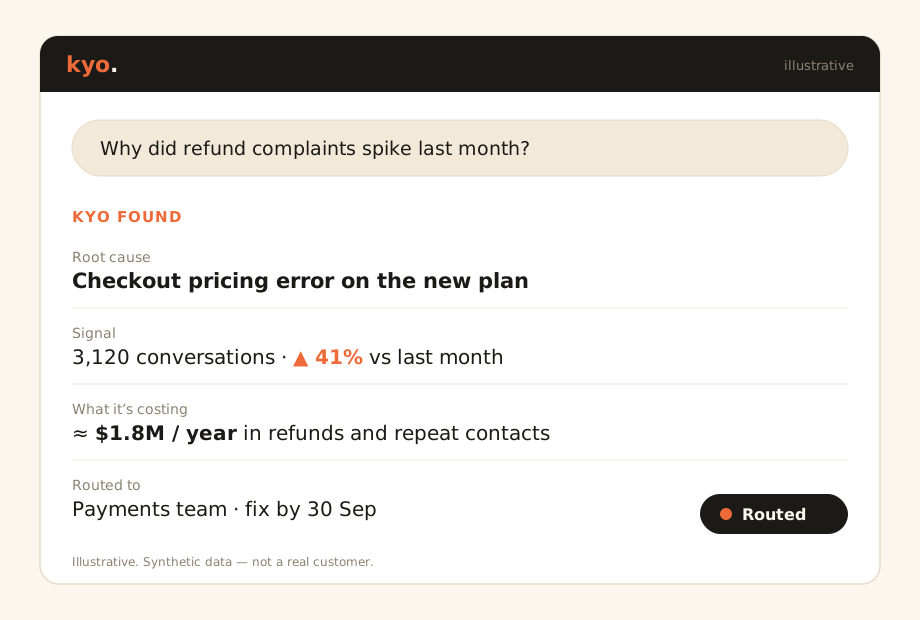
Kyo answer card showing a root cause, its cost and the owning team
Trusted by high-volume retail, fintech and financial-services brands reading millions of customer conversations a year.
Gousto logo
Razorpay logo
Holland & Barrett logo
Super logo
Comparison

SentiSum vs unitQ, side by side

Compare SentiSum and unitQ for customer feedback analytics and CX intelligence.
Product comparison
SentiSum
unitQ
Built for
The whole organisation — Support, Product, Operations, Risk and Leadership read from one layer, and so do your AI agents and copilots
Product, Engineering, Support, CX and Research teams, each working inside the module built for their job
What it analyzes
Every customer conversation in full — calls, chats, tickets, emails, surveys, reviews and your AI bots plus transaction data, read end to end, not sampled
Feedback and signals across 100+ channels - app stores, social, reviews, support, surveys - categorized by AI into each module’s own taxonomy
Proactive
An Early Warning agent watches continuously and knows what’s normal for a Tuesday in August. When refunds, login failures or KYC contacts move abnormally, the alert lands in Slack or email with the cost attached, while the issue is still small.
Monitor’s real-time anomaly detection alerts Slack, Teams or PagerDuty the moment feedback moves outside the seasonal pattern — flagging that something moved, not what it’s costing you or who should fix it.
How you get answers
Ask in plain language, get an evidenced answer, priced, owned, ranked with the source conversations one click away.
Query each module for its own view — Monitor’s alerts, Impact’s KPI ranking, Support QA’s scorecards — read separately by the team that owns that module.
How deep it goes
Past the bucket to the specific failure inside it — an adaptive taxonomy built from your own data and vocabulary, thousands of drivers, correctable in plain English.
A multi-tier taxonomy per module — Monitor’s categories, supportQ’s rubrics, Impact’s KPIs each tuned and read separately, not one shared model of the business.
AI agent governance
Every AI agent graded against your human agents on the same scorecard, continuously. So, you see whether the bot is beating your team or quietly falling behind it.
Support QA scores 100% of interactions with separate scorecards for bots and humans. Strong on each track alone, not built to put them head to head.
Extensible
An agentic platform, not a closed tool. Build your own agents on the same layer and connect ChatGPT, Claude or Copilot via MCP. Every agent inherits one taxonomy, so your AI investment compounds.
Six specialized products — Monitor, Impact, Compete, Support QA, Research and Social. Each has its own dashboard to configure and check. Built for teams to use, not a layer you extend with your own agents.
What you get
The root cause, its dollar cost, the owner of the fix, and proof the number dropped.
KPI-ranked opportunities, quality scorecards and category alerts. One output per module, interpreted by the team reading it.
Why SentiSum

From customer issue to the team that can fix it

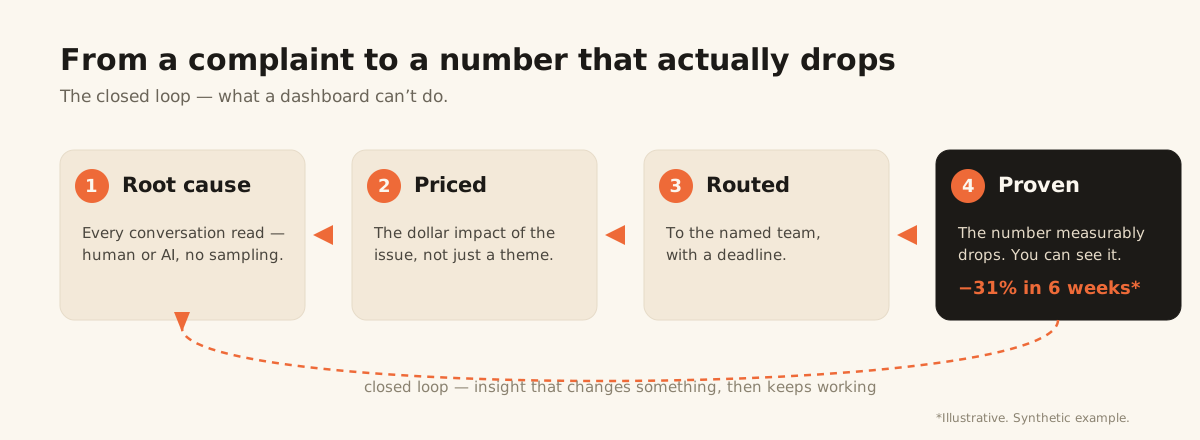
Every issue routes to the system or team that created it, not just a dashboard. A report tells you the top themes; it doesn’t make anything change. SentiSum names the cause, the owner and the deadline — then measures whether the number actually fell.
SentiSum closed loop: detect the issue, find the root cause, route it to the owner, and measure the drop

Catch it before it spreads.

A refund spike after a pricing change gets flagged while it’s still small, not after it shows up in the quarterly numbers.

Trace the actual source.

Delivery complaints trace back to the fulfillment centre causing them, not just a rising ticket count with no explanation.

Prove it worked.

Product sees the product friction. Operations sees the fulfillment issue. CX and Support see the quality trend. The fix goes to the owner automatically — and the drop in volume is measured, not assumed.
Why SentiSum

Answers, not dashboards

The most common reason enterprise VoC programmes stall is adoption. The insight team lives in the platform; nobody else opens it.

Anyone can ask.

A plain-language question from anyone in the business returns an evidenced answer in minutes, with the underlying conversations one click away — no analyst queue, no dashboard hunt.

Granular enough to act on.

Not “5,000 customers contacted us about billing” but which billing failure, how many, what it costs, and who owns it.

Correct it in plain English.

Merge, split or exclude anything in the taxonomy by saying so. No model rebuild, no professional-services ticket, no months of custom configuration.
Why SentiSum

One system for human agents and AI agents

Support today runs through a mix of people and bots. SentiSum reads both — and catches the failures that live between them.

The failure no survey and no dashboard can see.

An agent promises a refund or a cancellation on a call. It never gets actioned in the back office. The customer isn’t upset — they were reassured — so nothing flags. Days later they come back, logged as something unrelated, and the real cause stays invisible. SentiSum reads the promise and the follow-up together, so that gap gets found instead of buried.

Grade your own AI agents.

Containment, resolution accuracy and failure points for your bots — not just customer sentiment about them.

Score every conversation, not a sample.

100% of conversations quality-scored, human and AI, on the same layer and the same taxonomy as everything else.

One scorecard, not two.

Grading bots and humans on separate tracks tells you how each performs alone. It doesn’t tell you whether the bot is quietly outperforming, or quietly falling behind, the humans it’s meant to be working alongside. SentiSum puts both on the same scorecard, so the gap shows up, not just the two halves.
The right fit

Which one’s the better fit

Both are capable platforms. The right choice depends on what your programme is measured on.
unitQ is the stronger choice
if you want a broad quality-intelligence suite in one subscription: anomaly monitoring, KPI-ranked impact, competitive benchmarking against other apps, support QA and AI-moderated research, each built as its own module.
SentiSum is the stronger choice
if you need the organisation to act on a single closed loop: the specific failure behind the KPI move, what it’s costing you, who owns the fix, and proof the number actually moved — one layer, not six dashboards to check. If your programme is measured on compensation, contact cost, churn or CSAT, that’s us.

See what your customer conversations are actually costing you.

Book a 20-minute demo and we’ll show you the fixes hiding in your own conversation data, and the revenue on the other side of them.
Book a Demo
Book a Demo